


Right-size your fleet: utilization dashboards and TCO triggers for small service operators
Utilization dashboards, replacement TCO models and annual fleet budget cadence tied to route design and utilization thresholds for small fleets.

Actionable insights on pool maintenance scheduling, technician efficiency, customer retention strategies, operational best practices, and real-world growth tips for pool service businesses.
Utilization dashboards, replacement TCO models and annual fleet budget cadence tied to route design and utilization thresholds for small fleets.
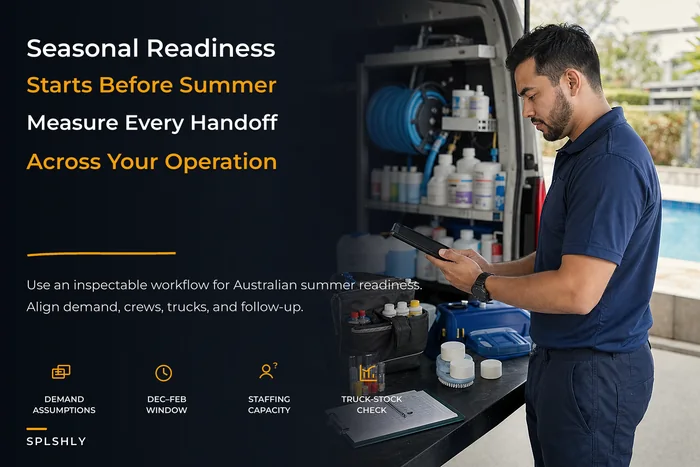
Splshly’s existing U.S.-focused methodology asset provides useful metric definitions and worksheets, but it does not contain Australia-adapted terminology, seasonal context, Australian primary-source references where country-specific claims are made, or credible Australian practitioner review. Those gaps limit its suitability for a SPLASH! contribution aimed at a potentially Australia-focused trade audience. A localized framework is justified because SPLASH! has an evidenced editorial-submissions route and has solicited feature contributions and practical industry/standards participation; however, the asset must remain a methodology resource rather than an unsupported benchmark report.
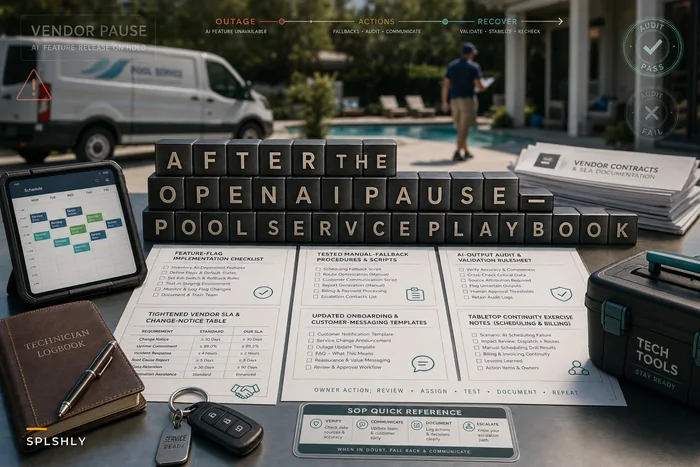
Explains the recent pause of a major AI model release and translates the vendor‑risk implications into prioritized operational actions for pool services: implement feature flags and tested manual fallbacks, add audit/validation rules for AI outputs, tighten vendor SLAs and change‑notice requirements, update onboarding/training and customer messaging, and run a short tabletop to validate continuity of scheduling and billing workflows.

Pool & Spa News recommends that service businesses incorporate water-safety messaging into billing and other customer communications, but the supplied evidence does not identify a practical, bounded workflow showing when a service company should send reminders, what technicians should document, which observations require escalation, and where routine education must stop short of code, inspection, repair, or legal determinations.
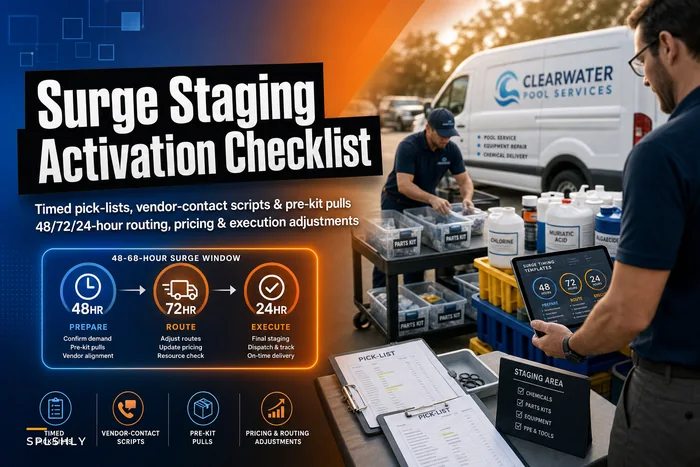
Precise 48/72/24-hour staging checklists with exact pull lists, temporary pricing and routing adjustments—execution-focused pick-lists and timing templates to operationalize surge response.
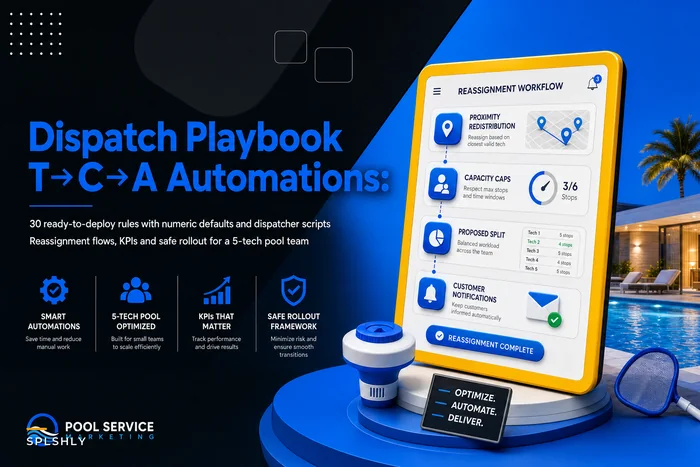
A hands-on companion to the parent scheduling rulebook that provides concrete, ready-to-deploy automation rules (Trigger → Condition → Action) with numeric defaults, message templates, tool-integration recipes (ServiceTitan/Jobber/Housecall Pro + Zapier/Make), a worked capacity example for a 5‑tech crew, precise reassignment/fallback flows, dispatcher scripts, KPIs and an A/B rollout plan. Designed for operations managers who need plug-and-play automations, escalation matrices, and customer-facing language to stop missed appointments and accelerate dispatch resolution.
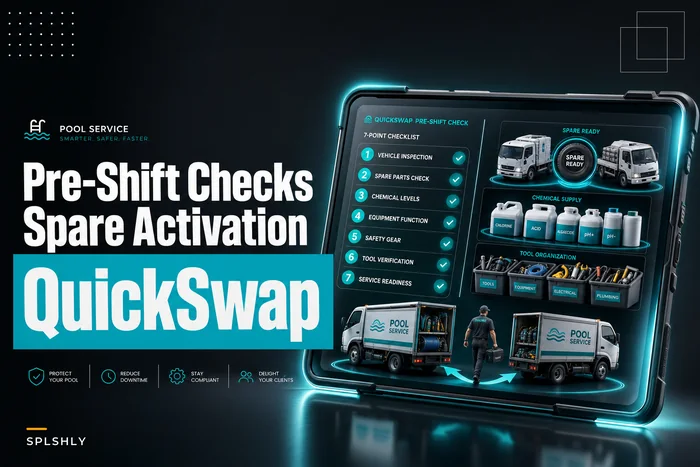
Fast daily 7-point checks tied to spare-vehicle activation SOP, quick rental vs delay decision tree and emergency swap rules tailored to small fleets to avoid route disruptions.

PoolPro readers are instructed to calculate monthly service pricing from labor, vehicles, chemicals, overhead, and profit, and the article says a free data-entry form was available through Pool Chasers. The supplied crawl records the cited Pool Chasers podcast URL and author-site link as 404. Splshly has no verified asset that helps readers build recurring monthly-service rates from those cost categories; its closest known asset concerns repair estimating, which is a different pricing decision.
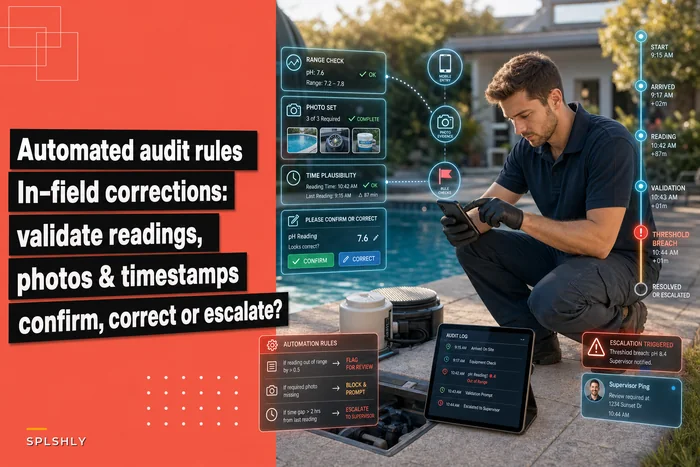
Operational rule-driven validation (numeric ranges, required shots, time-on-site plausibility) plus in-field correction prompts, escalation thresholds and sample audit rules owners can deploy to reduce disputes and rework.