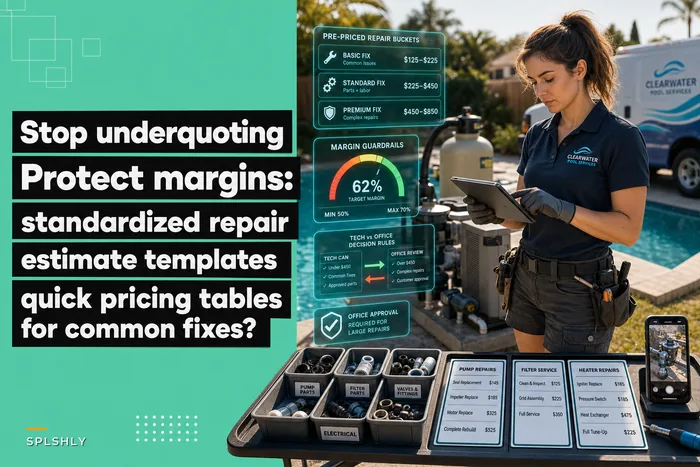



The hardest pricing decisions in pool service don't happen at the office. They happen at 2:40pm on a Thursday, when a tech is crouched next to a leaking pump, the homeowner is standing there asking "so how much is this gonna cost?", and the tech has about 90 seconds to decide whether to quote the pump seal alone, bundle in the motor that's clearly on its way out, or just stabilize it and defer the real conversation.
Most shops never give techs a framework for that moment. They hand over a price book and hope. What ends up happening is every tech prices differently, margins wander all over the place, and you get customers comparing notes at the neighborhood BBQ wondering why one got charged $180 for "the same thing" the other paid $240 for.
This is about fixing that specific gap — the live, on-site repair pricing decision in pool service — with approval thresholds, scripts, pricing bands, and bundling rules that protect margin without turning your techs into pushy salespeople.
The real problem: techs default to the cheapest version of the repair
When a tech isn't sure, they underquote. Not because they're bad at the job — because the cheap number feels safer. Nobody wants to be the guy who quoted $900 and got a hard "no." So they quote the $220 seal replacement, skip mentioning the bearing noise they definitely heard, and move on.
Three weeks later the motor fails completely. Now it's a second trip, a second diagnostic, an annoyed customer who feels like they just paid to fix the same thing twice, and a repair that could've been one clean bundle is now two awkward transactions with worse margin on both.
This usually happens for three reasons:
-
The tech has no authority ceiling, so anything "big" feels risky to quote
-
There's no script for presenting the bigger fix, so they avoid it entirely
-
Bundling isn't defined, so combining parts feels like making it up on the spot
The fix isn't "train techs to sell more." It's removing the guesswork so the right call becomes the easy call.
The tech-level decision matrix by repair type
The core tool here is a decision matrix that tells a tech, for each common repair category, three things: what they can approve on their own, what needs a quick call to dispatch, and the default move — upsell, bundle, or defer.
Eliminate missed appointments and dispatch delays.
Splshly ensures every pool service is scheduled, tracked, and completed efficiently.
- Unified scheduling dashboard
- Automated customer reminders
- Technician route optimization
No credit card required
| Repair type | Tech-approve ceiling | Needs approval above | Default move | Bundle trigger |
|---|---|---|---|---|
| Pump seal / shaft seal | ~$250 | Motor replacement on same unit | Bundle if bearings are noisy or motor is 7+ yrs | Combine seal + motor if motor age/noise flagged |
| Motor replacement | ~$600 | Full pump + plumbing rework | Upsell to matched pump if wet-end is cracked | Motor + union/gasket kit always |
| Filter cartridge/grids | ~$300 | Full filter tank swap | Defer tank unless cracked/leaking | Cartridge + o-ring + lube bundled |
| Valve / actuator | ~$200 | Multi-valve manifold rebuild | Bundle adjacent valves if same age | Replace 2+ valves together on old manifolds |
| Salt cell | ~$500 | Full chlorinator system | Defer controller unless erroring | Cell + flow sensor if sensor is marginal |
| Heater ignition/parts | ~$350 | Heater replacement | Defer — quote formally, never on-site | None (heater pricing goes to office) |
| Minor plumbing leak | ~$180 | Repipe section | Bundle fittings if PVC is brittle | Patch + nearby questionable joints |
| Electrical / GFCI | ~$0 (stabilize only) | Any live electrical repair | Defer always | None — safety routing |
A couple things worth noting about how this is built.
The ceilings aren't about trust — they're about speed and consistency. A seal replacement under $250 should never require a phone call; that's wasted time for a routine fix. But a $1,400 heater is never priced from the pad, because heater decisions involve efficiency specs, rebates, and warranty questions a tech shouldn't be improvising on the spot.
Electrical is its own category on purpose. The default is always defer-and-route, regardless of how simple it looks, because on-site electrical pricing creates liability and inconsistency in equal measure.
The three moves, and when each one is actually right
Upsell — when the better part is barely more expensive
Upselling has a bad reputation because it's usually done wrong — tacking on stuff nobody needs. The version that actually works is narrow: you upsell when the better version of the same repair costs marginally more and saves a future trip.
Classic example: a customer needs a motor. The standard replacement runs about $520 installed. A matched, higher-efficiency motor that fits the same wet-end is around $610. The upsell isn't "do you want the fancy one" — it's "for about ninety bucks more you get a quieter motor and a lower power bill, same labor either way." That's a real value framing, and it holds up.
When upselling is a bad idea: when it requires a second visit, when the customer mentioned they're selling the house, or when the "upgrade" doesn't actually reduce future failure risk. Upselling a premium cartridge to someone closing escrow next month just makes you look like you're padding the invoice.
Bundle — when two failures are riding together
Bundling is the most underused and most margin-protective move in field service, and it's where techs need the most explicit permission.
The rule: bundle when a second component on the same system is likely to fail within one season and the incremental labor is near zero because you're already in there. You've got the pump open for a seal. The bearings are growling. Replacing the motor now adds maybe 20 minutes of labor. Coming back for it later is a full trip, full diagnostic, and a frustrated customer who wonders why you didn't just say something the first time.
The bundling discount is what makes this honest. If seal-alone is $230 and motor-alone is $520, the bundle shouldn't be $750. Price it around $640–$680. The customer sees real savings, you capture labor efficiency, and you've eliminated a low-margin return trip. This connects directly to the first-time-fix thinking in standardized repair kits and kitting — bundling only works if the tech actually has the bundled parts on the truck.
Defer — when honesty beats revenue today
Deferring is a decision, not a failure to close. You defer when pricing on-site would be guessing, when the repair needs office-level inputs, or when the customer needs time with a real written quote.
Heaters, major repipes, full filter tank swaps, controller and automation systems — these all defer by default. The tech's job on-site is to stabilize, document, and set up the formal quote. Trying to price a $2,000+ job from the pad almost always produces either an underquote you regret or a number so scary it kills the deal before the customer sees it in context.
The scripts that make this work out loud
A matrix is useless if the tech can't say it naturally. These are the three scripts that cover most situations. They're short on purpose — long scripts get abandoned.
Upsell script:
> "So this needs a new motor either way. The standard one's $X. There's a matched upgrade that's quieter and runs about Y% less power for roughly $Z more — same install today. Want me to put the better one in while I'm here?"
Bundle script:
> "While I was in the pump I noticed the bearings are starting to go — you can hear it. I can do just the seal today, but it's very likely I'm back out for the motor within a few months, which means another trip charge. If I do both now it's $X instead of $Y across two visits. I'd rather save you the second trip."
Defer script:
> "I've got this stabilized so you're good for now. For the heater, I don't want to throw a number at you that's off — there are efficiency and warranty options that change the price quite a bit. Let me get you a proper written quote by tomorrow so you can actually compare."
The defer script matters most. Techs who feel awkward about not quoting will either make up a number or mumble "it'll be expensive," both of which hurt you. Giving them explicit permission to say "I'll get you a real quote" takes the pressure off.
A workflow for the whole decision, start to finish
Here's how the live moment should actually flow:
-
Diagnose and identify the primary repair. What's the thing they called about, or what failed?
-
Scan for adjacent risk. Is anything on the same system noisy, brittle, corroded, or near end-of-life? This is the bundle check.
-
Check the ceiling. Is the primary repair under the tech-approve threshold for that category? If yes, quote it on the spot.
-
Decide the move. Upsell if a better version is marginally more. Bundle if adjacent failure is likely and labor overlaps. Defer if it's over ceiling or needs office inputs.
-
Document before quoting. Photos of the failure and the adjacent risk, so the price has evidence behind it.
-
Deliver the script. Quote it the way the matrix says to.
-
Log the decision. What was quoted, what was approved, what was deferred — so the office can follow up on anything that didn't close.
Visualize this as a simple decision flow to help techs memorize the steps.
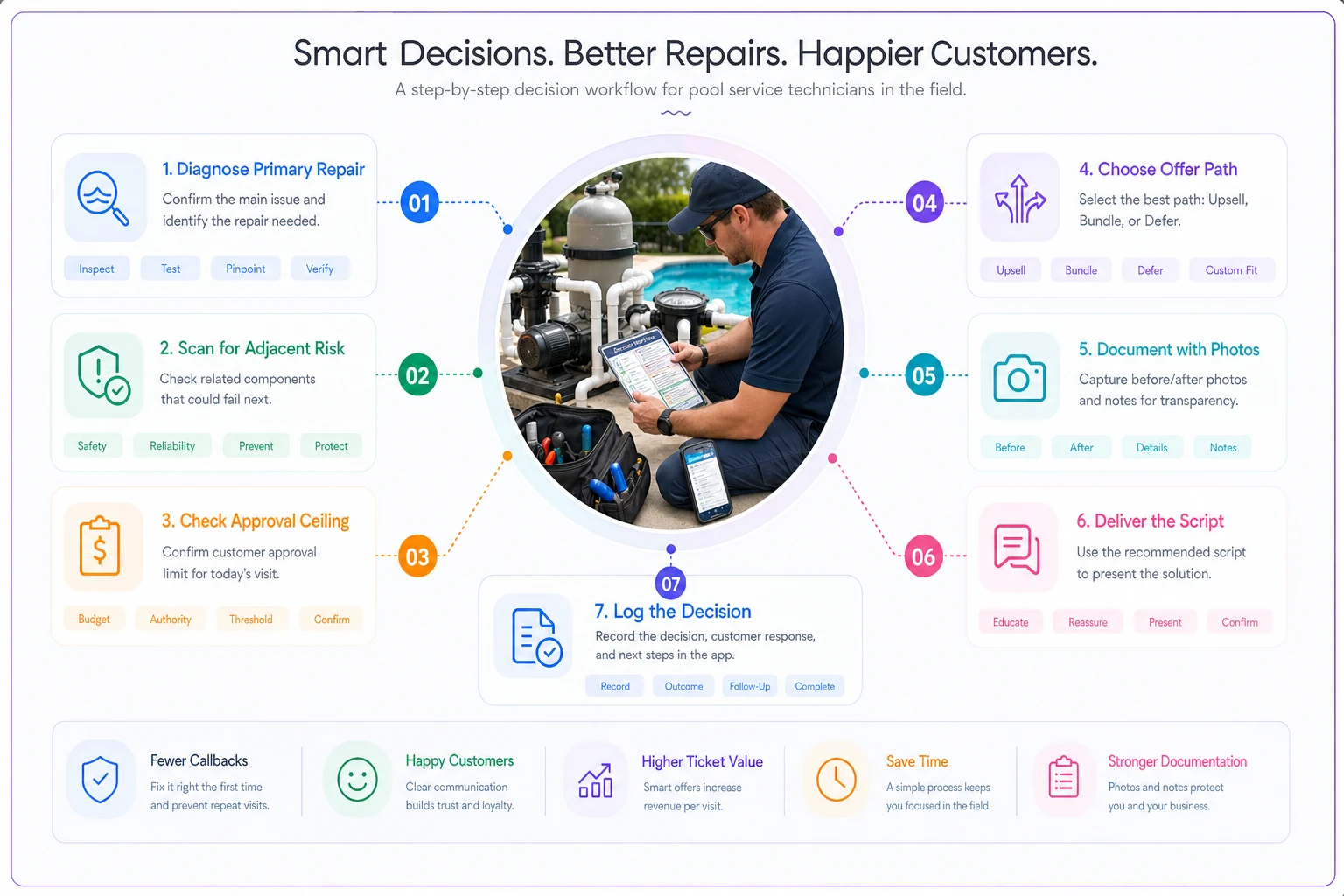
Step 5 is the one techs skip and regret. A bundle quote lands completely differently when the tech can show a photo of a rusted, growling bearing versus just asserting it's going bad. The evidence is the sale.
Margin-protecting bundling rules you set once
Left to improvise, techs will discount bundles too aggressively — they feel generous in the moment, and it's not their money on the line. So the bundle discounts need guardrails baked in, not invented per job.
-
Bundle discount caps at 15% off combined individual pricing — never deeper without approval
-
Labor is never discounted, only the second part's markup — you're sharing the trip efficiency, not giving away work
-
Minimum bundle floor no bundle prices below the cost of the more expensive component plus full labor
-
Never bundle across safety categories — electrical and gas stay separate and routed
-
Bundles require both-part photos before the quote is valid
-
Deferred items auto-generate a follow-up task so revenue doesn't just disappear
Cap bundle discounts at 15% and require photos to validate the combined quote.
That last point is where a lot of money leaks. A tech defers a heater, says "we'll send a quote," and then nothing happens. No quote goes out. The customer calls a competitor two weeks later. If your system automatically turns every deferred item into a tracked follow-up task, you stop bleeding deferred revenue — which, across a full season, is usually a bigger number than any upsell gain.
Sample pricing bands (adjust to your market)
These are illustrative bands, not gospel — your labor rate and regional parts costs will shift them. The point is giving techs a range, not a single number, so they can read the specific situation without feeling like they're freelancing.
-
Pump seal replacement roughly $190–$260
-
Motor replacement (standard) roughly $480–$580
-
Motor replacement (matched upgrade) roughly $580–$680
-
Seal + motor bundle roughly $620–$700
-
Filter cartridge set + o-rings roughly $240–$320
-
Valve/actuator replacement roughly $150–$220
-
Salt cell replacement roughly $420–$520
-
Minor plumbing patch + fittings roughly $120–$190
If you don't have bands like these dialed in yet, that's prerequisite work — and it pairs directly with standardized repair estimating templates and quick pricing tables. You can't run a live decision matrix on top of pricing you haven't standardized.
A real scenario: the five-tech shop that was leaking bundle revenue
A mid-sized residential operation — five techs, somewhere around 600 recurring accounts — had a classic version of this problem. Their techs were competent, but repair pricing was inconsistent and nearly every bundle-able situation got quoted as a single part.
When they actually looked at the numbers, they found motors were being replaced as standalone jobs within 60–90 days of a seal replacement on the same pump more often than anyone had realized — roughly one in six seal jobs turned into a separate motor trip within the quarter. Every one of those was a second trip charge they ate, a second diagnostic, and a customer who felt like they'd just paid to fix the same problem twice.
They rolled out a version of this matrix with three fixed scripts and a 15% bundle cap. Nothing fancy — a laminated card in each truck and a five-minute morning walkthrough. Within a couple months, seal-plus-motor bundles went from almost never to a meaningful share of seal jobs, return trips on pump work dropped noticeably, and average repair ticket climbed without a single complaint about pushy pricing. The deferred-heater follow-ups, now tracked instead of forgotten, recovered several thousand dollars that quarter that would've otherwise walked.
The owner's takeaway was the useful part: the revenue gain wasn't from charging more per item. It was from stopping the leaks — fewer return trips, fewer forgotten deferrals, fewer inconsistent quotes.
When this matrix is the wrong tool
This system assumes your techs are already reliable diagnosticians. If they're still misreading failures, a pricing matrix just helps them confidently sell the wrong repair. Fix diagnosis first.
It also assumes you actually stock bundle-able parts. A bundle rule is theater if the motor isn't on the truck when the seal fails — the tech defaults back to deferring because they have no choice. This is why your truck stocking and parts procurement have to line up with your bundling strategy. The most common failure isn't the pricing logic — it's that the parts to execute the preferred move aren't in the van.
And if you're a tiny operation where the owner does every repair personally, you don't need approval ceilings — you are the ceiling. The matrix still helps for consistency and scripts, but the threshold columns matter more once you've got techs making calls without you standing there.
Pulling it together
On-site repair pricing goes sideways not because techs are bad at pricing, but because they're left to invent the decision every single time. The fix is boring in the best way: define the ceilings, define the three moves, write the scripts, cap the discounts, and track the deferrals.
Do that, and the tech crouched by the pump at 2:40 on a Thursday isn't guessing anymore. They know whether to upsell the motor, bundle the seal and motor together, or stabilize and route the heater to the office — and they know exactly how to say it. That consistency is worth more over a season than any individual clever upsell, because it shows up in fewer return trips, steadier margins, and customers who stop feeling like the price depends on which tech showed up.
Ready to elevate your pool service business?
Join hundreds of pool service professionals using Splshly to save time, optimize routes, and enhance customer satisfaction.