


The parts problem in pool service isn't usually about running out of chlorine tabs. It's the pump seal that fails on a Thursday when your usual distributor is out until Tuesday, and the customer's pool goes green over the weekend while they text you every four hours. It's the variable-speed motor that got backordered in June and now you're eating a $180 rush shipping fee just to salvage a job you already quoted.
Most owners treat procurement as a background task — order when you run low, call the distributor, hope it shows up. That works fine until the season heats up and every distributor in your area is fielding the same emergency calls you are. Then your "just order it" system quietly becomes your biggest source of blown SLAs and canceled jobs.
This is a pool parts procurement playbook built around three things that actually move the needle: vendor scorecards so you know who to trust when it matters, seasonally-adjusted reorder points so you're never caught flat during peak, and escalation templates so rush orders and SLA disputes don't turn into hour-long phone calls. No theory, just the operational scaffolding.
Where parts procurement actually breaks down
The failure almost never happens at the moment you place an order. It happens weeks earlier, in decisions nobody thought of as procurement decisions.
A typical example: a mid-sized service company carries two pump models on their trucks and relies on one primary distributor for everything else. In April, that distributor's lead time on a common cartridge filter housing is one day. By mid-July, the same part is quoted at four to seven days because regional demand spiked and the distributor is rationing stock to their biggest accounts. Nobody adjusted the reorder trigger. So the company keeps ordering at the same threshold that worked in spring, runs dry mid-July, and now every filter repair is on a delay.
The pattern keeps showing up: reorder logic that's static while demand and lead times are seasonal. A reorder point that assumes two-day delivery becomes dangerous the moment your supplier quietly stretches to five. You don't get a warning. You just start missing.
The second breakdown is vendor blindness. Owners know their good vendors and their flaky ones by feel, but that knowledge lives in their head, not anywhere useful. So when the primary is out of a part, dispatch calls vendors in random order instead of the one who actually fills rush orders reliably. You lose 40 minutes of phone tag on a job that needed the part yesterday.
Vendor scorecards: turning gut feel into a routing decision
The point of a scorecard isn't to grade vendors for fun. It's so that when a critical part is down, anyone in your shop can look at one sheet and know exactly who to call first, second, and third for that specific part category.
Eliminate missed appointments and dispatch delays.
Splshly ensures every pool service is scheduled, tracked, and completed efficiently.
- Unified scheduling dashboard
- Automated customer reminders
- Technician route optimization
No credit card required
Score each vendor on the things that actually cost you money when they fail:
| Metric | What you're measuring | How to score |
|---|---|---|
| Fill rate | % of orders shipped complete, first attempt | Track over 90 days, aim above 90% |
| Lead time reliability | Do they hit their quoted date? | On-time %, not average days |
| Rush responsiveness | Can they turn a same-day/next-day order? | Yes / limited / no, by part category |
| Price stability | How often do quoted prices jump? | Flag vendors with >10% swings |
| Backorder honesty | Do they warn you early or let you find out? | Subjective 1–5, but track it |
| Returns/warranty ease | Hassle level on defective parts | 1–5 based on real incidents |
A few things worth calling out here.
Fill rate matters more than price for critical parts. A distributor who's 8% cheaper but ships incomplete one in five times is costing you far more in return trips and reschedules than you're saving on unit price. For commodity items where a stockout doesn't stall a job, chase price. For pump motors, filter housings, control boards, and anything that holds up billable work, chase reliability.
Score by part category, not just by vendor. Your main distributor might be excellent on Pentair equipment and unreliable on Jandy. A vendor's overall grade hides that. Break the scorecard down so you know "who's fast on heaters" versus "who's reliable on pump internals."
Update it quarterly, not never. The most common mistake is building a scorecard once, feeling organized, and then letting it rot. Vendor performance shifts with the season and with their own staffing. A vendor who was your hero last winter might be drowning in July. This connects directly to how you align service plans to scheduling and parts — your best vendor relationships should be feeding the parts you actually schedule most.
Seasonally-adjusted reorder points for critical parts
This is the part most owners skip because it feels like math homework. But the formula is simple, and getting it wrong is what causes the mid-summer stockout spiral.
A basic reorder point is:
Reorder Point = (Average Daily Usage × Lead Time in Days) + Safety Stock
The problem is that all three of those numbers change with the season. In pool service, June through August usage of pump and filter parts can run two to three times your winter baseline, and lead times often stretch at exactly the same time because everyone's demand spiked together. Calculate your reorder point once using annual averages and you'll carry too much dead stock in January and run dry in July.
So you split the year into demand tiers and recalculate for each.
A worked example
Say you go through cartridge filter elements at these rates:
-
Off-season (Nov–Mar) about 2 per week
-
Shoulder (Apr–May, Sep–Oct) about 5 per week
-
Peak (Jun–Aug) about 12 per week
And your distributor's lead time behaves like this:
-
Off-season
2 days, very reliable
-
Peak
quoted 2 days, but realistically 4–6 days
Off-season reorder point, with a small safety buffer:
-
Daily usage ≈ 0.3 units, lead time 2 days → 0.6 units + safety stock of 2 → reorder at 3 on hand
Peak reorder point, using the realistic 5-day lead time and heavier safety stock because failures cost more:
-
Daily usage ≈ 1.7 units, lead time 5 days → 8.5 units + safety stock of 6 → reorder at roughly 14–15 on hand
That's not a small difference. The same part goes from "reorder at 3" to "reorder at 15" depending on the month. Run peak logic in winter and you're tying up cash. Run winter logic in peak and you're stocking out constantly.
Which parts get this treatment
-
Pump seals, shaft seals, and mechanical seal kits
-
Variable-speed and single-speed motors for your common models
-
Filter cartridges and DE grids
-
Control board / automation modules for your dominant equipment brand
-
Common valve actuators and diverter parts
-
Heater ignition components before shoulder season
Everything else can stay on a simple flat reorder point. Your truck stocking strategy should mirror this same tiering logic — the tiered truck stocking plan with seasonal PARs is the field-level version of the same idea. Warehouse reorder points and truck PARs should be set from the same usage data so they don't contradict each other.
Escalation templates for rush orders
When a part is down and you need it now, the quality of the phone call determines the outcome. A vague "hey do you have any of these in stock" call gets you a vague answer. A tight, specific rush request gets you moved to the front.
> "Hi, this is [Name] with [Company], account #[####]. I have an emergency rush need for [exact part number], qty [#]. This is for a job scheduled [today/tomorrow AM]. Can you confirm stock, the fastest ship or will-call option, and the cutoff time to make that happen today? If you're out, can you check [branch B] or tell me the closest alternate part number?"
The specificity does three things: it signals you're an organized account worth prioritizing, it gets you a real answer instead of a maybe, and it forces the alternate-part conversation immediately instead of after you've already lost a day.
Build a simple escalation ladder so nobody has to improvise:
-
Primary vendor, will-call or same-day. Confirm cutoff time before hanging up.
-
Secondary vendor from the scorecard (the one rated best on rush for that category).
-
Cross-branch check — many distributors will transfer stock between branches if you ask directly.
-
Alternate/superseded part number — keep a cheat sheet of acceptable substitutes for your top 20 critical parts.
-
Local counter pickup at retail markup — expensive, but sometimes a $30 markup saves a $400 job and a lost customer.
The mistake is treating rush orders as a one-off scramble every time. When you pre-decide the ladder and pre-write the script, a stockout becomes a 90-second process instead of a stressful 45-minute one.
SLA negotiation notes: what to actually ask your distributors for
Most pool service owners never negotiate service terms with distributors. They negotiate price and stop there. For the vendors carrying your critical parts, the service terms are what actually protect your jobs.
-
Guaranteed will-call fulfillment window for your account during peak season. Even a soft commitment ("we'll hold priority for accounts over $X/month") is worth having in writing.
-
Backorder notification within 24 hours, not "you'll find out when it doesn't ship." This single term prevents more blown SLAs than almost anything else.
-
Substitution authority — pre-approve them to ship an equivalent part when your first choice is out, so you're not re-confirming every time.
-
Held safety stock on your two or three most critical part numbers, especially if you're a consistent buyer. Some distributors will earmark stock for reliable accounts.
-
Volume commitments in exchange for priority, not just discount. Trade predictable ordering for front-of-line treatment during the rush.
Keep short notes on every SLA conversation — date, who you spoke to, what they committed to. When July comes and they claim they "never promised same-day," your note from March is what holds the line. Vendors keep records; you should too.
A real scenario
A residential-focused pool company running about 6 trucks kept losing a handful of repair jobs every week during peak summer to parts delays. Not because they lacked vendors, but because their reorder points were flat year-round and dispatch called vendors in no particular order when the primary was out. Rush shipping fees were running somewhere around $600–$900 a month at peak, and they'd started losing repeat customers who got tired of "we're waiting on the part" texts.
They did three unglamorous things: built a one-page scorecard ranking their four distributors by fill rate and rush responsiveness per part category, recalculated reorder points for their 18 most critical parts using peak-season usage and realistic — not quoted — lead times, and saved a rush-order script plus a five-step escalation ladder that any dispatcher could follow.
By the back half of the following summer, peak rush fees dropped to roughly $200–$300 a month, mostly because they were reordering before the emergency instead of during it. Lost-to-parts jobs fell noticeably. The bigger win was quieter — fewer angry weekend texts, and the two commercial accounts they'd been worried about renewed without a fuss.
When this level of structure makes sense — and when it doesn't
When it makes sense: You're running multiple trucks, doing meaningful repair volume, and peak season reliably strains your parts pipeline. If parts delays are costing you jobs or forcing regular rush fees, the payback on building this is fast.
When it's overkill: If you're a one or two-tech operation doing mostly maintenance and light repairs, a full scorecard and seasonal reorder math is more system than you need. Keep a simple critical-parts list, know your two best vendors, and don't overbuild.
Who should skip the seasonal reorder formulas: Anyone whose part usage doesn't actually swing much by season, or who operates in a year-round pool market with genuinely flat demand. The formula only earns its keep when demand and lead times move in real, meaningful ways.
Where this lives once you've built it
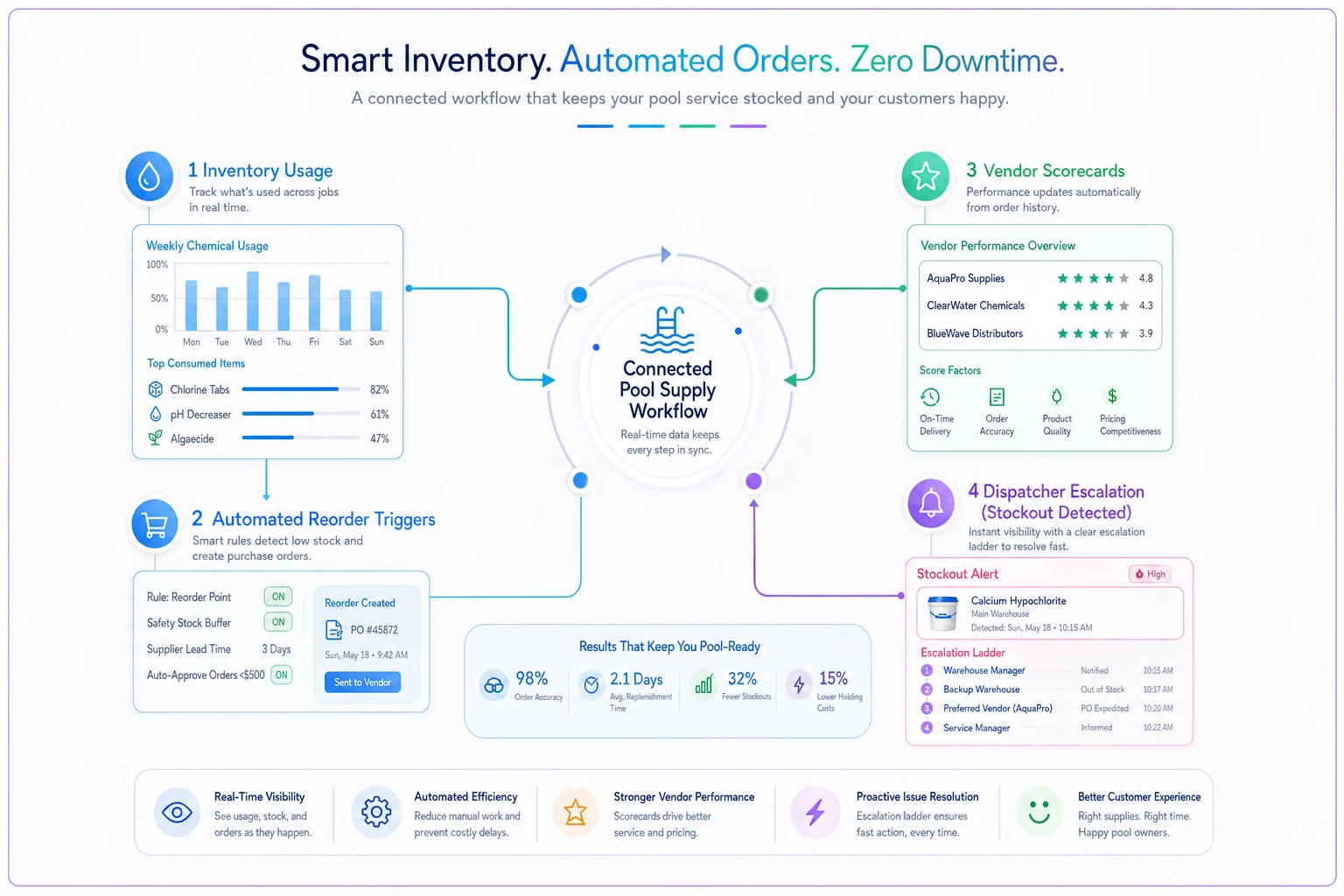
Scorecards and reorder points fall apart when they live in a spreadsheet nobody opens. The version that actually sticks is wired into how you already track inventory and dispatch — reorder triggers fire automatically off usage data, vendor performance updates from actual order history, and dispatchers see the escalation ladder on the same screen where they're pulling the part number.
AI-powered operational software that connects parts usage, vendor records, and job scheduling in one place is what keeps this from decaying back into gut feel by August. Platforms built around this kind of workflow automation handle the tedious upkeep automatically — flagging vendors whose fill rates have slipped, adjusting reorder triggers when seasonal thresholds change, and surfacing the escalation path the moment a stockout is detected.
Here's a simple depiction of that workflow.
But the system matters more than the software.
Get the logic right first, then automate the parts that are painful to maintain by hand.
The whole point is boring reliability — parts procurement done well is invisible because nothing stalls.
Done poorly, it's the thing eating your margins and your reputation one delayed job at a time. Build the scorecard, move your reorder points with the season, and pre-write the escalation so your worst days become a script instead of a scramble.
Ready to elevate your pool service business?
Join hundreds of pool service professionals using Splshly to save time, optimize routes, and enhance customer satisfaction.