


Every pool tech knows that sick feeling when you're standing at a customer's pool, staring at a broken Pentair valve, and realizing the exact part you need is sitting in your garage. Not on your truck. In your garage. Twenty-three miles away. The drive back costs you $47 in fuel and labor time. The customer reschedule costs you their trust. The domino effect on your afternoon route costs you another $180 in pushed appointments. All because your truck wasn't stocked right for the actual work you're doing. Most pool companies try to solve this by either cramming everything possible onto every truck (impossible) or by hoping techs remember what they need (unreliable). Neither works. What actually works is treating your trucks like mini warehouses that adjust based on route type, season, and actual usage patterns.
Why standard truck loads fail pool service operations
Pool service trucks aren't delivery vans where every stop needs the same thing. Your Monday residential maintenance route needs completely different parts than your Thursday commercial equipment repair run. Your April startup season needs different inventory than your September winterization push.
Yet most operations run one standard truck load year-round. Techs end up carrying 40 pounds of rarely-used commercial fittings on residential routes while missing the basic o-rings they actually need. Or hauling winter plugs through July heat waves while running out of chlorine tabs during peak season.
-
3-4 return trips per truck weekly
-
$1,400-1,900 monthly in wasted drive time
-
15% of appointments pushed or incomplete
-
Techs hoarding parts in personal stashes because they don't trust the system
Then there's the hidden damage: customers who switch to competitors after their third "sorry, need to grab a part" experience. Good techs who burn out from constant scrambling. The owner who spends evenings playing parts detective instead of growing the business.
Building a tiered stocking system that matches reality
A functional truck stock management pool technicians can actually use starts with accepting that different work needs different tools. Not philosophically—operationally.
Eliminate missed appointments and dispatch delays.
Splshly ensures every pool service is scheduled, tracked, and completed efficiently.
- Unified scheduling dashboard
- Automated customer reminders
- Technician route optimization
No credit card required
Tier 1: Base stock (every truck, every day)
-
Standard o-rings (15 of each common size)
-
Pump and filter gauges
-
Basic test kit with fresh reagents
-
Chlorine tabs (50-pound minimum)
-
Common pump seals
-
PVC primer and cement
-
Teflon tape
-
Basic hand tools
One operation in Phoenix tracked every return trip for six weeks. 73% were for items that should've been base stock. They weren't exotic parts—they were boring basics that nobody thought to systematically restock.
Tier 2: Route-specific additions
Residential maintenance routes:
-
Skimmer baskets (3-4 styles)
-
Automatic cleaner parts for common models
-
Small equipment o-rings
-
Valve handles
-
Timer pins and dogs
-
Residential-size chemical doses
Commercial/HOA routes:
-
Commercial pump seals
-
Large-format chemicals
-
Safety equipment (cones, signs)
-
Backflow test kits
-
2" and 3" plumbing fittings
-
Commercial timer components
Repair-focused routes:
-
Full seal kit sets
-
Capacitors (multiple ratings)
-
Pump motor brushes
-
Heater components
-
Control board fuses
-
Multimeter and diagnostic tools
New pool/equipment routes:
-
Complete equipment startup kits
-
Programming guides
-
Warranty documentation
-
Full chemical startup sets
-
All equipment manuals
-
Customer education materials
Tier 3: Seasonal overlays
Spring startup (March-May):
-
Startup chemical kits
-
Replacement drain plugs
-
Pressure gauges
-
Filter elements (all types)
-
Gasket/o-ring mega-kit
-
Algaecide varieties
Peak season (June-August):
-
Triple normal chlorine stock
-
Salt cell cleaning supplies
-
Extra test kit reagents
-
Stabilizer/conditioner
-
Clarifiers and enzymes
-
Pump capacitors (heat failures spike)
Fall prep (September-November):
-
Winter closing kits
-
Plug sets (all sizes)
-
Antifreeze
-
Cover repair patches
-
Water bags
-
Winterization tags
Off-season (December-February):
-
Minimal chemical stock
-
Repair-focus parts
-
Equipment replacement items
-
Safety salt for walkways
-
Indoor pool specialties
The key: match inventory to scheduled work, not theoretical possibilities.
Creating PARs that prevent stockouts without overloading
PAR levels (Periodic Automatic Replenishment) for trucks work differently than warehouse PARs. You're optimizing for space, weight, and usage frequency, not just turnover.
Start with a two-week usage baseline for each truck. Track every part used, not just what's grabbed from the warehouse. Techs often buy parts themselves when the truck runs out, hiding real consumption.
Setting truck-specific PARs:
-
Calculate average weekly usage per part
-
Add 40% buffer for variability
-
Round up to standard pack sizes
-
Adjust for truck space constraints
-
Flag high-value items for tighter control
A residential route truck might need:
-
1" o-rings
20 (uses 12-15 weekly)
-
Chlorine tabs
75 lbs (uses 50-60 weekly)
-
Test strips
2 bottles (uses 1.5 weekly)
-
Pump lid o-rings
4 (uses 2-3 weekly)
But a repair truck on the same operation needs:
-
1" o-rings
8 (uses 3-5 weekly)
-
Chlorine tabs
25 lbs (emergency adds only)
-
Capacitors
6 assorted (uses 4-5 weekly)
-
Seal kits
3 complete (uses 2 weekly)
The difference in stocking needs is massive, yet most companies run identical loads.
Weekly audit cadence that takes 15 minutes
The best truck stocking system fails without a simple audit routine. Not a complex inventory management process—a basic check that techs actually do.
The Friday 15-minute audit:
-
Tech counts five critical categories (not everything)
-
Compares to PAR levels on laminated card
-
Writes shortage list
-
Drops list in warehouse bin
-
Monday morning
restocked before routes
Keep the laminated PAR card in a consistent spot in the truck so audits stay quick.
The five categories rotate weekly but always include:
-
Week's highest-use items (from simple tracking)
-
Seasonal critical parts
-
High-value inventory
-
New problem patterns
-
Safety/compliance items
One operation near Tampa tried complex inventory apps, barcode scanners, and detailed spreadsheets. All failed. The laminated card system with rotating categories has worked for two years straight. Compliance runs around 90% because it's actually doable.
Monthly deep audit (first Monday):
-
Pull everything out
-
Check expiration dates (chemicals, test kits)
-
Verify tool condition
-
Update PAR cards based on actual usage
-
Adjust for upcoming seasonal shifts
-
Remove accumulated junk
This takes 45 minutes per truck but prevents the gradual drift toward chaos that kills stocking systems.
Tracking what actually drives return trips
Most operations track return trips wrong. They count them (sometimes) but don't analyze patterns. A return trip for a $400 heater element is different than driving back for generic o-rings.
Track three things:
| Metric | What to Measure | Why It Matters |
|---|---|---|
| Frequency by part type | Which specific items cause multiple return trips? | Reveals systematic stocking gaps |
| Cost impact | Lost time + fuel + customer impact | Prioritizes which problems to fix first |
| Root cause | Stocking error, unusual failure, or systematic problem? | Prevents recurring issues |
Simple tracking system:
-
Clipboard in each truck
-
Tech writes
Date, part needed, customer type, time lost
-
Weekly review to spot patterns
-
Monthly adjustment to PARs
-
Quarterly review of entire stocking strategy
Return trips often cluster around:
-
Specific equipment brands
-
Certain neighborhoods (water chemistry variations)
-
Particular tech routes (different work styles)
-
Seasonal transition periods
-
After supplier changes
A Houston operation discovered 60% of their return trips were for just eight specific parts. Not categories—actual part numbers. They adjusted truck PARs for just those eight items and cut return trips by half within three weeks.
Real impact on a 6-truck operation
A Scottsdale pool service company with six trucks implemented tiered stocking in January. Their previous system: every truck got the same weekly load, techs figured out the rest.
Before tiered stocking:
-
22 return trips weekly across all trucks
-
$8,400 monthly in lost productivity
-
18% of repairs required two visits
-
Three techs maintaining personal parts stashes
-
Owner spending nights coordinating emergency parts runs
After three months with tiered system:
-
6 return trips weekly
-
$2,200 monthly productivity loss (74% reduction)
-
4% of repairs need return visits
-
Zero personal hoarding (trucks have what's needed)
-
Owner focused on operations, not parts emergency
The biggest surprise: customer complaints about delays dropped 80%. Customers really notice when techs show up prepared versus scrambling for parts.
They spent roughly $3,000 more on truck inventory (having the right parts across all trucks) but saved $6,200 monthly in operational costs. Plus, they could handle 15% more appointments with the same crew since techs weren't burning time on return trips.
When different stocking strategies make sense
Tiered stocking works when routes have distinct service types, seasonal patterns are predictable, you run 4+ trucks, techs follow consistent routes, and space on trucks is limited.
Skip tiered stocking if every tech does everything (tiny operations), routes are completely random daily, you have 1-2 trucks total, no warehouse exists, or tech turnover exceeds 50% annually.
Modified approaches for edge cases:
High-turnover operations: Simplify to just base + seasonal, skip route-specific tiers
Space-constrained trucks: Focus on high-frequency parts only, use zone staging for bulky items
Mixed-route operations: Create "combination packs" techs grab based on daily schedule
Rural/spread operations: Establish supply caches at strategic customer locations
Adjusting when seasons hit weird
Seasonal stocking plans work great until weather goes sideways. A late freeze, early heatwave, or extended rain pattern throws everything off. Your trucks need adjustment protocols that don't require redoing the entire system.
Quick adjustment triggers:
When temperature jumps 15°F above normal for 5+ days:
-
Add 50% more sanitizer
-
Double algaecide stock
-
Increase pump capacitors
-
Add salt cell cleaning supplies
When unseasonable rain exceeds 3 inches weekly:
-
Triple phosphate remover
-
Add clarifier varieties
-
Increase test kit supplies
-
Stock more pH decreaser
When freeze warnings hit unexpectedly:
-
Emergency load winterization supplies
-
Add heat tape and insulation
-
Stock antifreeze immediately
-
Include emergency repair fittings
Build these adjustments into your operational software as triggered workflows. When weather conditions hit thresholds, the system automatically generates adjusted stock lists for the warehouse team. No scrambling, no guessing, just systematic response to conditions.
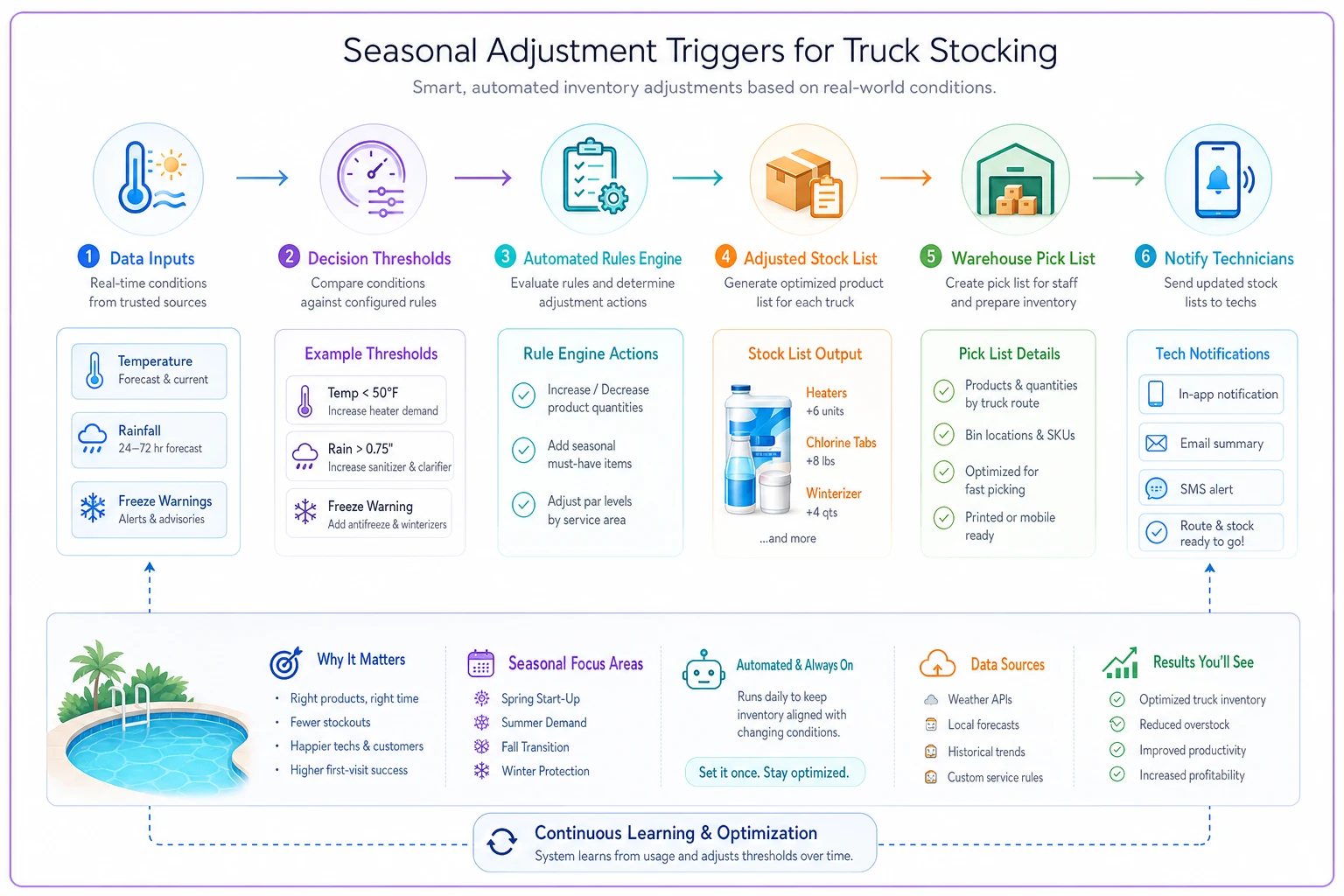
This illustrates the trigger-to-warehouse workflow.
Turning stock data into route optimization
Your truck stocking data reveals route problems you didn't know existed. When specific trucks consistently burn through unusual parts, dig deeper.
A Dallas operation noticed one truck used 3x more valve actuators than others. That route covered a neighborhood where the builder used a defective batch of actuators eight years ago. They were all failing within the same six-month window. Instead of reacting to constant failures, they proactively replaced actuators during routine service, turning a problem into a profit center.
Pattern recognition from stock usage:
-
Equipment age clusters in neighborhoods
-
Builder-specific equipment problems
-
Water chemistry zones requiring different approaches
-
Seasonal failure patterns by area
-
Customer behavior differences by route type
This data feeds back into route planning. Maybe you purposely assign repair-certified techs to areas with aging equipment. Or schedule chemical-heavy routes after warehouse delivery days. Or group customers with same equipment brands to maximize expertise efficiency.
Making peace with partial stockouts
Perfect truck stocking doesn't exist. Accept that some stockouts will happen and build response protocols instead of chasing perfection.
Stockout response hierarchy:
-
Check nearby tech trucks (coordinate via group text)
-
Hit the nearest pool store (company card, no receipt hassles)
-
Customer-approved temporary fix with follow-up scheduled
-
Reschedule if non-critical
-
Owner/manager emergency run if critical
The key: predetermined decisions. Techs shouldn't waste 20 minutes calling around when there's a clear protocol. One operation created zone maps showing nearest supply sources to every customer. Techs know instantly whether it's faster to backtrack to warehouse or hit the pool store two miles away.
Also track "near misses"—when you're down to last unit of critical parts. These are your early warning system for PAR adjustments.
Inventory float between warehouse and trucks
Treating truck inventory and warehouse inventory as separate systems is expensive. They're one system with multiple locations.
Your warehouse needs to maintain float inventory specifically for truck replenishment, separate from customer-direct parts. Otherwise, Monday morning truck loading cannibalizes parts needed for scheduled repairs, creating artificial shortages.
Calculate float requirements:
-
Sum all truck PAR levels
-
Add 20% safety buffer
-
Separate from sellable inventory
-
Mark as "truck replenishment only"
-
Reorder when float hits 50%
This prevents the Thursday afternoon scramble when trucks need restocking but the warehouse is empty because everything went to retail customers or emergency repairs.
The tech trust factor in stocking success
Truck stocking systems fail when techs don't trust them. They start hoarding parts, hiding inventory, and creating personal stashes. This usually happens because previous systems left them stranded too often.
Build trust through consistent availability of promised parts, quick response to shortage reports, no blame for stockouts (fix system, not people), tech input on PAR levels, and visible improvements from their feedback.
One operation holds monthly "stock talks"—15-minute standing meetings where techs report what's working and what's not. No lengthy discussions, just quick feedback that drives next month's adjustments. Techs actually comply with audit requirements when they see their input creates change.
Technology integration without overwhelming operations
The right operational software makes tiered stocking manageable without creating overhead. Not through complex inventory systems, but through simple automation of decisions you're already making.
AI-powered operational software can track patterns across routes, automatically adjust PARs based on seasonal triggers, and predict stockouts before they happen. The system watches actual usage (not theoretical needs) and suggests adjustments weekly.
What this looks like operationally:
-
Monday
System generates truck-specific pick lists based on routes
-
Daily
Techs mark used parts on mobile app during service
-
Friday
Automated PAR report shows what needs replenishment
-
Weekly
AI analyzes patterns and suggests PAR adjustments
-
Monthly
Complete inventory reconciliation without manual counts
The platform connects truck inventory to route scheduling to warehouse management, eliminating the gaps where parts problems hide. When a repair appointment gets scheduled, the system checks if that truck has typical parts for that equipment type. When seasons change, PARs automatically adjust based on historical patterns and weather data.
This reduces the mental load of managing truck inventory. Instead of owners spending evenings figuring out who needs what, the platform handles the complexity. Techs trust the system because their trucks are consistently stocked right. Operations run smoother because return trips become rare exceptions, not daily friction.
Clear wins from proper truck stocking
The difference between good and bad truck stock management pool technicians experience daily shows up everywhere in your operation. Customer reviews improve because service gets completed in one visit. Tech retention increases because they're not constantly frustrated. Profit margins expand because you're not bleeding money on windshield time.
Most importantly, proper truck stocking gives you operational capacity you didn't know you had. When techs aren't driving back for parts, they can handle more appointments. When customers get consistent service, they refer more business. When operations run smoothly, you can focus on growth instead of fighting fires.
The tiered system with seasonal adjustments isn't complex once it's built. It's just systematic thinking applied to a real problem. Track what actually gets used, stock trucks based on route reality, adjust for seasons, and audit consistently.
Your trucks become productive assets instead of rolling frustration generators. Your techs become efficient professionals instead of parts scavengers. Your business becomes a well-oiled operation instead of barely controlled chaos.
That's the real value of getting truck stocking right—it fixes problems you didn't even realize were connected to inventory. Everything downstream gets easier when techs have what they need to do the job right the first time.
Ready to elevate your pool service business?
Join hundreds of pool service professionals using Splshly to save time, optimize routes, and enhance customer satisfaction.