



You're sitting across from a new client, calculator in hand, trying to price their weekly pool service. $180 per month sounds right—covers your labor, chemicals, basic maintenance. They sign up. Three months later you're losing money on their account because the filter replacement cycle hit during peak season when parts take two weeks to arrive and your best tech is already overbooked.
This happens constantly in pool service businesses trying to build recurring revenue models. The problem isn't pricing itself—most operators treat recurring revenue pool service plans as simple multiplication (service cost × frequency) when reality involves complex operational dependencies that compound over time.
The operational chain reaction nobody talks about
Most pool service businesses approach recurring revenue backwards. They start with competitive pricing, maybe $150-200 for basic weekly service, then try to make operations work around that number. But what actually determines whether a recurring plan succeeds or fails is the interconnected relationship between scheduling capacity, parts inventory cycles, and technician workload distribution.
Consider what happens when you onboard 15 new recurring clients in April without adjusting parts ordering. Your standard monthly order of DE powder and o-rings runs out by week three. Now you're making emergency supply runs, paying retail prices, and your techs waste billable hours picking up parts. That $180 monthly plan just became a $140 plan after accounting for operational inefficiency—except you're still billing $180.
These problems cascade. When your tech spends an extra hour sourcing parts, they're late to the next appointment. That delay pushes into tomorrow's route. By Friday, you're either paying overtime or rescheduling clients. Multiply this across 200+ recurring accounts and you've built a system designed to fail during any slight disruption.
Why traditional pricing models break at 40+ recurring accounts
Around 40-45 recurring accounts, most pool service operations hit an invisible wall. Not that they can't handle more clients—they can't handle more clients with their current operational structure. The math changes fundamentally at this scale.
Eliminate missed appointments and dispatch delays.
Splshly ensures every pool service is scheduled, tracked, and completed efficiently.
- Unified scheduling dashboard
- Automated customer reminders
- Technician route optimization
No credit card required
Below 40 accounts, you can absorb inefficiencies through hustle. Your lead tech knows every pool's quirks. Parts shortages get solved with quick supplier trips. Schedule conflicts resolve through personal client relationships.
Above 40 accounts, those same workarounds become failure points. Your parts provisioning hits a complexity threshold where standard reorder points stop working. A residential pool might need a new pressure gauge every 18 months, but across 45 pools with different equipment ages, you're replacing 2-3 gauges monthly at random intervals. Miss one order cycle and three clients wait on parts.
Scheduling density reaches a point where buffer time disappears. With 25 accounts, you service 5-6 pools daily with flexibility between stops. With 50 accounts at the same service frequency, you're running 10-11 stops with zero margin for error. One pool with surprise algae bloom and your entire day shifts.
Building frameworks that actually prevent operational collapse
The solution isn't working harder or hiring more people—it's building service plans that explicitly account for operational constraints from day one. This means creating pricing and service cadences that align with your actual capacity, not theoretical maximums.
Start with scheduling impact as your primary constraint. Map out maximum daily service capacity accounting for drive time, service time, and a 15% buffer for complications. If that number is 8 pools per tech per day, your recurring revenue model needs to price around 7 to maintain sustainability.
Next, tie pricing tiers directly to parts consumption patterns. A basic chemical-only plan might run $150 monthly because parts requirements are predictable. But a full-service plan including equipment maintenance needs to price in the reality that you'll stock $300-400 in miscellaneous parts per month just for that tier of service. That means pricing at $280+ monthly or accepting lower margins.
The three-tier template that aligns operations with revenue
There's a consistent pattern among pool service companies who succeed with recurring revenue: they build three distinct service tiers that map directly to operational complexity, not just service features.
Tier 1: Chemical-Only Maintenance ($140-160/month)
-
Weekly chemical testing and balancing
-
Visual equipment inspection
-
Requires 20-minute site visits maximum
-
Parts requirement
chemicals only (predictable monthly ordering)
-
Can be serviced by any trained technician
-
Scheduling flexibility
can shift +/- 2 days without issues
Tier 2: Full Service Standard ($220-250/month)
-
Everything in Tier 1
-
Skimming, brushing, vacuum
-
Filter cleaning monthly
-
Basic equipment adjustments
-
Requires 35-45 minute visits
-
Parts requirement
basic o-rings, gaskets (quarterly bulk orders)
-
Needs experienced technician every 4th visit
-
Scheduling flexibility
+/- 1 day maximum
Tier 3: Premium Complete Care ($320-380/month)
-
Everything in Tier 2
-
Quarterly equipment deep inspection
-
Priority emergency response
-
Seasonal equipment prep/storage
-
Minor repairs included (up to $50 parts)
-
Requires 45-60 minute visits plus quarterly 90-minute service
-
Parts requirement
maintain pool-specific inventory
-
Needs senior technician monthly minimum
-
Scheduling
fixed day/time required
| Tier | Price | Key Operational Notes |
|---|---|---|
| Tier 1: Chemical-Only Maintenance | $140-160/month | Weekly chemical testing and balancing; 20-minute visits; predictable chemicals-only ordering; scheduling flexibility +/- 2 days |
| Tier 2: Full Service Standard | $220-250/month | Includes skimming/brushing/vacuum; 35-45 minute visits; quarterly bulk parts ordering; needs experienced technician every 4th visit; scheduling flexibility +/- 1 day |
| Tier 3: Premium Complete Care | $320-380/month | Quarterly deep inspection; priority response; minor repairs up to $50; 45-60 minute visits plus quarterly 90-minute service; pool-specific inventory; fixed day/time scheduling |
Each tier explicitly defines operational requirements, not just service features. This prevents selling Tier 3 service at Tier 2 operational planning.
Real operational model: from chaos to predictable growth
A pool service company in Arizona was running 67 recurring accounts, mostly at $175/month for "full service." They were barely breaking even despite being fully booked.
Their core problem: delivering Tier 3 service at Tier 2 pricing with Tier 1 operational planning. Their techs averaged 52 minutes per pool because they'd fix minor issues on-site to maintain service quality. Parts runs happened 3-4 times weekly because they hadn't mapped consumption to service tiers.
The fix started with segmenting existing clients into the three-tier model based on actual service history. Forty-one accounts were really Tier 1. Nineteen were true Tier 2. Seven pools required Tier 3 service levels.
They repriced during contract renewals over three months. The seven Tier 3 pools accepted the price increase because they were already receiving that service level.
Results after six months:
-
Revenue increased from roughly $11,700 to $14,300 monthly
-
Parts emergency runs dropped from 15-20 monthly to 2-3
-
Overtime hours decreased by approximately 60%
-
They added 12 new recurring accounts without hiring additional staff
These changes turned a barely breaking-even book into predictable, scalable recurring revenue without immediate headcount increases.
When recurring revenue models should actually be avoided
Not every pool service business should chase recurring revenue. If you're in any of these situations, fix the underlying issues first:
-
Your technician turnover exceeds 40% annually. Recurring revenue depends on consistency. When techs constantly change, you lose operational knowledge that makes efficient routing and service possible.
-
You're primarily serving vacation homes or seasonal properties. The operational complexity of stopping and starting service, combined with equipment issues from non-use periods, makes standard recurring models inefficient.
-
Your market has extreme seasonal variations that compress work into 4-5 months. Traditional monthly recurring revenue doesn't align with reality when pools operate May through September.
Address these structural issues before scaling recurring revenue—turnover, seasonality, and property mix undermine operational consistency required for sustainable plans.
The scheduling rules that keep recurring revenue profitable
Build routes with a maximum 70% capacity target. If a technician can physically service 10 pools in a day, schedule 7. That 30% buffer keeps recurring service actually recurring instead of constantly rescheduling.
Geographic clustering matters more than you think. A 15-minute drive between pools compounds across hundreds of service visits monthly. Group recurring clients by geography, even if it means having "light" days in certain areas.
Never mix service tiers within the same route unless absolutely necessary. A technician switching between chemical-only and full service pools loses efficiency with every transition.
Build "swing capacity" into your weekly schedule. Keep Wednesday afternoons or Friday mornings deliberately light for inevitable disruptions—equipment repairs that ran long, weather delays, urgent first services.
Parts provisioning strategies that scale with growth
Track parts consumption by service tier, not just overall usage. Tier 1 chemical-only services should have near-zero parts requirements beyond test kit replacements. Tier 3 requires pool-specific inventory based on equipment age and history.
Create "parts packages" for common repairs. Instead of tracking 47 individual SKUs for a pump rebuild, create a pre-staged kit. Price these into your Tier 3 services explicitly.
Establish reorder triggers based on service schedule, not just quantity. If you have 30 Tier 2 pools scheduled for filter cleaning next month, you need 30 sets of filter o-rings regardless of current inventory.
Pre-pack common repair kits for Tier 3 pools so technicians can avoid emergency parts runs and maintain schedule adherence.
Treat parts provisioning as a forward-looking operational plan tied to scheduled work, not a reactive inventory process.
The technician workload distribution everyone gets wrong
Your best technician gets all the "problem" pools because they can handle anything. Meanwhile, your newer tech cruises through straightforward pools. This seems logical until your senior tech burns out and takes irreplaceable knowledge with them.
The sustainable approach requires deliberate load balancing. Senior technicians should spend 60% of their time on Tier 2/3 services where expertise matters, 20% on training and quality checks, and 20% on straightforward routes.
Rotate challenging accounts quarterly. That problematic commercial property shouldn't become one person's permanent burden.
Software automation's role in preventing revenue model failures
The complexity of managing recurring revenue pool service plans overwhelms traditional systems once you pass 30-40 accounts. Modern operational software addresses this by automatically tracking the interconnections between scheduling, parts, and technician workload that determine profitability.
AI-powered platforms can predict parts consumption based on service history, automatically generating purchase orders before shortages occur. When a technician calls in sick, the system instantly identifies which routes need coverage and which clients can shift days without impact.
The automation handles complexity that makes recurring revenue models fail—tracking hundreds of service intervals, matching technician skills to requirements, maintaining inventory across service tiers. This frees operators to focus on service quality rather than constantly fighting operational fires.
Building your recurring revenue implementation checklist
Phase 1: Operational Baseline (Weeks 1-2)
-
Calculate true capacity per technician
-
Document current parts consumption patterns
-
Map existing client service requirements to proposed tiers
-
Identify scheduling bottlenecks
Phase 2: Framework Design (Weeks 3-4)
-
Define three service tiers with explicit operational requirements
-
Set pricing based on true operational cost plus margin
-
Create parts packages for each tier
-
Design scheduling templates that respect capacity limits
Phase 3: Gradual Implementation (Months 2-3)
-
Start with new clients only
-
Test scheduling density limits with small batches
-
Refine parts provisioning based on actual consumption
-
Adjust technician assignments
Here's a simple visual of the implementation workflow to keep the phases and operational ties clear.
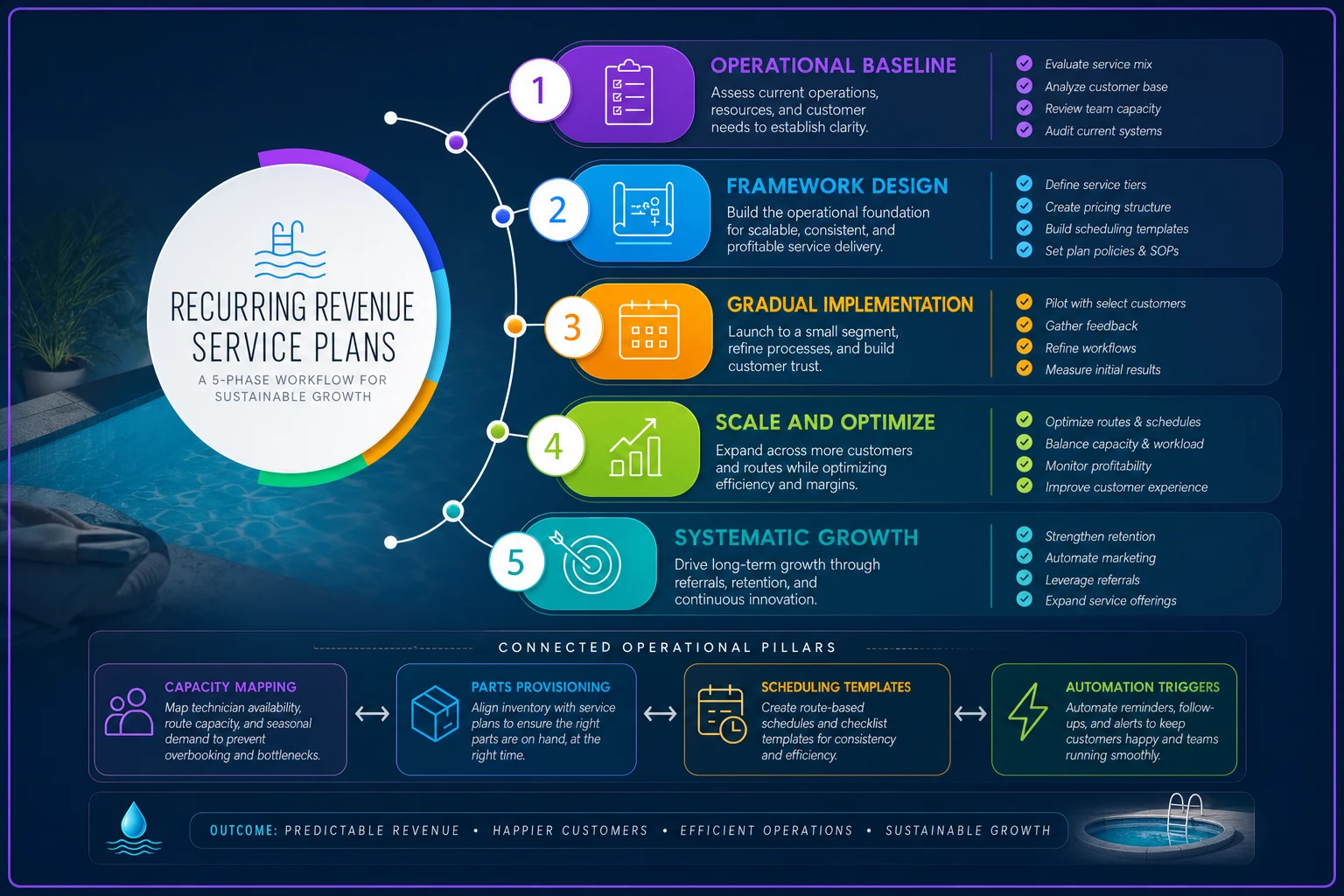
Phase 4: Scale and Optimize (Months 4-6)
-
Migrate existing clients during renewal
-
Implement workload balancing protocols
-
Establish reorder triggers and supplier relationships
-
Monitor KPIs
revenue per route, parts variance, overtime hours
Phase 5: Systematic Growth (Ongoing)
-
Add capacity only when existing routes are profitable
-
Maintain tier ratios that support operational efficiency
-
Regular price adjustments based on operational cost changes
Follow these phases sequentially and tie each phase to measurable operational thresholds before moving to the next.
Building successful recurring revenue pool service plans isn't about finding the perfect price point. It's about aligning every operational element—scheduling density, parts provisioning, technician workload—into a system that can actually deliver consistent service profitably.
Most pool service businesses that fail with recurring revenue models didn't fail because of bad pricing or poor service quality. They failed because they treated recurring revenue as a sales model instead of an operational model.
When you align service tiers with operational complexity, build scheduling rules that respect capacity limits, provision parts based on forward-looking requirements, and distribute workload sustainably, recurring revenue becomes a growth engine instead of an operational nightmare.
The pool service businesses thriving with recurring revenue aren't necessarily better at sales. They're better at operations. They've built systems that can actually deliver what they sell, consistently and profitably.
Start with operations, and the recurring revenue will follow. Start with revenue promises, and operations will eventually break.
Ready to elevate your pool service business?
Join hundreds of pool service professionals using Splshly to save time, optimize routes, and enhance customer satisfaction.