


A tech shows up to swap a leaking multiport valve on a sand filter. He's got the valve. He does not have the gasket kit — the spider gasket is sitting in a different bin back at the shop, and the union O-rings he grabbed are the wrong size because someone restocked the truck with the 1.5" set instead of the 2". Now he's calling the office, the customer is annoyed, and that repair just turned into two visits.
That's the whole game with kitting. Not the flashy stuff. The boring difference between a kit that has everything for a specific repair type and a kit that has most of it. Most of it means a return trip. And return trips are where your margin quietly bleeds out.
This post is about building a pool repair kit checklist organized by repair type, with real rules for how kits get packed, labeled, audited, replenished, and tracked from the warehouse to the truck. The goal is narrow: raise first-time-fix rates by fixing the kitting lifecycle, not by randomly adding more parts to the truck.
Why "stock the truck heavier" doesn't solve first-time-fix
The instinct when techs keep missing parts is to throw more inventory on every truck. It feels logical. It's also expensive and it doesn't actually move first-time-fix much.
The pattern is consistent: a truck stocked "heavy" still fails on specific combinations. A tech might have twelve O-rings but not the exact three that go with a Pentair cartridge housing. He has PVC glue but not the transition bushing for that one weird 2" to 1.5" reducer situation. Heavier trucks create clutter, more shrinkage, and slower load-outs — but the miss rate stays flat because parts aren't organized around the actual job.
Kitting flips the logic. Instead of asking "what parts might we need this week," you ask "what does a pump seal replacement require, start to finish, every single time." Then you build that as a defined kit. The tech grabs one kit, not fourteen loose parts, and the completeness is baked in.
This pairs closely with how you're already structuring your rolling stock. If you've set up a tiered truck stocking plan and seasonal PARs, kits sit on top of that as the job-specific layer — the PAR keeps bulk consumables topped up, the kit handles the repair-type completeness.
Kits should be defined by repair type, not by part category
This is the single biggest shift. Most shops organize inventory by category — bins of gaskets, bins of unions, a shelf of valves. Techs assemble the parts mentally at load-out. That mental assembly is exactly where things get missed, especially at 6:40am when the tech is behind schedule.
Eliminate missed appointments and dispatch delays.
Splshly ensures every pool service is scheduled, tracked, and completed efficiently.
- Unified scheduling dashboard
- Automated customer reminders
- Technician route optimization
No credit card required
A repair-type kit removes the mental math. Below is how a handful of common pool repairs break down when you define them as complete kits.
| Repair type | Core part | Supporting parts that get forgotten | Consumables |
|---|---|---|---|
| Pump mechanical seal replacement | Seal assembly (model-specific) | Diffuser gasket, housing O-ring, impeller screw | Silicone lube, thread sealant |
| Multiport valve rebuild | Spider gasket | Key/handle assembly, cover O-ring, air bleed | PVC primer + glue, Teflon tape |
| Salt cell replacement | Cell (correct model) | Union O-rings (2x), flow sensor grommet | Silicone lube, di-electric grease |
| Heater ignitor/flame sensor | Ignitor | Gasket set, wire nuts, mounting screws | High-temp RTV |
| Filter cartridge housing leak | Housing O-ring | Manifold gasket, air relief O-ring, clamp band | Silicone lube |
The middle column is the point. Those are the parts that aren't the star of the repair but stop the job cold when they're missing. A tech never forgets the salt cell. He forgets the two union O-rings that let him actually install it without a leak. Kitting exists to protect the middle column.
One rule that helps: a kit is defined by the most common variant, with a documented sub-variant. You don't build one kit for every pump seal in existence. You build the kit for your top two or three seal models, and each carries a note for the alternate seal number so the tech confirms before leaving.
Packaging and labeling rules that actually get followed
Techs won't follow a labeling system that's fussy. It has to survive a wet truck bed, a rushed load-out, and someone who doesn't read carefully. A few rules that hold up in real operations:
-
One kit, one sealed bag or bin. If it's loose, it's already broken. The moment a kit lives as "parts near each other" instead of "parts in one container," completeness disappears.
-
Label the outside with repair type + kit version + revision date. Something like
PUMP SEAL — WhisperFlo — v3 — 04/2026. The version matters because when you change what's in the kit, old kits floating around cause confusion. -
Include a packing slip inside listing every SKU and quantity. This is what makes audits fast. The tech (and the auditor) checks contents against the slip, not against memory.
-
Color-code by system category — pump, filter, heater, sanitation. A tech reaching into a bin should be able to grab the right family instantly by color before even reading the label.
-
Mark the "confirm before install" items. Union O-ring sizes, seal sub-variants — anything with a common wrong option gets a bright tag so the tech checks it against the actual equipment on site.
Pack the packing slip in a small waterproof sleeve inside the kit so wet trucks don't ruin audit checks.
The labeling isn't decoration. When a kit gets opened and one item gets pulled during a multi-repair trip, the label and slip are how you know what was consumed and what needs replenishing before that kit goes out again.
The audit cadence: catching broken kits before the truck rolls
A kit is only reliable if it's actually complete when the tech grabs it. The failure mode is subtle — a kit gets raided. A tech in a hurry pulls an O-ring out of a packed kit because his loose bin is empty. Now that kit is a landmine. It looks complete. It isn't.
-
Load-out spot check (daily, quick) Whoever loads trucks confirms each kit's seal is intact. Broken seal = pull it for a full audit. Takes seconds per kit.
-
Post-job reconciliation (per repair) When a tech uses a kit, they mark what was consumed. This drives replenishment and flags partial kits before reuse.
-
Weekly bench audit (deeper) Pull a rotating sample — somewhere around 15–20% of kits — and check contents against the packing slip. You're looking for slow drift: missing consumables, expired glue, wrong-variant parts that crept in.
-
Version audit (monthly) Confirm kits in the field match the current version. If you revised the multiport kit last month, hunt down the v2 kits still riding around.
The weekly bench audit is where you catch the stuff that quietly erodes first-time-fix. PVC primer that's dried out. Silicone lube tubes gone hard. A "gasket set" missing one gasket because the last rebuild used a spare. None of these show up until a tech is standing at a customer's equipment pad.
Replenishment workflow: warehouse to truck without the gaps
Replenishment is where kitting either becomes sustainable or falls apart in three weeks. The problem isn't building the first batch — anyone can do that on a slow Saturday. The problem is keeping kits complete and flowing after they get used.
-
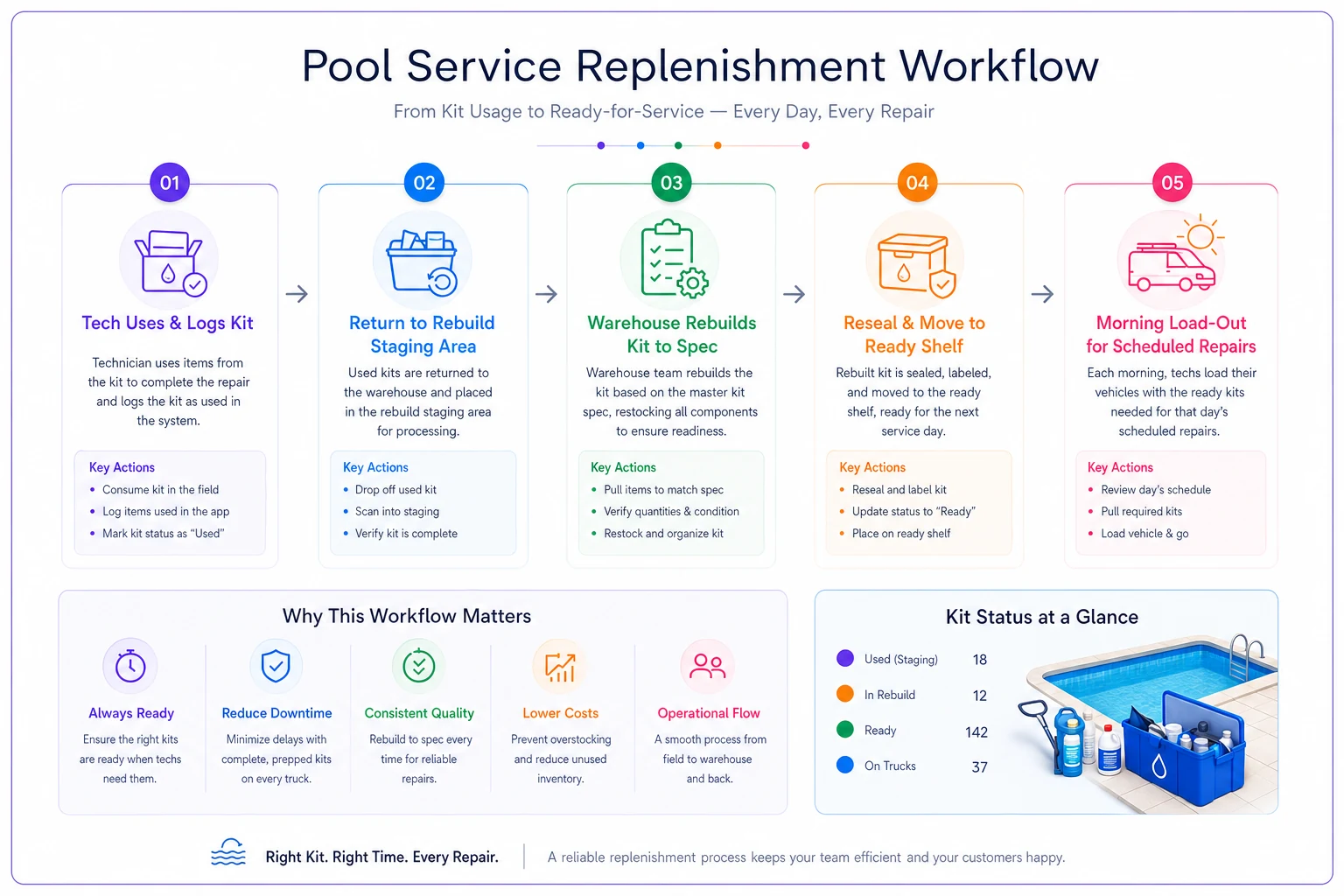
Tech consumes a kit → logs it as used (via packing slip check-off or a scan). This is the trigger event. No trigger, no replenishment.
-
Used kit returns to a "rebuild" staging area at the warehouse, physically separated from ready kits. Never let a used kit sit next to a complete one.
-
Warehouse rebuilds against the master kit spec, pulling from bulk stock, resealing, relabeling with a fresh revision date.
-
Bulk stock triggers its own reorder when kit rebuilds pull it below PAR. This is the link that prevents the slow-motion stockout where you run out of spider gaskets because kits kept quietly draining the shelf.
-
Rebuilt kit moves to the ready shelf, sorted by repair type and quantity target.
-
Morning load-out pulls ready kits based on the day's scheduled repairs — which means dispatch and kitting need to actually talk to each other.
That last point matters more than it sounds. If dispatch knows tomorrow has three salt cell jobs and a heater ignitor, load-out should be pulling those exact kits, not guessing. Tying kit pull to the actual schedule closes the loop — and it connects directly to how you're building your scheduling rulebook. When the schedule feeds kitting, techs stop leaving the yard under-equipped for the day they're actually about to have.
Diagram: rebuild and load-out flow.
That last point matters more than it sounds. If dispatch knows tomorrow has three salt cell jobs and a heater ignitor, load-out should be pulling those exact kits, not guessing. Tying kit pull to the actual schedule closes the loop — and it connects directly to how you're building your scheduling rulebook. When the schedule feeds kitting, techs stop leaving the yard under-equipped for the day they're actually about to have.
Tracking rules so a kit is never a mystery
The tracking layer answers three questions at any moment: where is each kit, what's in it, and what version is it. Without tracking, kitting degrades into "bags of parts" within a month and nobody trusts them.
-
Every kit gets an ID (barcode or QR). Scan on rebuild, scan on load, scan on use.
-
State is always one of four ready, on-truck, used/staging, retired. A kit should never sit in undefined limbo.
-
Consumption logs against the job, so you can see which repair types eat the most kits and which kits fail completeness most often.
-
Version changes force a retirement date on the old version so stragglers get pulled.
This is the point where a lot of shops realize the whiteboard-and-clipboard version stops scaling. Once you're running more than a couple of trucks, tracking kit state, consumption, and replenishment triggers by hand becomes its own part-time job. Operational software that ties inventory, kit definitions, and the schedule together makes the replenishment loop mostly self-running — the used-kit log flags the rebuild, the rebuild decrements bulk stock, and load-out gets a pull list based on tomorrow's route. You're not chasing paper; the system surfaces what needs rebuilding and what's close to stocking out. But the value comes from the discipline of the kitting lifecycle itself — the software just keeps it from quietly falling apart at the edges.
A real scenario: what changes when kitting is defined by repair type
A mid-size pool service running four trucks was sitting at a first-time-fix rate around 68% on repairs — meaning roughly one in three repair calls needed a second trip. Their techs were competent; the misses were almost always a missing gasket, wrong O-ring size, or dried-out glue.
They rebuilt their most common repairs into ten defined kits — pump seal, multiport rebuild, salt cell, heater ignitor, cartridge housing, and a few others — each sealed, labeled by repair type and version, with a packing slip inside. They added a weekly bench audit on a rotating sample and tied kit pull to the next day's schedule.
Over the following couple of months, first-time-fix on those repair types climbed into the mid-to-high 80s. Return trips on kitted repairs dropped noticeably — somewhere around 20–25 fewer second visits a month across the four trucks. At even a conservative loaded cost per trip, that's real money back, plus the customer-experience win of not making people wait a second time for a leaking valve.
The interesting part: they didn't add much total inventory. They reorganized it around repair types and enforced the lifecycle. The heavier-truck approach they'd tried before had actually cost more and moved the needle less.
When repair-type kitting makes sense — and when it doesn't
Kitting pays off when you have repeatable repair types with predictable part combinations. Pump seals, valve rebuilds, salt cells, cartridge housings — these repeat constantly with the same supporting parts. That's the sweet spot.
When it's a bad idea to over-kit: one-off or highly variable repairs. If a repair type shows up twice a season and the parts change every time, building and maintaining a kit for it is overhead with no payoff. Keep those as loose stock. Kit the top 8–12 repair types that cover the bulk of your service calls, not everything.
Who should hold off entirely: a solo operator running one truck who knows their own inventory cold might not need formal kits yet — though even they benefit from sealed kits for their two or three most common repairs, because memory fails on the busy days. The bigger the crew and the more trucks, the more the lifecycle discipline matters, because you're no longer relying on one person's knowledge.
The short checklist to start
If you want to build your first repair-type kits, start here:
-
Pull your last 3–6 months of repair jobs and rank repair types by frequency.
-
Take the top 8–12 and document the complete part list for each — especially the supporting parts and consumables that get forgotten.
-
Seal each as one container, label with repair type + version + date, include a packing slip inside.
-
Mark the "confirm before install" items that have common wrong variants.
-
Set the audit rhythm
daily seal check, per-job reconciliation, weekly bench sample, monthly version sweep.
-
Wire replenishment so a used kit triggers a rebuild and a rebuild decrements bulk stock.
-
Tie morning load-out to the actual schedule so techs pull the right kits for the day they're about to have.
First-time-fix isn't really about how good your techs are — most of them are plenty good. It's about whether the parts they need are physically in their hands when they open the truck. Repair-type kitting, packed and labeled and replenished with real rules, is how you make "everything's here" the default instead of the exception. Get the kitting lifecycle right and the return trips mostly take care of themselves.
First-time-fix isn't really about how good your techs are — most of them are plenty good. It's about whether the parts they need are physically in their hands when they open the truck. Repair-type kitting, packed and labeled and replenished with real rules, is how you make "everything's here" the default instead of the exception. Get the kitting lifecycle right and the return trips mostly take care of themselves.
Ready to elevate your pool service business?
Join hundreds of pool service professionals using Splshly to save time, optimize routes, and enhance customer satisfaction.