


Pool service scheduling is different. You're not dealing with one-off appointments like plumbers or electricians. You're juggling weekly maintenance routes, seasonal openings and closings, equipment repairs that pop up randomly, and emergency algae blooms that need immediate attention.
Most pool service companies hit the wall around 60-80 regular accounts. The owner-operator who kept everything straight in their head suddenly can't. Routes overlap. Emergency calls throw off the entire week. Seasonal rushes create bottlenecks. Techs show up to the same pool twice while another customer hasn't seen anyone in three weeks.
The fix isn't hiring more dispatchers or buying fancy routing software. It's building concrete scheduling rules that protect your capacity while keeping customers happy.
Time Blocking Creates Predictable Capacity
Standard appointment booking doesn't work for pool routes. You need structured time blocks that respect how pool service actually operates.
Think about how pool routes work. Your tech starts their Wednesday route at 7 AM with a string of weekly maintenance stops on the east side of town. Each pool takes 35-45 minutes depending on condition. Drive time between stops averages 12 minutes. By noon, they've hit 6-7 pools and need to head back for lunch and chemical restocking.
Without time blocking, dispatchers squeeze "quick" repair calls between maintenance stops. Except that filter replacement isn't quick when you discover the multiport valve also needs replacing. Now your tech is 90 minutes behind, rushing through maintenance stops, probably skipping chemical tests to catch up.
Morning blocks (7 AM - 12 PM): Reserved exclusively for recurring weekly maintenance on established routes. No exceptions unless a customer on that specific route has an equipment failure.
Early afternoon (12 PM - 2 PM): Buffer time for lunch, restocking, catching up on morning delays, and handling quick customer callbacks from the morning route.
Late afternoon (2 PM - 5 PM): Open blocks for repairs, new customer evaluations, and one-time services. These can be scheduled but stay flexible.
End of day (5 PM - 6 PM): Administrative time for techs to complete service reports, order parts for tomorrow's repairs, and prep their trucks.
Offer afternoon or next-day slots for non-route customers to keep morning maintenance intact.
The power comes from protecting those morning blocks religiously. When a customer calls Tuesday afternoon about cloudy water, you don't jam it into Wednesday morning's route. You offer Wednesday afternoon or Thursday afternoon. Your maintenance routes stay consistent, techs maintain their rhythm, and you handle urgent issues promptly.
Emergency Buffer Rules Prevent Cascade Failures
Every pool service business needs emergency capacity, but most handle it wrong. They either overreact to every "emergency" call or ignore real problems until customers threaten to cancel.
Eliminate missed appointments and dispatch delays.
Splshly ensures every pool service is scheduled, tracked, and completed efficiently.
- Unified scheduling dashboard
- Automated customer reminders
- Technician route optimization
No credit card required
Real pool emergencies that need same-day response:
-
Pool turning green before a planned event
-
Pump failure causing rapid water loss
-
Broken equipment creating safety hazards
-
Chemical imbalances making pools unusable
Everything else can wait 24-48 hours with proper customer communication.
Keep 20% of your afternoon capacity unscheduled. For a company running 5 techs, that means one full tech-afternoon equivalent stays open daily for true emergencies and schedule recovery.
This isn't wasted time. On days without emergencies, techs use buffer time for:
-
Getting ahead on tomorrow's route
-
Detailed equipment inspections that prevent future emergencies
-
New customer quotes and evaluations
-
Training and certification work
When an emergency hits, you have capacity without destroying tomorrow's schedule. A green pool before Saturday's pool party gets handled Friday afternoon without bumping regular Friday maintenance to Monday.
Automated Conflict Resolution Through Business Rules
Manual scheduling creates conflicts. Even experienced dispatchers can't track every constraint while booking appointments. You need systematic rules that prevent double-booking before it happens.
Start with non-negotiable constraints:
Geographic clustering: Appointments must stay within defined zones to minimize windshield time. A tech working the north zone doesn't get pulled south for an emergency unless no other option exists.
Skill matching: New techs don't get sent to properties with automated systems or saltwater conversions they haven't been trained on. Senior techs handle complex equipment repairs.
Customer preferences: Some customers only want specific techs. Others need afternoon service because of dogs in the yard mornings. These preferences become scheduling constraints, not suggestions.
Equipment requirements: Certain jobs need specific tools or vehicles. Don't send a tech in a compact truck to a commercial property needing 100 pounds of chemicals.
These rules layer together into scheduling logic. When someone calls about a sand filter replacement, the system checks: Which techs have sand filter experience? Who's working in that zone this week? What's their capacity in the repair time blocks? Who has the necessary equipment on their truck?
The automated system might determine: "Tom can handle this Thursday afternoon in zone 3, he has sand filter experience and his truck carries the necessary equipment. Sarah could also do it Friday morning but would need to pick up equipment first, adding 45 minutes to the job."
This isn't complex AI trying to optimize everything. It's simple business rules preventing obvious mistakes. The dispatcher still makes the final decision, but they're choosing between valid options, not creating conflicts they'll discover later.
Priority Heuristics That Reflect Business Reality
Not all appointments carry equal weight. A systematic priority framework keeps you focused on what matters for profitability and growth.
Priority Level 1 - Contractual obligations: Commercial properties, HOAs, and high-value residential contracts with specific service level agreements. Missing these triggers penalties or contract losses.
Priority Level 2 - Revenue protection: Regular weekly maintenance customers who pay on time and refer others. Losing one costs you roughly $3,000-4,500 annually plus potential referrals.
Priority Level 3 - Growth opportunities: New customer evaluations, upsell appointments for equipment upgrades, and referrals from your best customers.
Priority Level 4 - Reactive work: One-time repairs for non-regular customers, seasonal services for occasional clients.
This hierarchy drives scheduling decisions. When Thursday afternoon fills up, the dispatcher knows a Priority 1 commercial property emergency bumps a Priority 4 one-time repair to Friday. The one-time customer might be annoyed, but you don't risk a $24,000 annual contract.
| Priority Level | Description |
|---|---|
| Priority Level 1 - Contractual obligations | Commercial properties, HOAs, and high-value residential contracts with specific service level agreements. Missing these triggers penalties or contract losses. |
| Priority Level 2 - Revenue protection | Regular weekly maintenance customers who pay on time and refer others. Losing one costs you roughly $3,000-4,500 annually plus potential referrals. |
| Priority Level 3 - Growth opportunities | New customer evaluations, upsell appointments for equipment upgrades, and referrals from your best customers. |
| Priority Level 4 - Reactive work | One-time repairs for non-regular customers, seasonal services for occasional clients. |
The priorities also guide capacity planning. If Priority 1 and 2 work fills 85% of your schedule, you're healthy. If Priority 4 reactive work dominates, you're working hard but not building recurring revenue.
Seasonal Capacity Planning Without Chaos
Pool service has extreme seasonality that breaks normal scheduling approaches. Spring opening season might see 300% normal demand while January drops to 40% of peak. Most companies either turn away profitable seasonal work or overcommit and destroy their reputation.
Pre-season (March-April): Extend daily operating hours to 7 AM - 7 PM. Authorize overtime for experienced techs. Bring on seasonal helpers for basic tasks like cover removal and deck cleaning. Block out Saturdays for opening appointments only.
Peak season (May-September): Maintain normal hours but optimize routes for maximum efficiency. Pause non-essential activities like detailed equipment inspections. Focus purely on service delivery.
Transition season (October-November): Return to normal hours. Dedicate Friday afternoons to closing appointments. Start scheduling winter equipment rebuilds and major repairs.
Off-season (December-February): Reduce to 4-day weeks if possible. Focus remaining time on equipment maintenance, training, and commercial pool contracts that run year-round.
Each seasonal mode has different scheduling rules. Spring opening appointments get booked in 2-hour blocks because timing varies wildly based on pool condition. Summer maintenance stays in tight 45-minute windows. Winter work expands to allow for thorough preventive maintenance.
Technology That Enforces Rules Without Babysitting
Manual scheduling rule enforcement doesn't scale. By the time you hit 100+ customers, dispatchers spend more time checking constraints than actually scheduling.
Pool service operations need scheduling platforms that embed rules directly into the booking process. When a customer calls for service, the system should automatically:
-
Check which techs are certified for that service type
-
Identify available time blocks in the correct geographic zone
-
Flag potential conflicts with existing appointments
-
Suggest optimal scheduling based on route efficiency
-
Alert dispatchers to violations of business rules
This isn't about replacing human judgment. Experienced dispatchers understand customer relationships and special circumstances that no system can capture. But the technology handles the mechanical rule-checking that humans do poorly when rushed.
Here's a simple workflow visualization you can reference.
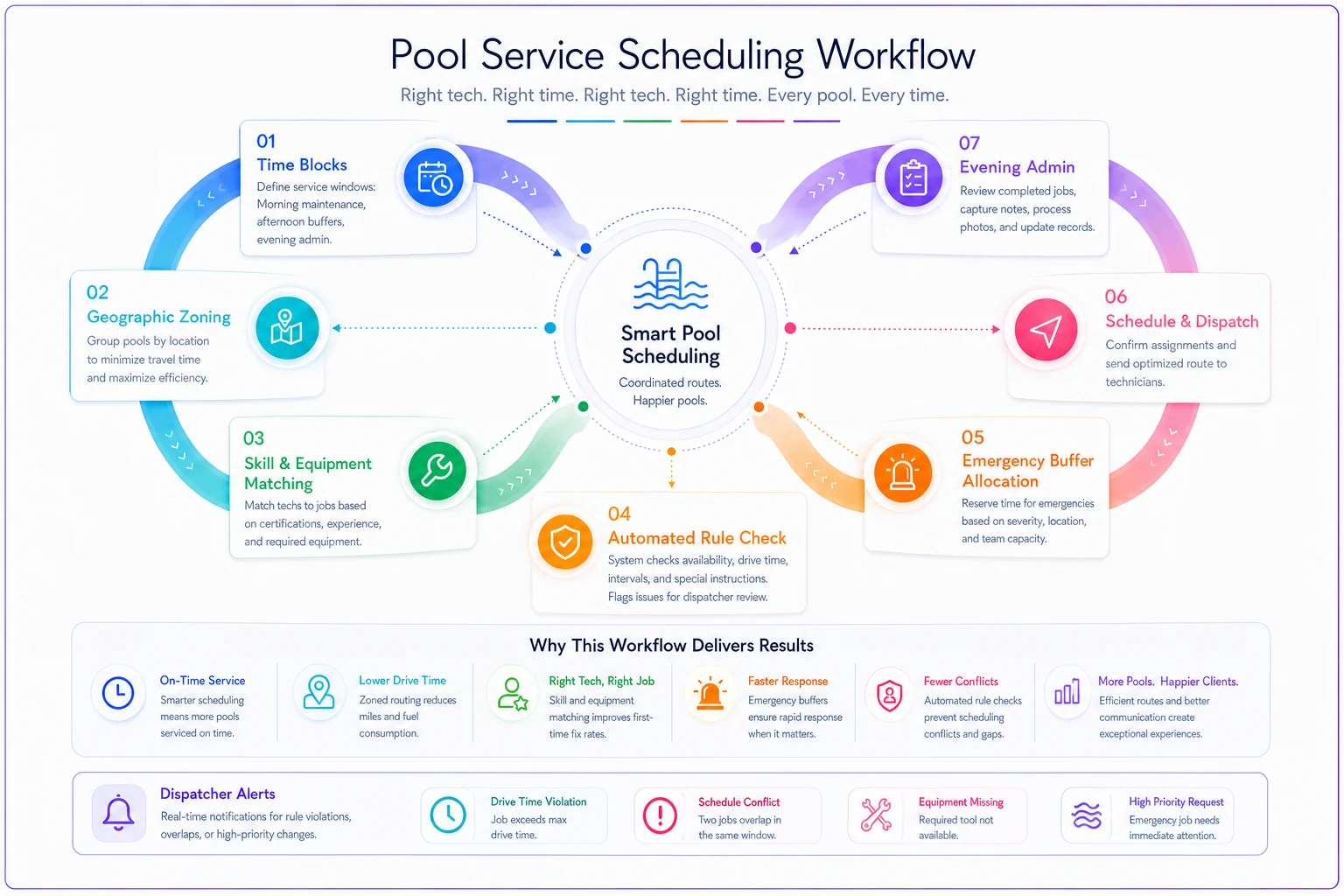
When scheduling a new regular maintenance customer, the system might show: "Adding this stop to Route 3 increases drive time by 22 minutes. Consider moving the Johnson account to Route 4 to maintain balance." The dispatcher makes the call, but with complete information.
The value comes from preventing small violations that cascade into major problems. That tech scheduled for two pools 45 minutes apart in rush hour traffic. The seasonal opening booked for a tech who doesn't know how to prime vintage pumps. The emergency repair scheduled during the monthly HOA pool inspection that can't be moved.
What This Means for Your Pool Service Business
Scheduling rules aren't about rigidity. They create predictable capacity that lets you deliver consistent service while handling the chaos of pool service reality.
Start with basic time blocking. Protect recurring revenue by dedicating morning blocks to regular maintenance. Build in emergency buffers so urgent issues don't cascade into multi-day schedule disasters. Create clear priorities so dispatchers make consistent decisions under pressure.
Then add automation that makes rules stick. Use scheduling software that prevents conflicts before they happen. Build in seasonal adjustments that happen automatically. Create reports that show when rules get violated so you can adjust them based on reality.
Pool service companies that scale successfully don't do it through heroic scheduling efforts. They build systematic approaches that work whether the owner is dispatching or a new employee is covering vacation. They protect core revenue while maintaining flexibility for growth. They turn scheduling from a daily crisis into a predictable operation.
Your techs know what they're doing each day. Customers get consistent service windows. Emergency calls get handled without destroying tomorrow's productivity. You can focus on growing the business instead of juggling the daily schedule.
That's what proper scheduling rules deliver - not perfect optimization, but predictable operations that let you run a real business instead of fighting fires every morning.
That's what proper scheduling rules deliver - not perfect optimization, but predictable operations that let you run a real business instead of fighting fires every morning.
Ready to elevate your pool service business?
Join hundreds of pool service professionals using Splshly to save time, optimize routes, and enhance customer satisfaction.