

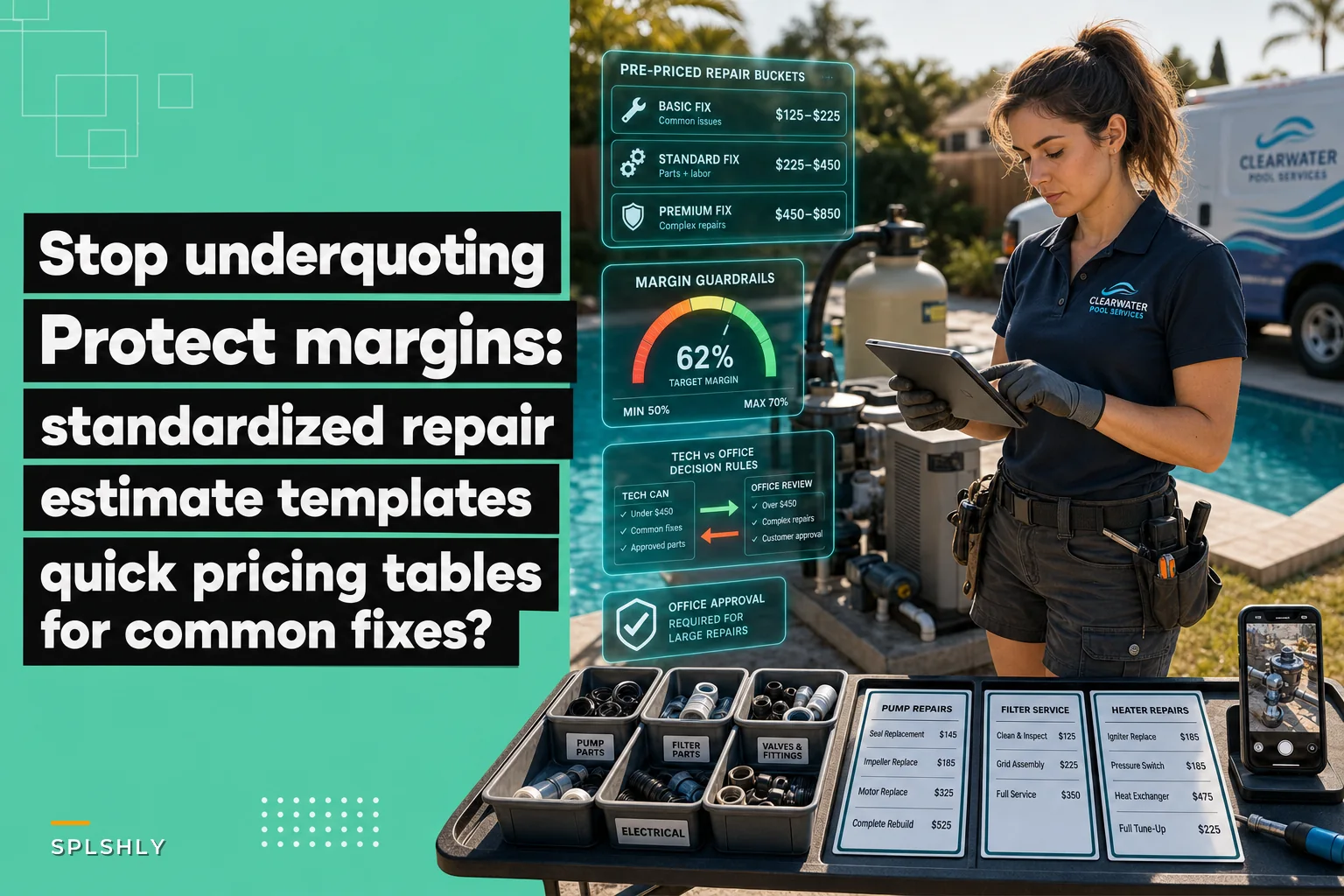

Most underquoting doesn't come from bad math. It comes from the tech standing at the equipment pad, mentally adding up parts, guessing at labor, rounding down because the homeowner is watching, and firing off a number that feels fair. Then the office finds out the actuator was seized, the union fittings crumbled, and what looked like a two-hour job turned into four. The quote's already out. Nobody wants to make that callback.
That gap — between the number a tech quotes on the spot and what the job actually costs — is where pool repair margins quietly die. This post is about closing it with reusable estimate templates, clear pricing buckets, and simple rules for who gets to quote what.
Why the on-truck estimate keeps coming in low
There are a few predictable reasons a field-quoted repair lands short, and none of them are the tech being careless.
The first is parts blindness. A tech quoting a pump swap sees the pump. They don't always price the union kit, the check valve that's clearly failing right next to it, the brittle electrical whip, or the extra couple hours of re-plumbing because the replacement pump has a different footprint. The "one part" job is almost never just one part.
The second is labor optimism. Everyone underestimates the annoying stuff — the seized fitting, the buried valve, the panel mounted so tight you can barely get a wrench in. Techs quote the clean version of the job in their head, not the one they'll actually be cursing at in the sun.
Third is social pressure at the quote moment. When a homeowner is standing right there, techs round down. Saying "$680" out loud feels aggressive, so it becomes "around $550." That $130 is pure margin, gone. Multiply that across a full season and it adds up faster than anyone wants to admit.
And the fourth — the sneaky one — is no consistent structure. Two techs quoting the same heater ignitor replacement will produce two different numbers because they're both building it from scratch in their heads. Standardization isn't about control. It's about not reinventing pricing on every driveway.
The core idea: time-and-parts buckets
The fix that actually holds up in the field is a template built around buckets, not freeform line-by-line entry. A tech shouldn't be typing custom line items on a phone in 95-degree heat. They should be picking from pre-priced buckets that already account for the messy reality of the job.
Eliminate missed appointments and dispatch delays.
Splshly ensures every pool service is scheduled, tracked, and completed efficiently.
- Unified scheduling dashboard
- Automated customer reminders
- Technician route optimization
No credit card required
-
Base labor for the task (already padded for real-world friction)
-
Standard parts kit the job usually needs — not just the headline part
-
Common add-ons the tech can toggle on with one tap
-
A margin floor baked in so the job can't be quoted below cost
Instead of quoting "pump = $X," the tech opens the Pump Replacement bucket, which already contains the pump, union kit, sealant, base install labor, and a checklist of likely add-ons — re-plumb, new check valve, electrical whip, timer swap. They confirm what's needed, and the number builds itself with the margin already protected.
Quick pricing table for common pool repairs
Below is a starter structure. Your actual numbers depend on your market, labor rates, and supplier costs — treat these as a template shape, not gospel pricing. The point is the bucket + guardrail format.
| Repair bucket | Base labor (hrs) | Typical parts range | Common add-ons | Margin floor |
|---|---|---|---|---|
| Pump replacement | 1.5–2.5 | $450–$900 | Re-plumb, check valve, whip, timer | 35% |
| Pump motor + seal kit | 1.0–1.5 | $180–$340 | Impeller, diffuser, shaft seal | 40% |
| Filter cartridge set | 0.5 | $120–$400 | O-rings, lube, band clamp | 45% |
| DE filter grid replacement | 1.5–2.0 | $220–$480 | Manifold, air relief, backwash valve | 40% |
| Heater ignitor / igniter | 1.0–1.5 | $90–$260 | Flame sensor, gas valve, pressure switch | 40% |
| Salt cell replacement | 0.5–1.0 | $350–$800 | Flow switch, unions, board check | 38% |
| Actuator / valve rebuild | 1.0–2.0 | $60–$220 | Diverter, o-rings, valve body | 42% |
| Automation panel board | 1.5–3.0 | $300–$900 | Relays, transformer, comm cable | 35% |
The margin floor column is what most shops skip. That number is the guardrail: if the built estimate falls below it — because parts costs spiked or the tech tried to knock something off — the template flags it before the quote goes out.
Margin guardrails: the rule that stops the bleeding
A guardrail is a simple rule the estimate template enforces automatically. Three that matter most:
-
Minimum margin per bucket. If discounts push a job under its floor — say, 35% on a pump job — the estimate can't be sent without a manager override. This alone catches most of the "I felt bad so I knocked $100 off" leaks.
-
Minimum ticket size. Trucks cost money to move. A $95 repair that takes a full drive across town loses money once you count windshield time. Set a floor — no repair estimate under roughly $180 without bundling it into a maintenance visit.
-
Parts markup lock. Techs shouldn't be quoting parts from memory or at last year's cost. Markup should apply automatically off current supplier cost, so a $220 part isn't accidentally quoted at $180 because that's what it used to be.
The shops that actually fix this tend to share one mindset shift: they stop treating margin as something they hope survives the job and start treating it as something the estimate locks in before it ever gets sent.
Tech-quoted vs office-approved: draw the line clearly
Not every repair should be quotable on the spot, and not every repair needs to wait for the office. The most common failure is having no rule at all — techs quote a $2,800 automation rebuild off the cuff, or the office creates a bottleneck on a $150 actuator swap that could've been closed in the driveway.
Tech can quote and close on-site when:
-
The repair matches a standard bucket
-
The built estimate is under a set threshold (e.g., around $800)
-
No structural or electrical unknowns are involved
-
The margin floor is met automatically
Route to office approval when:
-
The estimate exceeds the threshold
-
It involves automation, gas lines, or bonding/electrical work
-
It requires special-order parts or has a supplier lead time
-
The tech had to override the margin guardrail
-
The scope is unclear and needs a second set of eyes on the photos
That last point is where documentation habits matter. When a job routes to the office, the approver isn't standing at the pad — they're deciding off photos and notes. If those are inconsistent or missing, they either rubber-stamp blindly or bounce it back and stall the whole job. This is exactly why mandatory photo shot lists and caption templates matter for approvals — the office can only move fast when they can actually see the failure.
A sample filled estimate (so this isn't abstract)
Walk through a real-shaped example. Homeowner calls: pump is loud and leaking.
-
Base labor
2.0 hrs @ shop rate → $220
-
Pump (from live supplier cost + markup)
$610
-
Union kit + sealant (standard in bucket)
$38
-
Add-on toggled re-plumb (old pump different footprint) → +0.75 hr labor + fittings → $145
-
Add-on toggled failing check valve visible → +$70 part, +0.25 hr
Built total: ~$1,140. Margin check: 37% — above the 35% floor, passes.
The total crossed the ~$800 tech-quote threshold, so the template routes it to office approval with photos attached. The office reviews the shot of the corroded check valve and the mismatched footprint, approves in a few minutes, and the tech presents the finalized number to the homeowner.
Compare that to the old way: tech eyeballs it, says "probably around $850 for the pump and install," forgets the re-plumb, ignores the check valve, and eats roughly $290 of unbilled scope on a job they thought was profitable. Do that twenty times in a season and you've quietly handed away several thousand dollars.
The workflow, start to finish
Once buckets and rules are in place, the flow is fairly straightforward — but the order matters.
-
Diagnose failure
-
Match to repair bucket
-
Confirm standard kit + toggle add-ons
-
Shoot required photos
-
Template builds estimate + checks margin floor
-
Under threshold? Tech closes on-site. Over threshold or flagged? Routes to office with photos
-
Approver reviews and approves or adjusts
-
Quote sent to customer
The tech diagnoses the failure first — ideally using a consistent diagnostic process so the right bucket gets chosen. Misdiagnosis upstream breaks the estimate downstream. If you quote a salt cell when the real problem is a flow switch, the number's wrong before you even start. A repeatable diagnostic flowchart keeps that from happening.
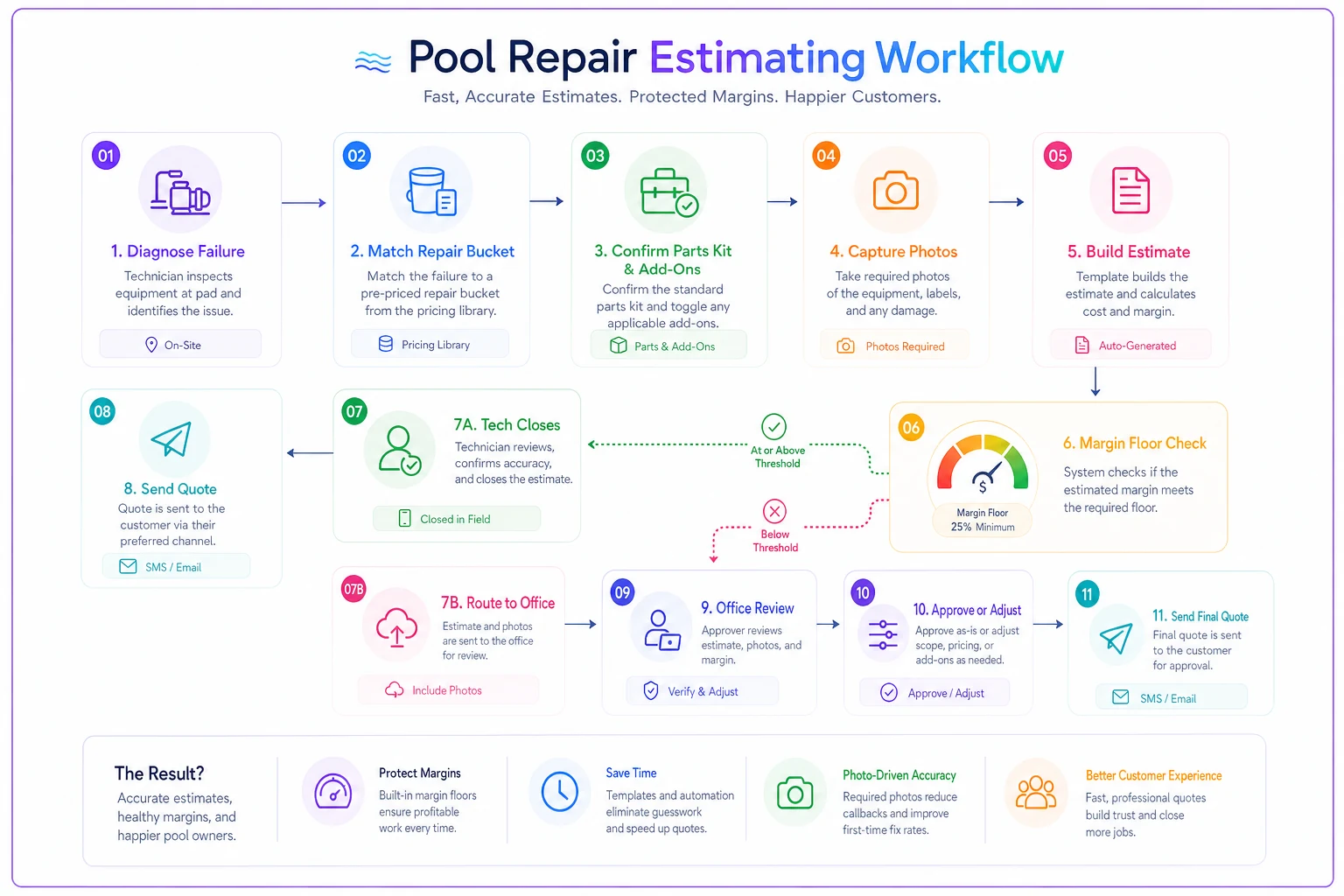
Here's a simple visual of that flow to make the routing and decision point obvious.
Once the bucket is matched, the tech confirms the standard kit and toggles any visible add-ons. Photos get taken before anything gets routed. The template checks the margin floor automatically, then decides — based on the threshold and job type — whether the tech closes on-site or hands it off for approval. The approver works off the estimate and photos together, which means they can move fast instead of calling the tech back for more detail.
AI-assisted operational software fits naturally into this flow. It can pull live parts costs so markups stay current, flag any estimate that dips below margin before it's sent, and auto-route jobs to the right approver based on whatever rules you've set. It doesn't replace what the tech knows — it just makes sure that knowledge works inside guardrails instead of on a best guess.
Your estimating template checklist
Before rolling this out, make sure your templates cover:
-
[ ] A defined bucket for every repair you run more than a few times a month
-
[ ] Base labor hours padded for real-world friction, not best-case scenarios
-
[ ] A standard parts kit inside each bucket — not just the headline part
-
[ ] One-tap add-ons for the usual "while I'm in there" items
-
[ ] A margin floor per bucket with an override that requires a reason
-
[ ] A minimum ticket size to protect against money-losing single visits
-
[ ] Parts markup pulled from current supplier cost, not memory
-
[ ] A clear dollar threshold and job-type rules for tech-quote vs office-approval
-
[ ] Required photos attached before any office routing
Before rolling this out, make sure your templates cover:
When this makes sense — and when it doesn't
Worth building if you run more than one tech, your margins or close rates vary widely between people, or you keep seeing jobs that "should've been profitable" come in flat. Buckets pay off fastest when inconsistency is the real problem.
Probably overkill if you're a solo operator quoting a handful of jobs a week and already know your numbers cold. Building out ten buckets for a one-truck operation is effort you don't need yet — though it becomes valuable fast once you hire your first tech.
Don't build this if you're going to set it up once and never update parts costs. Stale pricing is arguably worse than no template, because it gives everyone false confidence in a number that's quietly wrong.
Real scenario
A three-truck service company in a hot-summer market kept posting solid revenue but thin repair margins. Their techs were strong diagnostically but quoted everything freehand. When they audited a season of repair jobs, the pattern was hard to ignore: field-quoted repairs were landing roughly 8–12 points below intended margin, mostly from unbilled add-ons and soft discounting at the door.
They built eight repair buckets with margin floors and set an $800 tech-quote threshold with office routing above it. Nothing complicated — just consistent buckets and a clear approval line. Within a couple of months, average repair margin climbed back into the mid-30s where it was supposed to be, and the office stopped getting surprise callbacks about jobs that ran long. The techs were actually relieved — they weren't the ones stuck making the awkward "I have to raise the quote" phone calls anymore.
The takeaway
Underquoting isn't a discipline problem you can yell your way out of.
It's a structure problem. When every repair gets priced from scratch in someone's head, the number will drift low — that's just how driveways and homeowners and hot afternoons work. Buckets, margin floors, and a clean tech-vs-office line take the guessing out of it, so the price reflects the real job instead of the optimistic version of it. Build the templates once, keep the parts costs current, and let the guardrails hold the margin so your people don't have to.
Underquoting isn't a discipline problem you can yell your way out of.
It's a structure problem. When every repair gets priced from scratch in someone's head, the number will drift low — that's just how driveways and homeowners and hot afternoons work. Buckets, margin floors, and a clean tech-vs-office line take the guessing out of it, so the price reflects the real job instead of the optimistic version of it. Build the templates once, keep the parts costs current, and let the guardrails hold the margin so your people don't have to.
Ready to elevate your pool service business?
Join hundreds of pool service professionals using Splshly to save time, optimize routes, and enhance customer satisfaction.