


Pool techs hate taking photos. They're already juggling test kits, chemicals, and equipment while trying to hit their 12-stop daily route. But without proper documentation, customers deny authorizing repairs, dispute service quality, and reject necessary equipment replacements because they never saw the problem.
Last month I watched a tech spend 40 minutes arguing with a homeowner about a cracked filter housing. The crack was obvious during the service visit, but when the invoice arrived three days later, the homeowner was convinced the tech was trying to upsell unnecessary repairs. No photos meant no proof. The tech lost the $850 repair job and the customer switched companies.
Pool service businesses lose thousands in approved repairs and face constant payment disputes because their techs either don't take photos, take useless photos, or send them too late. A structured photo documentation system changes this completely.
Why techs skip photos (and why owners let them)
Pool technicians operate under constant time pressure. They're scheduled for 10-14 stops daily during peak season, with drive time eating up 30-40% of their day. Adding "take photos" feels like one more thing slowing them down.
Most pool companies never define what photos to take, when to take them, or how to caption them. Techs get vague instructions like "document any issues," which translates to random, poorly-lit shots of equipment that mean nothing to homeowners. One tech might snap 15 photos per visit while another takes zero.
Then there's the delivery problem. Photos sit on techs' phones, get uploaded to random cloud folders, or disappear into text message threads. By the time a homeowner sees evidence of their cracked skimmer or corroded heater exchanger, they've mentally rejected the repair recommendation. The window for acceptance closes fast - usually within 4 hours based on patterns I've tracked across multiple service companies.
Companies that convert repair recommendations into approved work orders follow strict photo protocols. They treat photo documentation as a core operational requirement.
Building shot lists that eliminate interpretation
Generic photo requirements produce generic results. Telling techs to "photograph equipment issues" leads to blurry shots taken from 10 feet away that show nothing useful. The fix is creating shot lists so specific that any tech produces identical documentation.
Eliminate missed appointments and dispatch delays.
Splshly ensures every pool service is scheduled, tracked, and completed efficiently.
- Unified scheduling dashboard
- Automated customer reminders
- Technician route optimization
No credit card required
An effective weekly maintenance shot list includes these requirements:
Arrival shots (2 required):
-
Wide shot of pool from skimmer side showing overall water clarity
-
Close-up of water surface at deep end showing debris level
Equipment inspection (4 required):
-
Pump basket contents before cleaning
-
Filter pressure gauge reading
-
Salt cell (if applicable) showing scale buildup
-
Skimmer basket contents before cleaning
Departure shots (2 required):
-
Wide shot matching arrival angle showing cleaned pool
-
Test strip or digital reading display
Each shot has a specific subject and angle. There's no room for interpretation. A tech can't skip the pump basket photo or substitute it with something else.
For repair scenarios, requirements get more granular:
Leak detection documentation:
-
Dry equipment pad before testing
-
Wet areas with measuring tape for scale
-
Close-up of leak source with arrow overlay
-
Wide shot showing leak location relative to equipment
Pump seal failure:
-
Shaft seal area showing moisture/salt buildup
-
Pump label showing model number
-
Motor data plate
-
Moisture damage on motor housing
When a homeowner sees their actual pump motor with visible corrosion next to a ruler showing 2 inches of salt buildup, they stop questioning whether replacement is necessary.
Caption templates that sell the problem, not the tech
A photo of a green pool means nothing without context. Homeowners don't understand what they're looking at, why it matters, or what happens if they ignore it. The caption transforms documentation into persuasion.
Bad captions state the obvious: "Dirty filter" or "Pump making noise." Effective captions follow a problem-impact-timeline structure.
Instead of: "Filter needs cleaning" Write: "Filter pressure at 28 PSI (8 PSI above clean baseline). Restricted flow reducing chlorine circulation. Will cause algae growth within 5-7 days if not addressed."
Instead of: "Found leak" Write: "Active leak at pump volute losing approximately 1 inch of water daily. Current water loss costs $18/week in chemicals and water. Leak will worsen and potentially damage motor within 2-3 weeks."
Instead of: "Heater not working" Write: "Heater displaying LO error code indicating low water flow from clogged filter. Cannot heat pool until filter cleaned. Extended operation in this state will damage heat exchanger (typical replacement cost $1,200)."
This structure answers three questions every homeowner has: What's wrong? Why should I care? What happens if I wait?
Some companies use pre-written caption libraries. Techs select from dropdown menus:
-
Pump seal leak - Level 1
"Minor moisture at shaft seal. No immediate action required but monitor weekly."
-
Pump seal leak - Level 2
"Active dripping at shaft seal. Repair needed within 30 days to prevent motor damage."
-
Pump seal leak - Level 3
"Significant leak at shaft seal. Motor damage likely within 7 days without repair."
A tech spends 20 seconds selecting appropriate captions rather than 3 minutes trying to describe problems.
The 4-hour delivery rule
Photo documentation becomes worthless if it arrives too late. Repair acceptance rates drop by roughly 40% when photos arrive more than 4 hours after the service visit. After 24 hours, acceptance rates crater to below 20%.
During the service visit, homeowners are thinking about their pool. Four hours later, they've moved on. A repair estimate arriving two days later feels like an ambush.
Immediate delivery trigger points:
-
Any repair recommendation over $200
-
Safety issues (electrical, chemical, structural)
-
Equipment showing imminent failure signs
-
First sign of problems on high-value customers
Standard delivery windows:
-
Routine maintenance photos
Within 2 hours of visit
-
Minor repair recommendations
Within 4 hours
-
Major repair quotes
Within 1 hour with follow-up call
One company increased repair acceptance from 35% to 68% just by implementing a 2-hour photo delivery standard. They didn't change pricing, sales approach, or service quality. They just started showing customers problems while those problems still felt urgent.
Email gets lost. Text messages work better but can feel informal for larger repairs. The sweet spot is immediate text with key photos for urgent issues, followed by email with complete documentation and formal estimate.
Seasonal shot list adjustments
Pool service requirements change dramatically by season, but most companies use the same photo checklist year-round. This misses critical documentation opportunities.
Spring opening additions:
-
Cover condition before removal
-
Water level relative to tile line
-
Debris accumulation under cover
-
Equipment condition after winter
-
Startup pressure readings
-
Initial chemical test results
Peak summer modifications:
-
Algae prevention areas (corners, steps, behind ladders)
-
Bather load indicators (oils, debris patterns)
-
Chemical feeder settings and levels
-
Solar cover wear patterns
-
Automatic cleaner performance
Fall/winter prep focus:
-
Freeze damage vulnerability points
-
Winterization valve positions
-
Antifreeze levels in lines
-
Cover installation quality
-
Equipment drainage confirmation
A tech servicing pools in Phoenix needs different summer documentation than someone in Atlanta. Desert pools deal with extreme evaporation and calcium buildup. Humid climates battle constant algae pressure.
Smart companies maintain multiple shot lists activated by date ranges. When October 1st hits, the system automatically switches to fall documentation requirements.
Real numbers from structured documentation
When a 300-pool route company in Georgia implemented mandatory shot lists with caption templates, the results were significant:
| Metric | Before Implementation | After 90 Days | Improvement |
|---|---|---|---|
| Repair acceptance rate | 31% | 67% | +116% |
| Average repair ticket | $380 | $420 | +11% |
| Monthly repair revenue | $8,900 | $19,300 | +117% |
| Customer disputes per month | 12-15 | 2-3 | -80% |
| Time spent on dispute resolution | 18 hours | 3 hours | -83% |
Average ticket size increased even though pricing didn't change. With better documentation, techs felt confident recommending complete repairs rather than temporary fixes. Customers approved comprehensive solutions when they could see the full scope of problems.
The owner previously spent almost half a week monthly arguing about service quality and negotiating disputes. Proper documentation eliminated most conflicts before they started.
Training techs on documentation discipline
Creating shot lists means nothing if techs don't follow them. The training approach that works focuses on personal benefit rather than company policy. Show techs how photos protect them from blame, reduce callbacks, and eliminate arguments with difficult customers.
Start with ride-alongs where experienced techs demonstrate the photo process. New techs need to see that documentation takes 2-3 minutes per stop when done efficiently, not the 10-15 minutes they imagine.
Track photo compliance the same way you track chemical readings or completed services. If a tech completes 12 stops but only submits photos for 8, that's a training or discipline issue.
Rather than forcing older techs to figure it out alone, pair them with younger techs for peer training.
The 22-year-old who grew up with smartphones can teach the 55-year-old veteran.
When documentation becomes evidence
Every pool service company eventually faces serious disputes. Property damage claims, injury lawsuits, or warranty conflicts with manufacturers. When legal issues arise, your photo documentation transforms from operational tool to legal evidence.
Companies save tens of thousands in liability claims because they had time-stamped photos proving equipment condition before and after service. One company faced a $45,000 claim when a customer's pool surface developed staining. Their weekly photos showed the staining appeared gradually over three months, corresponding with the homeowner's DIY chemical additions between service visits. Case dismissed.
Legal documentation standards:
-
Time and date stamps embedded in image metadata
-
GPS coordinates when possible
-
Consistent angles for comparison
-
Unedited original files
-
Clear chain of custody
Use actual camera apps with metadata, not social media filters that strip information. Back up originals before adding arrows or annotations. Organize files by date and customer.
Insurance companies increasingly offer premium discounts for businesses with documented service protocols. Some carriers require photo evidence for certain coverage types.
Building the operational backbone
Photo documentation touches every part of your operation. Routes, training, customer communication, billing, and quality control all intersect with documentation requirements. Most companies either never implement proper systems or let them decay over time.
Treat documentation as core infrastructure. New tech orientation includes photo training. Route sheets include shot list reminders. Customer onboarding sets expectations about photo delivery. Invoice systems automatically attach relevant images.
Modern pool service operations rely on software platforms that centralize these workflows. Instead of juggling separate apps for photos, routing, and customer communication, integrated systems handle the entire documentation pipeline. Techs capture photos within their route app, captions auto-populate based on service type, and customers receive documentation through their preferred channel without manual intervention.
Here's a simple visual of that workflow:
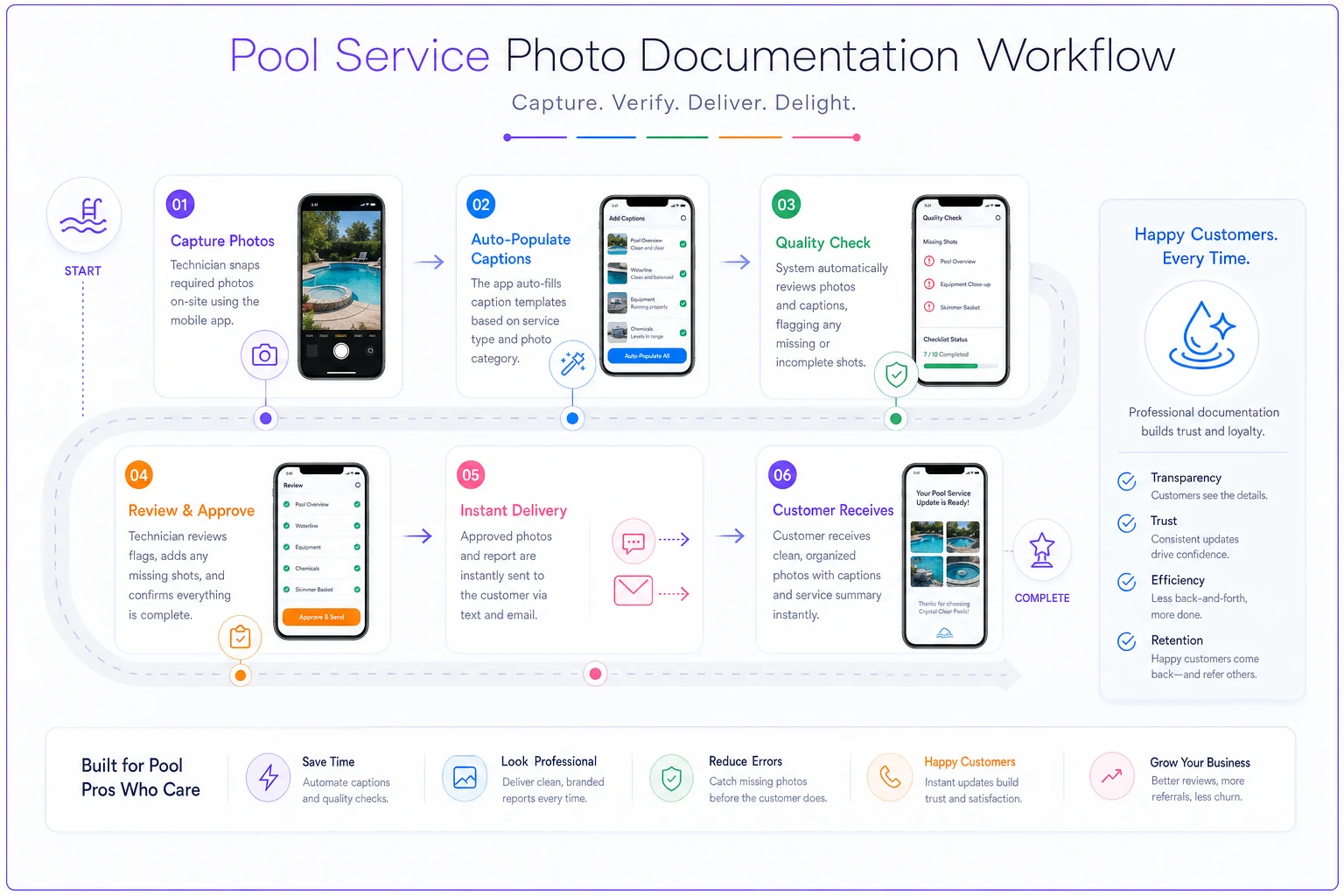
AI-powered features help maintain consistency. Automated quality checks flag missing photos before techs leave a property. Smart caption suggestions based on image recognition speed up documentation. Automated delivery schedules ensure photos reach customers within the optimal acceptance window.
The compound effect of consistent documentation
The real value compounds over time. After six months, you have visual history for every pool. You can show customers how their equipment degrades, when problems started, and why preventive maintenance matters. This transforms reactive service relationships into proactive partnerships.
Regular documentation reveals operational patterns invisible without visual data. Certain equipment brands fail consistently at 18 months. Algae problems cluster in specific neighborhoods due to irrigation runoff. These insights drive better inventory decisions, preventive maintenance scheduling, and customer education.
Companies excelling at pool service documentation treat it like any other critical metric. They track compliance rates, measure impact on repair acceptance, and continuously refine their requirements. In a business where trust drives customer retention, consistent photo documentation provides the transparency that builds lasting relationships.
Stop treating photos as optional nice-to-haves. Build mandatory shot lists, enforce caption standards, and deliver documentation while customers still care. The investment in training and systems pays back through higher repair acceptance, fewer disputes, and operational insights that drive growth.
Your techs might grumble initially about taking photos. But when they stop wasting time on disputes and start closing more repair work, they'll understand why documentation isn't overhead - it's operational armor that protects everyone involved.
Ready to elevate your pool service business?
Join hundreds of pool service professionals using Splshly to save time, optimize routes, and enhance customer satisfaction.