

Cloudy pool water creates pure operational chaos for pool service businesses. Customer calls about murky water, dispatcher sends a tech with test strips and shock, three hours later that same tech is calling back asking for pump seals. Meanwhile, another cloudy water call that needed five minutes of pH adjustment sits in the queue for tomorrow.
The difference between profitable and struggling pool operations isn't the quality of their techs or equipment. It's whether they treat cloudy water as one problem or recognize it as eight different problems wearing the same disguise.
Here's what really kills efficiency: sending wrong techs with wrong parts on wrong priority because nobody built proper diagnostic workflows. Experienced techs can tell filtration cloudiness from chemical imbalance just by looking. That knowledge disappears when they quit, and it definitely doesn't help dispatchers at 7 AM.
Why cloudy water destroys dispatch efficiency
Pool companies handle cloudy water with what we call "hope and pray" dispatch. Customer says cloudy, dispatcher schedules standard service, tech shows up with basic supplies. Sometimes they get lucky with simple chemistry. Usually they don't.
Take twelve cloudy water calls in a typical July week. Without diagnostic framework, you're looking at:
-
Four callbacks for missing parts
-
Three escalations to senior techs
-
Two angry customers whose "emergency" waited six hours
-
One preventable algae bloom from wrong treatment
That's forty percent of cloudy calls requiring double resources. With truck rolls costing $85-120 per visit, mis-dispatches add up brutally fast.
Symptoms overlap in ways that fool experienced techs without systematic testing. Failing DE filter looks identical to water balance issues for twenty-four hours. Dead algae from shock creates same milky appearance as calcium precipitation. Tech arrives thinking chemistry, treats for that, next morning the real problem got worse.
Phone patterns tell everything. Monday cloudy call, Tuesday tech adds clarifier and adjusts pH, Wednesday customer calls back worse, Thursday different tech finds torn filter grids, Friday repair scheduled. Saturday customer shops for new service company.
Building a cloudy pool water diagnostic flowchart that actually works
Real diagnostic flowchart starts with understanding "cloudy" describes twelve different pool conditions, each with distinct operational requirements. Framework needs to separate quick chemistry fixes from equipment problems before anyone drives anywhere.
Eliminate missed appointments and dispatch delays.
Splshly ensures every pool service is scheduled, tracked, and completed efficiently.
- Unified scheduling dashboard
- Automated customer reminders
- Technician route optimization
No credit card required
Phone intake questions that matter:
Initial diagnostic questions (dispatcher asks):
-
When did cloudiness start? (Sudden vs gradual means different things)
-
What color is the cloudy? (White, green-tinted, gray-brown)
-
Has anything changed recently? (New water, parties, equipment work)
-
Can you see the main drain? (Visibility depth shows severity)
-
Is pump running normally? (Sound changes indicate mechanical)
Five questions split calls into three dispatch categories: chemistry-likely (same-day, basic supplies), equipment-likely (next-day, parts prep), urgent-biological (immediate, full treatment).
Diagnostic tree branches on field observations:
Branch 1: White/Milky Cloudiness
-
Test pressure gauge first
-
If pressure >10 PSI over baseline → Filter issue (90% probability)
-
If pressure normal → Test calcium hardness
-
If CH >400ppm → Calcium precipitation (sequestrant treatment)
-
If CH normal → Test phosphates and TDS
Branch 2: Green-Tinted Cloudiness
-
Test chlorine and phosphate immediately
-
If FC <1ppm → Beginning algae bloom (shock priority)
-
If FC normal but phosphates >500ppb → Pre-algae conditions
-
If both normal → Check metals (especially after fills)
Branch 3: Brown/Gray Cloudiness
-
Check filter pressure, backwash first
-
If improves after backwash → Simple dirt/debris
-
If persists → Check sand channeling or torn grids
-
Secondary
Iron/manganese in source water
Each branch includes time estimates and parts requirements. Dispatcher knows before truck rolls whether this takes fifteen minutes or two hours.
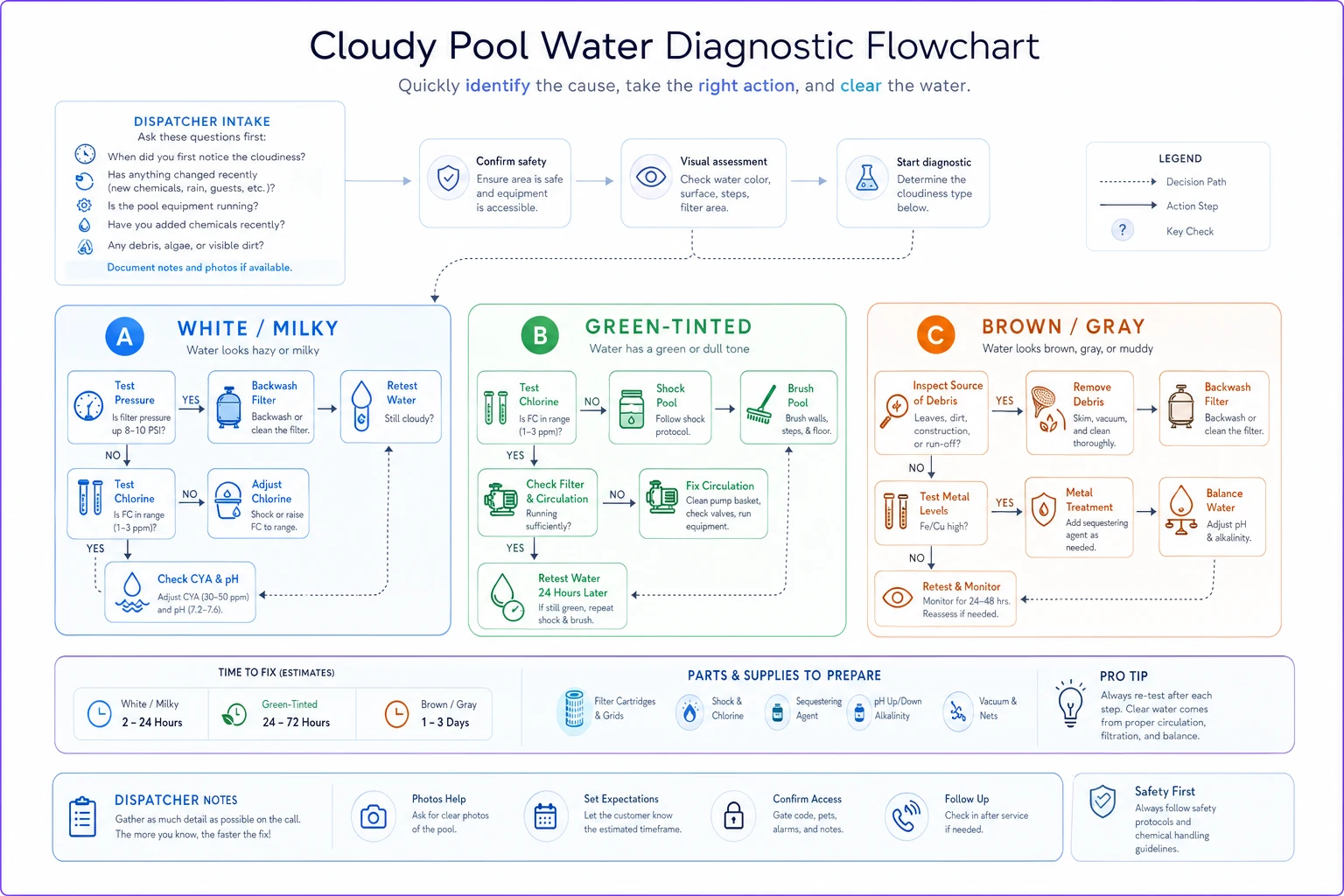
This flowchart visualizes the intake questions feeding into the branches and field tests.
Time-to-fix estimations and parts likelihood scoring
Operational magic happens when you attach realistic times and parts probabilities to each diagnosis. Vague service calls become predictable capacity planning.
Data across hundreds of routes typically shows:
| Diagnosis | Time to Fix | Parts Needed | Callback Risk |
|---|---|---|---|
| Simple chemistry imbalance | 20-30 mins | Chemicals only (on truck) | <5% |
| Filter cleaning needed | 45-60 mins | None (unless damaged) | 15% |
| Torn filter grids | 90-120 mins | DE grids (special order) | 40% if temporary fix |
| Pump seal failure | 60-90 mins | Seal kit (may have) | 25% |
| Algae bloom starting | 30-45 mins | Shock, algaecide (on truck) | 20% |
| Calcium precipitation | 30-40 mins | Sequestrant (special) | 30% |
| Sand filter channeling | 120-180 mins | New sand (delivery) | 60% if patched |
Parts likelihood changes everything about dispatch strategy. Torn grids and sand problems almost always need parts not on standard trucks. Schedule these as "check and advise" instead of repair visits - saves showing up unprepared.
Time estimates reveal hidden capacity drains. Tech handles six chemistry adjustments per morning or two filter replacements. Mixing without knowing which destroys daily routes.
Track actual fix times against estimates. After fifty calls, you'll have location-specific data. Phoenix routes might average ten minutes longer for filter work because of calcium buildup. Older neighborhood pools have 60% higher equipment failure rates. Data feeds back into dispatch decisions.
Corrective action prioritization matrix
Not all cloudy water carries equal business risk. Slightly hazy residential pool can wait. Cloudy commercial pool means health department shutdown. Diagnostic flowchart needs urgency scoring built in.
Priority scoring factors:
-
Pool type (commercial vs residential)
-
Visibility depth (safety threshold)
-
Day of week (weekend events coming)
-
Customer history (complaint tendency)
-
Weather forecast (rain dilution expected)
-
Chemical results (biological risk)
Three tiers work best:
Priority 1 (Same day, 4-hour window):
-
Commercial pools with <3 ft visibility
-
Confirmed algae with FC <0.5ppm
-
Any pool with event within 48 hours
-
Previous callback on same issue
Priority 2 (Next day, scheduled):
-
Residential with gradual onset
-
Suspected equipment issues
-
Chemistry imbalance without biological risk
-
Stable cloudiness >5 ft visibility
Priority 3 (Within 72 hours):
-
Minimal cloudiness, stable conditions
-
Post-treatment clearing period
-
Known construction dust/pollen
-
Customer traveling/pool not used
Corrective actions follow strict hierarchy based on diagnosis certainty. If phone diagnostic suggests 80% filter problems, prep for filter work but carry chemistry backup. If 50/50, send most experienced tech who handles either scenario.
Reducing mis-dispatch rates through pattern recognition
Best pool operations track cloudy water patterns obsessively. After few months, clear patterns emerge making dispatching almost predictive.
Common patterns:
-
Monday cloudiness after weekend parties
usually chemistry/bather load
-
Post-rain cloudiness
dilution requiring rebalance
-
August equipment failures
heat stress on seals, o-rings
-
New customer cloudiness
previous service neglect, needs full assessment
Phoenix company tracked cloudy calls for full season, discovered 75% of August calls in older neighborhoods involved equipment issues, while 80% of resort area calls were chemistry problems from high bather loads. They restructured truck stocking and tech assignments, cut callbacks by half.
Patterns reveal training gaps. If certain techs consistently diagnose cloudiness as chemistry when it's equipment, you've found skills development opportunity. Maybe they avoid checking pump seals, skip pressure readings to save time.
Weather patterns matter more than companies realize. Dust storm in Phoenix means tomorrow's cloudy calls are probably atmospheric. Cold snap in Florida causes calcium precipitation. Heavy Houston rain dilutes everything. Build these patterns into diagnostic assumptions.
Tech training and diagnostic discipline
Best diagnostic flowchart fails if techs don't follow it. Challenge is getting field techs to slow down for diagnosis when already behind schedule.
Training emphasizes five minutes proper diagnosis saves thirty minutes wrong treatment. Companies reduce this to simple mantra: "Test twice, treat once." Techs who guess at cloudiness causes make multiple trips, burn more time than they saved.
Diagnostic discipline shows in documentation. Techs writing "cloudy water - added clarifier" usually have high callback rates. Techs documenting "cloudy water - pressure 25psi (normal 15psi), visibility 4ft, chlorine 2.0ppm, recommended filter clean Friday" rarely get callbacks because they actually diagnosed.
Some operations build diagnostic accountability into pay structure. Callbacks within 72 hours for same issue trigger review. If original diagnosis was wrong or incomplete, affects performance metrics. Seems harsh but quickly builds thorough field diagnosis culture.
Training progression:
-
Week 1-2
Shadow experienced tech, observe diagnosis
-
Week 3-4
Diagnose with supervision, compare conclusions
-
Week 5-6
Solo diagnosis with photo documentation for review
-
Week 7-8
Full autonomy with callback tracking
Photo documentation accelerates learning.
Techs photograph water, test results, equipment readings, review with supervisors later. Photos become training library for new techs studying cloudiness patterns.
Integrating diagnostics with dispatch software
Pool service dispatch still runs on whiteboards and phone calls, destroying diagnostic consistency. When dispatcher juggles twelve callbacks while trying to remember which tech checks channeled sand filters, mistakes multiply.
Operational software changes this completely. Diagnostic flowchart becomes guided workflow in system. Dispatcher enters phone responses, system suggests likely diagnosis, appropriate tech, required supplies. No memory required, no expertise needed at dispatch desk.
Real improvement comes from historical tracking. System learns 147 Main Street had three filter-related cloudy calls in eighteen months - time to recommend replacement. Knows Tech A has 90% success on equipment diagnoses while Tech B excels at chemistry. Dispatch becomes data-driven instead of gut-feel.
Integration between diagnosis and inventory prevents worst sin: arriving without parts. When diagnostic tree shows 70% likelihood needing pump seal, system checks truck inventory, alerts if missing part. Simple check, massive efficiency gain.
Automated communication reduces phone chaos. Customer reports cloudy water through app, uploads photo, system runs initial diagnosis, schedules appropriate service, sends confirmation with realistic expectations. Customer knows whether to expect quick fix or major repair before tech arrives.
Data accumulation over time shows where AI-enhanced platforms excel. They identify patterns humans miss - correlation between chemical brands and precipitation issues, relationship between pool party frequency and equipment failures. Insights continuously refine diagnostic accuracy.
Measuring diagnostic success and continuous improvement
Most pool services measure wrong things about cloudy water calls. Track total service time but not diagnosis accuracy. Count callbacks but don't analyze why first visit failed.
Critical metrics for diagnostic effectiveness:
First-call resolution rate: Percentage of cloudy issues resolved on first visit. Industry average around 65%, companies with solid diagnostics hit 85% or higher.
Parts preparedness score: How often tech had necessary parts on truck? Should climb steadily as pattern recognition improves.
Diagnosis accuracy: Compare initial phone diagnosis to actual field finding. If these align less than 70%, phone intake needs work.
Time variance: Actual fix time versus estimated. Consistently off by more than 30% means estimates need recalibration.
Customer satisfaction by diagnosis type: Chemistry fixes might score 4.5 stars while equipment failures score 3.8. Shows where to improve customer communication.
Monthly reviews examine every mis-diagnosis. Not to punish but understand. Training issue? Rare condition? Bad phone intake? Each failure teaches diagnostic framework blind spots.
Continuous improvement cycle: collect data on all cloudy calls, identify failure patterns, adjust diagnostic tree or training, test changes on call subset, roll out improvements system-wide, repeat monthly. Small iterations beat massive overhauls.
Companies run "diagnosis accuracy contests" where techs compete on first-call resolution rates. Winners get recognition, bonuses, preferred routes. Gamification drives engagement with diagnostic process while surfacing best practices from top performers.
Conclusion: From reactive scrambling to predictive operations
Cloudy water calls will always exist in pool service. Question is whether they're predictable revenue or chaotic resource drains. Proper diagnostic flowchart transforms these calls from gambling to science.
Companies crushing pool service aren't necessarily those with most experienced techs or newest equipment. They've systematized knowledge into repeatable processes. Dispatchers don't need twenty years field experience for good routing decisions. New techs don't fumble diagnosis because they have clear decision trees. Customers don't suffer multiple visits because right tech showed up with right parts first time.
Building diagnostic capability isn't massive project. Start with next ten cloudy calls. Document phone intake, initial diagnosis, actual finding, outcome. Look for patterns. Build simple if-then rules. Test on next ten calls. Within a month, you'll have working framework cutting callbacks noticeably.
Real win comes when diagnostic discipline spreads beyond cloudy water. Green pool calls, equipment noise complaints, chemistry imbalances - all benefit from structured diagnosis. Eventually entire operation runs on predictable patterns instead of reactive scrambling.
Pool service companies thriving in five years won't be those with most trucks or lowest prices. They'll be ones who turned operational chaos into systematic efficiency. Cloudy pool diagnostic flowchart might seem like small step, but it's exactly the foundational process separating professional operations from guys with trucks.
Your techs already know most diagnostic information. Question is whether knowledge lives in their heads or operational systems. One approach scales. The other doesn't.
Ready to elevate your pool service business?
Join hundreds of pool service professionals using Splshly to save time, optimize routes, and enhance customer satisfaction.