

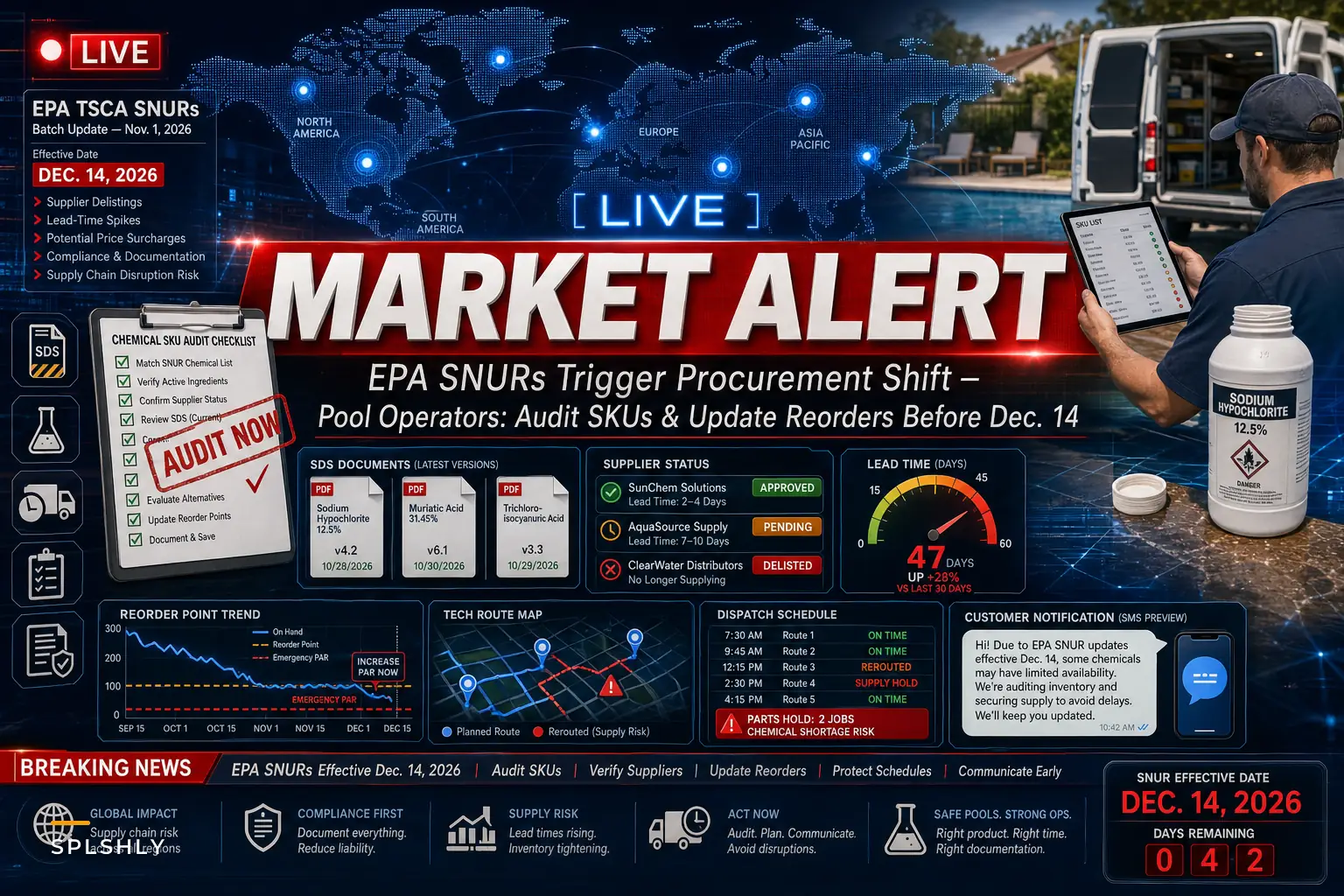

Most pool-service owners aren't reading the Federal Register on a Tuesday night. Fair enough. But the EPA just finalized a batch of Significant New Use Rules (SNURs) covering 19 chemical substances — Batch 26-1 — and the ripple from that lands squarely on anyone buying specialty chemicals, additives, or formulated products through a distributor. The rule was published mid-October, and industry write-ups started circulating around Oct 19–30. According to a Foresight summary of the final rule, the SNURs require 90 days' advance notice for any designated "new use" and take effect December 14, 2026.
The part that matters for you: SNURs don't ban anything you're currently using. What they do is add a regulatory gate upstream — at the manufacturer, importer, and processor level. And upstream friction has a way of showing up downstream as "sorry, that product is backordered" or "the formula changed, here's the new SDS." You don't get a warning letter. You get a short-ship on your next chemical order and a tech standing at a commercial pool with the wrong product on the truck.
This article isn't about the legal mechanics. It's about what the rule exposes in how pool-service companies run their chemical procurement — and the specific operational moves worth making before mid-December.
What actually changes for you (and what doesn't)
A SNUR does not mean a chemical disappears. It means that if a manufacturer or importer wants to use a covered substance in a new way not already accounted for, they have to notify EPA 90 days ahead. The EPA's new chemicals program page lays out the publication and effective-date mechanics.
So why does this matter if you're just buying cal-hypo, cyanuric acid, algaecides, clarifiers, and specialty enzyme products?
-
Suppliers get cautious. Some pull or pause SKUs rather than deal with notification uncertainty, especially on low-volume specialty items.
-
Reformulations get pushed out. A product you know by name comes back with a slightly different composition — and a new SDS.
-
Lead times stretch. Even products unaffected by the rule can get caught in the backlog when a distributor's supplier is sorting out their own compliance.
The chemicals most exposed are rarely your bulk commodities. It's the niche stuff — phosphate removers, specialty clarifiers, enzyme treatments, certain metal sequestrants, and any "pro only" formulated blend where a single reformulated input changes everything.
The real problem this surfaces: most chemical procurement runs on familiarity, not data
A lot of pool-service operations buy chemicals the same way they did five years ago — by product name, by habit, from one or two distributors, with reorder points living in someone's head or a tech's gut feel.
Eliminate missed appointments and dispatch delays.
Splshly ensures every pool service is scheduled, tracked, and completed efficiently.
- Unified scheduling dashboard
- Automated customer reminders
- Technician route optimization
No credit card required
That works fine until the product name stops meaning the same thing. When a SNUR-driven reformulation changes an SDS, "order two cases of the usual clarifier" quietly becomes "order two cases of something with a different active concentration, different dilution rate, and different handling notes." Nobody flagged it. The tech used it like the old one. Now you've got a commercial account with a cloudy pool and a callback.
What tends to separate the operations that absorb regulatory bumps without drama from those that don't isn't having the best lawyers — it's tracking chemicals by spec and function, not just brand name. Knowing that Product A is "a 10% polymer clarifier at X dose rate" means that when it's substituted, you can evaluate the replacement against the spec instead of blindly trusting the label matches.
The SNUR isn't the crisis. The crisis is that your procurement system can't tell the difference between the product you ordered and the product that showed up.
A realistic scenario of how this bites
Picture a mid-size operator — roughly 480 accounts, a mix of residential and a handful of commercial sites, five trucks. Two primary distributors, with heavy reliance on one for specialty products.
Late November: their go-to phosphate remover gets short-shipped. The distributor subs a "comparable" product. Nobody on the ops side catches the dose-rate difference — the new one is more concentrated. Techs apply it at the old volume across maybe 30–40 pools over two weeks. Some come back with over-treatment issues, a few metal-staining complaints on older plaster, and the commercial HOA account files a complaint.
Rough cost of that stumble: a couple weeks of callbacks, 15–20 return trips at loaded cost, plus the soft cost of one annoyed commercial client threatening to rebid. Somewhere in the $2k–$3k range in direct cost, and a relationship you now have to repair. None of it was the chemical's fault. It was a procurement blind spot.
That's the whole point. The dollar damage from regulatory friction almost never comes from the rule itself — it comes from the substitution nobody verified.
What to do before December 14 — a prioritized sequence
Don't try to boil the ocean. Work it in order.
-
Pull your full chemical SKU list and flag the specialty items. Commodities (chlorine, acid, salt) are low risk. The risk lives in formulated blends, clarifiers, enzymes, sequestrants, and anything "professional grade" from a single source. Mark those.
-
Call your distributor rep — specifically about these SKUs. Ask two direct questions: "Are any of these being reformulated or discontinued before year-end?" and "If a product is subbed, what's your notification process to me?" Write down the answers. Reps rotate; a documented answer protects you.
-
Capture the current SDS for each flagged product now. Date it. This gives you a baseline so that if a reformulated version arrives in January, you can compare active-ingredient percentages and dose rates side by side instead of guessing.
-
Set a substitution rule, in writing. Keep it simple
no substituted chemical goes on a truck until someone verifies the active concentration and dose rate against the original spec. This one rule prevents the scenario above.
-
Pre-buy a reasonable buffer on your highest-risk, slowest-moving specialty items — but don't hoard. Most have shelf-life limits, and over-ordering ties up cash and storage. A 60–90 day buffer on genuinely at-risk SKUs is reasonable. Six months of enzyme product that expires isn't.
-
Adjust reorder points on flagged SKUs upward temporarily. If a product normally has a 5-day lead time and you reorder at a 2-week supply, bump that trigger. You're buying schedule insurance for the uncertain window.
-
Brief your techs on the substitution rule and SDS changes. Thirty seconds at a morning huddle: "If a chemical looks different or the label's changed, flag it before you dose."
Here's a quick visual workflow to follow when a supplier notifies you of a potential change.
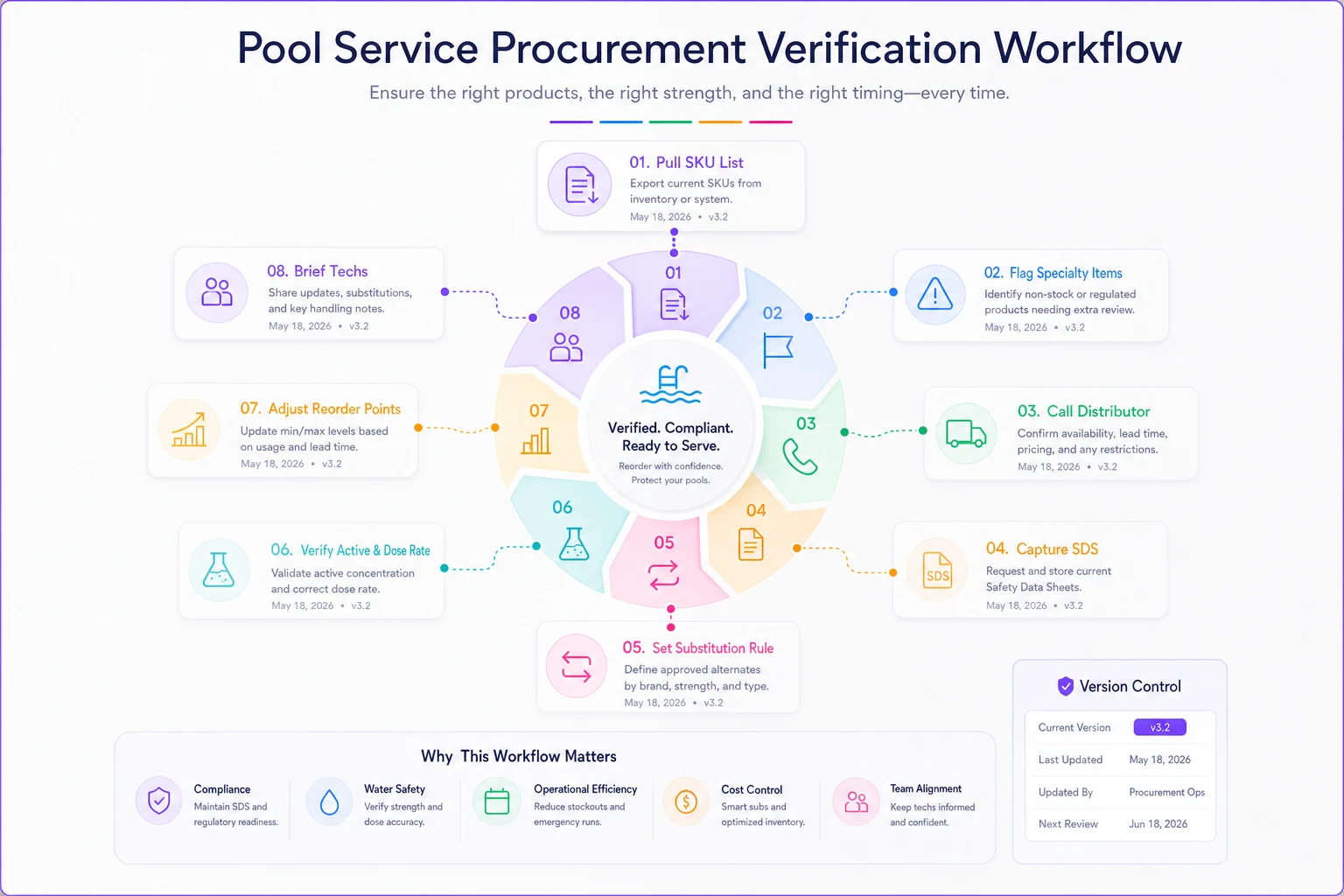
Date and save each SDS next to the SKU so you can quickly compare versions.
Don't try to boil the ocean. Work it in order.
A quick comparison: habit-based vs. spec-based procurement
The difference between operations that get caught flat and operations that don't usually comes down to how they define what they're buying.
| Dimension | Habit-based procurement | Spec-based procurement |
|---|---|---|
| How products are tracked | By brand name / "the usual" | By active ingredient, concentration, function |
| Reaction to a substitution | Tech uses it as-is | Verified against original spec first |
| SDS handling | Filed somewhere, rarely checked | Baselined and compared on change |
| Reorder points | Gut feel or static number | Tied to lead time + risk tier |
| Exposure to regulatory friction | High — invisible until a callback | Low — caught at receiving |
You don't need enterprise software to move toward the right column. You need a list, a baseline, and one verification rule. The gap between the two columns is mostly discipline, not budget.
Where this connects to your broader parts-and-chemical supply strategy
The SNUR is a single event, but the vulnerability it reveals is permanent. Chemical and parts supply chains get disrupted for a dozen reasons — regulatory changes, raw-material shortages, a supplier plant going down, freight issues. The operators who stay calm through all of it have already built reorder triggers, supplier SLAs, and substitution rules into how they work.
If you haven't formalized that side of your business, this is a decent forcing function to start. The same habits that protect you from a parts delay protect you from a chemical delay — documented lead times, backup suppliers, clear reorder points, and a receiving check that catches substitutions. The full framework for this is in the procurement playbook for pool parts and reorder triggers, and the chemical side maps onto it almost one-to-one.
Treat chemicals as a procurement category with the same rigor you'd apply to a pump motor or filter cartridge — not as "stuff we grab when we're low."
Where a system helps (and where it doesn't)
Honestly, you don't need a platform to survive December 14. A spreadsheet and a disciplined receiving process will get you through.
Where software earns its place is when this stops being a one-time scramble and becomes a repeatable process. If your operational platform holds each chemical's spec, baseline SDS, lead time, reorder trigger, and preferred/backup supplier in one record — and flags when a received product's details don't match the expected spec — then the verification step stops depending on whether a specific person remembered to check. The substitution rule enforces itself at receiving instead of hoping a busy tech catches it at 6:45 a.m.
That's the quiet value: not replacing your judgment, but making sure the right check happens every time, even on the chaotic weeks. For a five-truck operation running hundreds of accounts, that's the difference between a smooth substitution and a two-week callback cluster.
When to act aggressively vs. when to stay calm
Act aggressively if: you run commercial accounts with higher liability and tighter compliance expectations, you source specialty chemicals from a single distributor, or you've had SDS-related confusion in the past. These operations have the most to lose from a silent substitution.
Stay measured if: you're mostly residential, buy commodity chemicals, and have two or more supplier relationships. Your exposure is real but modest — a baseline SDS capture and a substitution rule covers most of your risk without pre-buying anything.
Don't over-rotate if: your instinct is to stockpile. Over-ordering short-shelf-life products to dodge a lead-time risk usually costs more in waste and tied-up cash than the disruption would have. The republished list of covered substances and implementation notes from GPC Gateway is worth skimming to confirm whether anything you actually buy is in scope before you start buffering stock.
The EPA rule is a nudge, not an emergency. But it's the kind of nudge that quietly separates operations with real procurement discipline from those running on habit. The companies that get hurt won't be the ones who used a covered chemical — they'll be the ones who couldn't tell when a substituted product landed on their trucks.
Spend an hour this week pulling your specialty SKU list, baselining the SDS sheets, and writing down one substitution rule. That's most of the protection right there. Everything else — the buffer stock, the reorder adjustments, the supplier conversations — is just tightening a system that'll keep paying off long after December 14 comes and goes.
Ready to elevate your pool service business?
Join hundreds of pool service professionals using Splshly to save time, optimize routes, and enhance customer satisfaction.