



Walk into most pool service storage areas and you'll find the same quiet problem sitting in the corner: a stack of cal hypo buckets with crusted lids, a couple of DE bags that got damp two winters ago, and a half-case of algaecide nobody can remember buying. None of it is scheduled for use. None of it is scheduled for disposal. It just sits there, degrading, taking up rack space, and quietly turning into a liability.
A chemical obsolescence policy for pool service isn't about being tidy. It's about not dosing a customer's pool with calcium hypochlorite that's lost 20% of its available chlorine, not getting written up during a county inspection, and not eating the cost of product you could have returned to the vendor if someone had caught it in time. This piece is narrowly about that: shelf-life rules, FIFO rotation that actually survives contact with a busy season, vendor return windows, and a quarterly purge SOP with reconciliation templates you can hand to a tech.
Why pool chemicals go obsolete faster than owners think
Degradation isn't linear, and that's what trips people up. Cal hypo doesn't gently fade — it holds strength for a while, then drops off a cliff once it's been through a few heat cycles or picked up moisture. Trichlor tabs are more forgiving but still gas off and lose binder integrity. Liquid chlorine is the worst offender nobody plans for: it can lose a meaningful chunk of its strength in a matter of weeks in a hot truck, and product sitting since early spring is basically expensive water by summer.
The pattern across operations is almost always the same. Obsolescence doesn't come from buying bad product. It comes from three things stacking up:
-
Over-ordering during a panic (storm prep, a supplier price jump, a "buy 10 get the 11th free" deal)
-
No physical rotation, so new stock gets stacked in front of old stock
-
No scheduled date to actually look at the shelf and make a keep/return/dispose call
The third one is the real killer. Most shops have a vague intention to "keep an eye on it." Intention isn't a process. A bucket doesn't announce that it's expired — it just quietly underperforms until a tech is standing at a green pool wondering why the shock isn't working.
The shelf-life rules worth writing down
You don't need a chemistry degree here. You need a short reference card that lives wherever chemicals are stored and on every truck, so nobody's guessing. Actual shelf life depends on storage conditions, but these are the working windows most operators should build their policy around.
Eliminate missed appointments and dispatch delays.
Splshly ensures every pool service is scheduled, tracked, and completed efficiently.
- Unified scheduling dashboard
- Automated customer reminders
- Technician route optimization
No credit card required
| Chemical | Practical shelf life (sealed, proper storage) | Degrades fastest when | Return-friendly? |
|---|---|---|---|
| Liquid chlorine (sodium hypochlorite) | 2–4 months usable | Heat + light exposure | Rarely — vendors won't take it back |
| Cal hypo (granular/tabs) | 1–2 years | Moisture, humidity, heat cycling | Sometimes, if sealed |
| Trichlor tabs | 2–3 years | Broken seal, humidity | Often, if unopened |
| Dichlor granular | 2–3 years | Moisture | Often, if unopened |
| Muriatic acid | 3+ years | Container degradation, venting | Sometimes |
| DE powder | Indefinite if dry | Any water contact | Yes, if dry and sealed |
| Algaecide / specialty (metal sequestrants, enzymes) | 1–3 years, varies widely | Freezing, separation | Check label + vendor |
The insight most owners miss: liquid chlorine should essentially never be in your obsolescence pile, because it should never be sitting as inventory in the first place. If it's aging out, your ordering cadence is the problem, not your storage. Treat it as a just-in-time item and the single biggest source of chemical waste disappears.
FIFO that actually survives July
Everybody nods along about First-In-First-Out. Almost nobody runs it properly. The reason is physical: during peak season, the delivery drops pallets, your tech is loading a truck at 6:40am in a hurry, and the path of least resistance is grabbing whatever's closest. New stock lands in front. Old stock gets buried. FIFO quietly becomes LIFO, and the buried stuff is what expires.
-
Date everything on arrival. Not the manufacture date — a big, fat received date written in marker on the container the moment it comes off the truck. Techs read your handwriting faster than a printed lot code.
-
Load from one side, restock from the other. If your shelving lets you pull from the front and add from the back, FIFO happens automatically. If you only have one access side, physically slide old stock forward every time new stock arrives. Yes, it's annoying. It's cheaper than throwing product away.
-
Color-code by quarter. A red dot for Q1 arrivals, blue for Q2, and so on. A tech can see across the whole rack which stuff needs to move first without reading a single date.
-
Keep truck stock on its own FIFO loop. Chemicals riding around in a hot truck age faster than warehouse stock. Apply the same oldest-first rule there too, and don't let a half-used bucket live on a truck for a month. This ties directly into how you build your tiered truck stocking plan and seasonal PARs — rotation and stocking levels have to be designed together, not bolted on afterward.
Use a thick black marker for received dates on bucket lids so techs can read them quickly during early-morning loadouts.
The mistake that comes up constantly: shops set up perfect FIFO shelving in the off-season and then abandon it the week things get busy — which is exactly the week it matters most. FIFO isn't a shelving project. It's a loading-habit project.
Vendor return options — the window you're probably missing
There's money most operators leave on the table. A lot of pool chemical distributors will take back unopened, undamaged, in-date product — especially dry goods — if you catch it inside their return window. That window is usually 30–90 days from purchase, sometimes longer for established accounts. The problem is nobody's tracking purchase dates against those windows, so by the time you notice you over-ordered, the return option is already gone.
To actually use vendor returns, you need three pieces of information captured at purchase:
-
Purchase date (this starts the return clock)
-
Return window length per vendor (ask your rep and write it down — it varies)
-
Restocking fee, if any (some charge 15–25%, which still beats a total loss)
The practical rule: during your quarterly purge, anything slow-moving that's still inside a return window and still in date goes into a "return candidate" pile before it goes into a "dispose" pile. Owners skip this step because returns feel like a hassle. But returning $600 of unopened trichlor you'll never use beats disposing of it and buying fresh later. Build return-window tracking into how you coordinate with suppliers overall — it fits naturally alongside the reorder logic in an integrated inventory strategy across warehouse, trucks and vendors.
When a return isn't worth it
Returns make sense for sealed dry goods inside the window with low or no restocking fees. They stop making sense when:
-
The restocking fee is higher than your realistic chance of using the product
-
Shipping costs more than the product's value
-
It's liquid chlorine or anything opened — plan to use or dispose
Don't turn returns into a project that costs more labor than it saves. The 80/20 here is catching the occasional over-order of expensive dry chemistry before the window closes.
The quarterly purge SOP
A purge isn't a spring-cleaning mood. It's a scheduled, repeatable procedure with a date, an owner, and a paper trail. Four times a year — align it with your season shifts if you can — somebody walks the entire chemical inventory and makes a decision on every item. Keep, return, or dispose. No "maybe" pile.
The SOP as a repeatable sequence:
-
Block the date. Put all four quarterly purge dates on the calendar at the start of the year. Assign one person as the owner — usually a lead tech or the owner — so it doesn't become everyone's job and therefore nobody's.
-
Pull the full inventory list. Walk every shelf, every truck, every staging area. Nothing gets skipped because it's "obviously fine."
-
Decide per item. For each container
check received/purchase date against shelf life, check seal integrity, check for moisture or separation. Mark it Keep, Return, or Dispose.
-
Route the Return pile. Cross-check against vendor return windows. Anything eligible gets photographed, logged, and staged for pickup or shipment.
-
Document the Dispose pile. Record what's being disposed, quantity, and reason. This is your regulatory paper trail. Follow proper disposal for each chemical class — don't improvise, and don't mix.
-
Reconcile. Update your inventory counts to match what's physically left. This is the step everyone skips, and it's why system counts drift from reality.
-
Log the dollar value lost. Write down the cost of what you disposed — not to feel bad, but to spot the ordering patterns causing it.
The disposal step is where safety and regulatory risk live. Improper storage and disposal of pool chemicals is exactly the kind of thing that turns an inspection into a citation, and it overlaps heavily with your handling procedures. If you haven't already, your purge SOP should reference the same handling discipline laid out in your mobile SOP for safe storage, transport and spill response. A purge involves moving a lot of aging, sometimes compromised containers at once — which is precisely when spills and incompatible-mixing accidents happen.
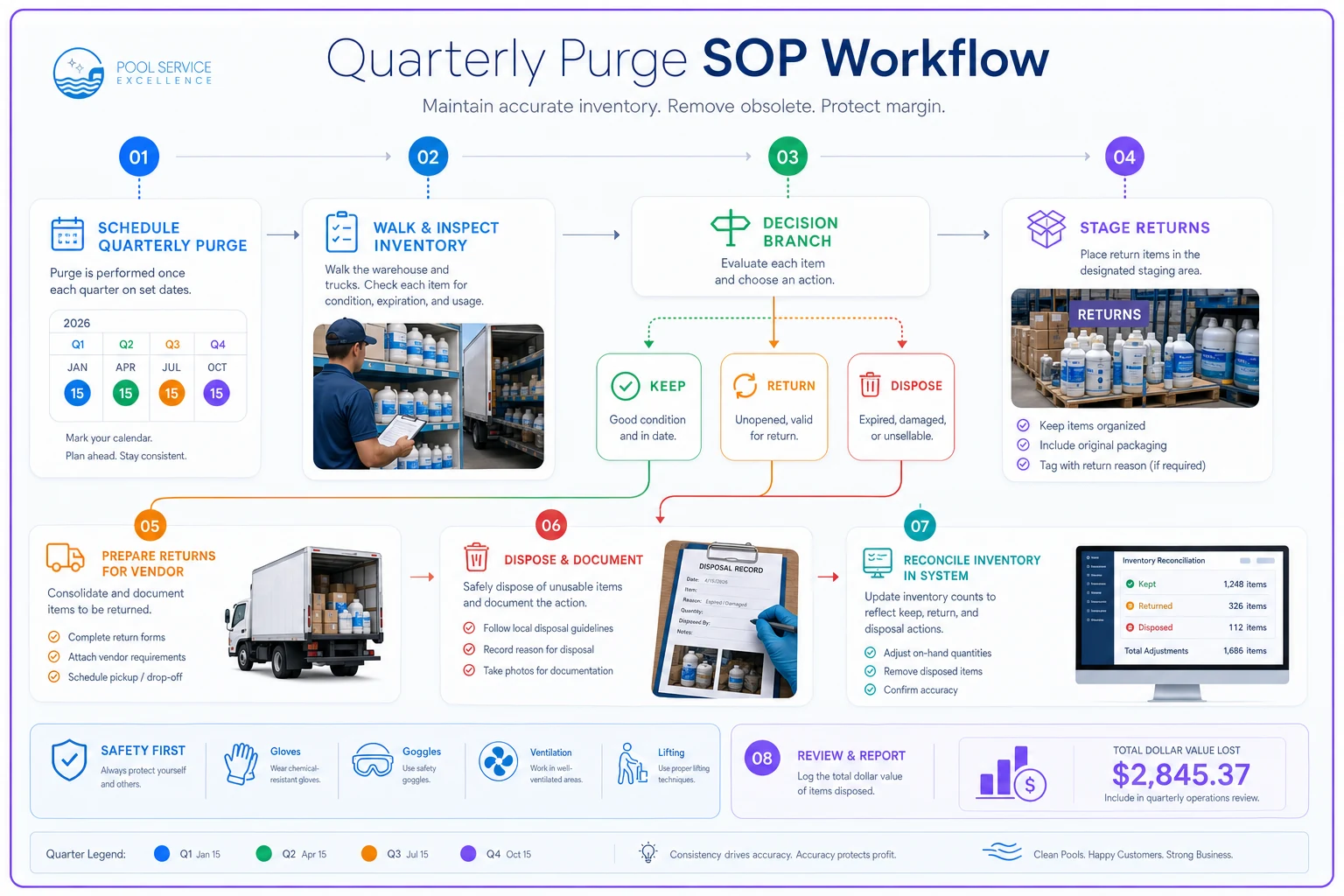
A simple visual makes the SOP easier to follow for techs during a busy purge.
Reconciliation templates tied to risk
The reconciliation piece is what connects obsolescence to actual regulatory and safety exposure. Two simple logs do most of the work.
Purge reconciliation log — one row per item handled during the purge:
-
Product name & type
-
Received/purchase date
-
Quantity on hand
-
Decision (Keep / Return / Dispose)
-
If disposed
disposal method & date
-
If returned
vendor, RMA/reference, date staged
-
Dollar value (returned or lost)
-
Initials of person making the call
Safety/regulatory cross-check — a short checklist attached to every purge:
-
[ ] All disposed chemicals handled per their SDS / disposal requirements
-
[ ] No incompatible chemicals stored or staged together during the purge
-
[ ] Damaged/leaking containers isolated and documented with photos
-
[ ] Storage area ventilation and containment verified after re-shelving
-
[ ] Disposal records filed and dated for inspection readiness
-
[ ] Inventory counts in your system updated to match physical reality
The value of the dollar column isn't bookkeeping. Over three or four quarters, it tells you a story. If you're consistently disposing of the same algaecide or the same oversized acid order, your ordering triggers are miscalibrated, not your storage. Obsolescence data is really ordering feedback in disguise.
A real scenario: the $2,800 lesson
A mid-size residential operation running about six trucks had no formal purge and a loose "FIFO when we remember" approach. Going into a slower season, the owner finally walked the storage room properly and counted it up: roughly $2,800 of chemistry that was either expired or too degraded to trust. A chunk of it — maybe $900 of unopened trichlor and dichlor — had passed its vendor return window by a few weeks. Everything else got disposed.
They put a quarterly purge on the calendar, started writing received dates in marker on arrival, and moved liquid chlorine to a strict just-in-time cadence instead of bulk-buying it. Over the following year, their disposal pile dropped to a few hundred dollars a quarter, and most of what did age out got caught inside the return window and sent back. The bigger win wasn't the recovered product — it was the near-misses they avoided, where techs would have dosed pools with cal hypo that had quietly lost a fifth of its strength. The callbacks that would've generated don't show up in a spreadsheet, but every operator knows what they cost.
Who should not over-engineer this
If you're a one-truck operation buying small quantities and turning chemicals over in weeks, you don't need color-coded quarters and a seven-step SOP. A received-date marker, a just-in-time habit on liquid chlorine, and a quick monthly shelf glance covers you. The full quarterly system earns its keep once you're running multiple trucks, holding real inventory, or buying in bulk — basically, once your storage area is big enough that stock can hide in it.
The owners who get burned are the ones in the middle: enough volume to accumulate obsolescence, not enough process to catch it. If product can sit somewhere in your operation long enough to expire without anyone deciding its fate, you've already got the problem — you just haven't counted it yet.
Bringing it together
Chemical obsolescence is one of those costs that never shows up as a line item, so it never gets managed. It hides inside your chemical spend as product you paid for twice — once to buy, once to dispose of — plus the harder-to-see cost of underdosed pools and the regulatory exposure of storing and dumping degraded chemistry without a paper trail.
The fix isn't complicated. Written shelf-life windows so nobody guesses. FIFO that's built into how trucks get loaded, not just how shelves are arranged. Vendor return windows tracked from the purchase date so you can send product back before it's a loss. And a quarterly purge with a reconciliation log that turns every expired bucket into feedback about your ordering. Do those four things on a calendar instead of a whim, and the stack of crusted buckets in the corner stops reappearing.
Ready to elevate your pool service business?
Join hundreds of pool service professionals using Splshly to save time, optimize routes, and enhance customer satisfaction.