

Most pool service inventory problems don't start at the shelf. They start at the boundaries—the handoffs between your warehouse, your trucks, and your vendors. A tech runs out of a Pentair replacement cartridge on a Tuesday. The warehouse "had one" but it was already promised to another job. The vendor could ship it, but not until Thursday, and only if you hit the $400 free-freight minimum. So the customer waits, the truck makes a second trip, and somewhere in the back office cash is sitting frozen in a shelf full of parts nobody's touched since last October.
That's the real problem with an integrated inventory strategy for pool service: it's not one shelf, one truck, or one supplier. It's three systems that have to talk to each other, and most operations treat them like separate universes. This post is about how the whole thing fits together—and where the seams tear when you grow.
Why "just order more" quietly bankrupts your working capital
The instinct when you get burned on a stockout is to overstock everything. Feels safe. It's also the fastest way to bury cash in slow-moving inventory that ties up your line of credit and gives you nothing back.
Stockouts and working capital pull in opposite directions—nobody explains this clearly enough. Reduce stockouts by hoarding, and your cash goes to sleep on shelves. Run lean to free up cash, and you get stranded techs and angry customers. The whole point of an integrated approach is to stop treating that as a single dial you crank up or down, and start treating different parts differently based on what they actually cost you when they run out. That's where seasonally-adjusted tiering comes in, and it's the foundation of everything else here.
Tier your inventory by consequence, not by category
Most owners sort parts by type: chemicals, filters, pumps, fittings. That tells you nothing about how to stock them. A better cut is by what happens when you don't have it. Break it into three tiers.
Eliminate missed appointments and dispatch delays.
Splshly ensures every pool service is scheduled, tracked, and completed efficiently.
- Unified scheduling dashboard
- Automated customer reminders
- Technician route optimization
No credit card required
| Tier | What it is | Stockout consequence | Stock posture |
|---|---|---|---|
| Critical | Parts that stop a job cold or risk a safety/health issue (specific pump motors, key valve seals, spa heater igniters) | Truck roll wasted, callback, possible warranty exposure | Buffer stock always on hand, redundant vendor sourcing |
| Seasonal | Demand swings hard with the calendar (opening kits, algaecides, cartridges, heater parts) | Missed revenue during peak, lost upsell window | PAR levels that ramp up before season, drop after |
| Consumable | High-turn, low-cost, predictable (chlorine tabs, common O-rings, test reagents) | Minor—usually easy to source locally | Simple reorder points, buy in bulk when cheap |
The mistake is stocking consumables like they're critical (money frozen for no reason) and treating critical parts like consumables (constant stockouts on the stuff that actually costs you jobs). A $6 O-ring stockout is an annoyance. A missing $180 pump seal on a Saturday emergency is a lost customer and a bad review.
The "seasonally-adjusted" part matters more in pool service than almost any other trade. A cartridge that's Tier 2 seasonal in May is basically dead weight in December. If your PAR levels don't move with the calendar, you're either overstocked half the year or stocked out the other half. Your tiers should breathe with the season, not sit static.
The truck is just a mobile warehouse—treat it like one
There's a coordination gap that shows up in almost every growing operation: the warehouse and the trucks run on completely separate mental models. The warehouse thinks in monthly reorder cycles. The trucks think in "what do I have in the bin right now." Nobody reconciles the two, so parts get double-counted or disappear somewhere between the two.
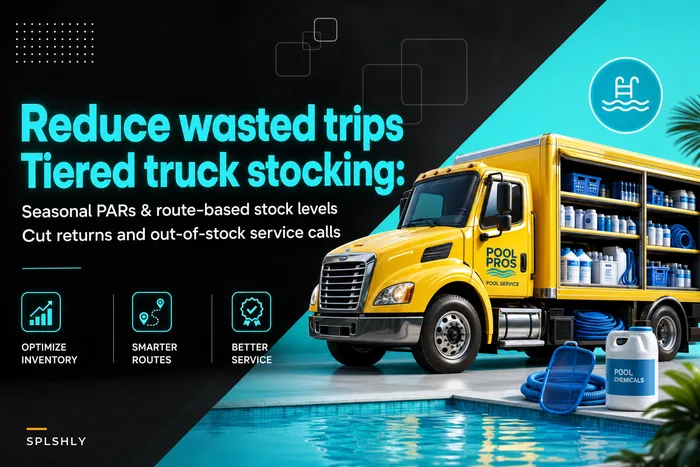
Your trucks should have their own tiered PAR levels that feed off the warehouse. When a tech pulls the last spare cartridge from the truck, that draw should trigger a restock from the warehouse—and if the warehouse dips below its own buffer, that triggers a vendor order. Each layer replenishes the layer below it. We went deep on truck-side stocking in the tiered truck stocking plan and seasonal PARs piece, and it pairs directly with what we're covering here—the truck is the last mile of the same inventory chain.
Reconcile truck pulls weekly under one owner so "just grab a few extra" doesn't become an invisible drain.
The failure pattern to watch: trucks quietly becoming their own uncontrolled inventory. In practice, this usually happens when techs "just grab a few extra" off the warehouse shelf so they don't get caught short. Multiply that across five trucks and you've got thousands of dollars of inventory rolling around in vans with zero visibility. You think you're understocked at the warehouse; you're actually just blind to what's on wheels.
Build an SLA matrix so replenishment isn't guesswork
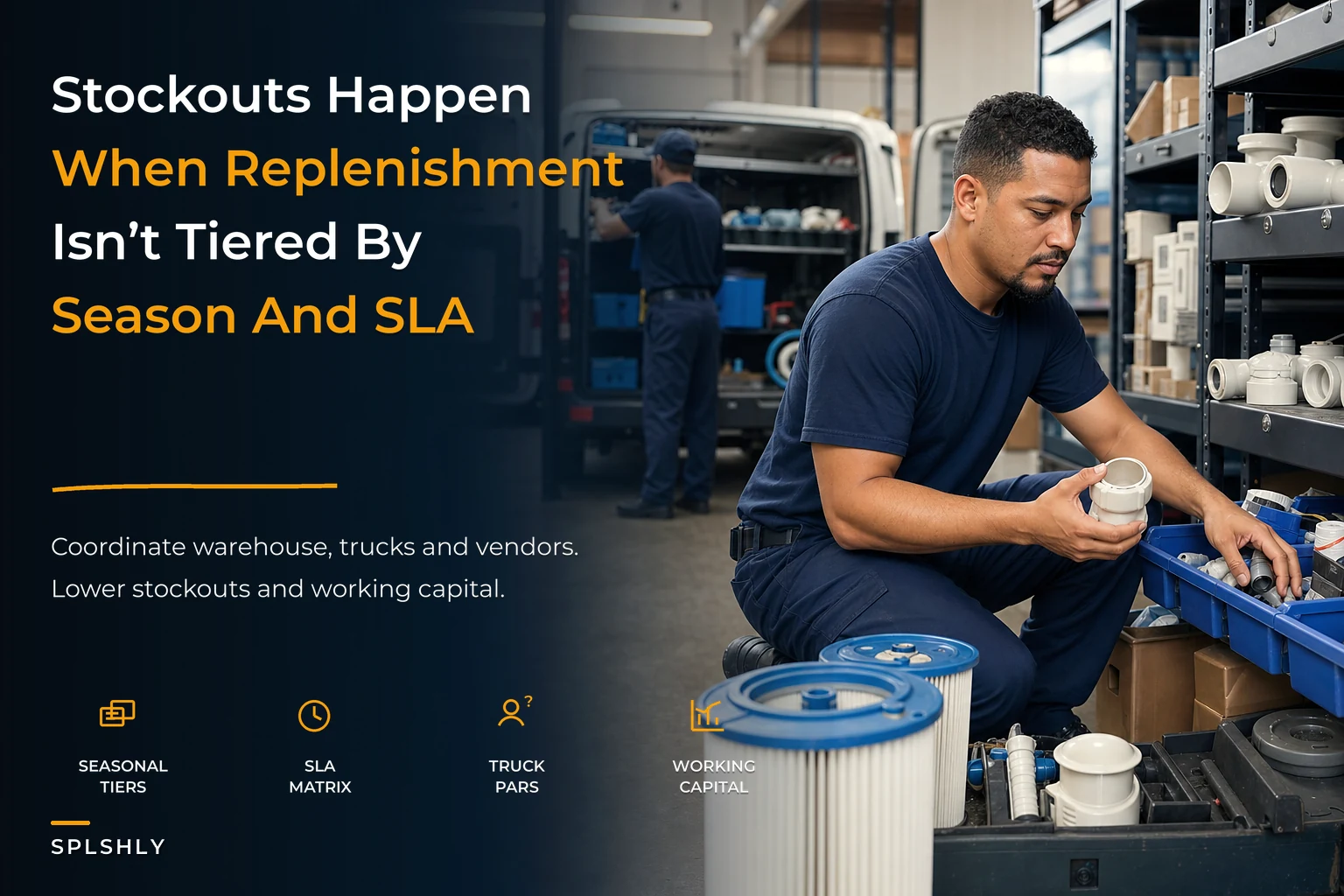
An SLA matrix is just a table that answers one question for every tier: how fast does this need to be back in stock, and who's responsible for making that happen? Without it, replenishment is whoever remembers, whenever they remember.
-
Critical parts get a same-day or next-day SLA. That means either a local supplier relationship or a buffer that never hits zero. You accept some carrying cost here because a stockout is genuinely expensive.
-
Seasonal parts get a lead-time SLA tied to the calendar. If your primary vendor needs 5 business days and season demand spikes in April, your reorder trigger fires in mid-March. The SLA isn't "when we run out"—it's "before we predictably will."
-
Consumables get a batch SLA. Order weekly or bi-weekly, hit freight minimums, done.
The part owners consistently underestimate: the SLA has to account for vendor reliability, not just your own targets. If a supplier promises next-day but delivers late 30% of the time on your critical parts, that's not a next-day SLA—that's a coin flip. You either need a backup vendor for those SKUs or a bigger buffer to cover the gap. Track vendor fill rates the same way you'd track your own service metrics.
The replenishment workflow that ties it together
Here's the actual sequence when all three systems coordinate properly:
-
A tech consumes a part on a job. The draw is logged against that truck's inventory—not the warehouse's.
-
Truck PAR check happens at end of route (or automatically if you're tracking digitally). Any SKU below truck PAR goes on a restock list.
-
Warehouse fulfills the restock from buffer stock and decrements its own count.
-
Warehouse PAR check fires. Anything below warehouse buffer generates a vendor purchase suggestion, grouped by vendor to hit freight minimums.
-
Vendor SLA lookup decides urgency—critical parts get expedited or sourced from the backup vendor; seasonal and consumable items batch into the next scheduled order.
-
PO goes out, receiving logs it in, and the buffer refills before it ever hits zero.
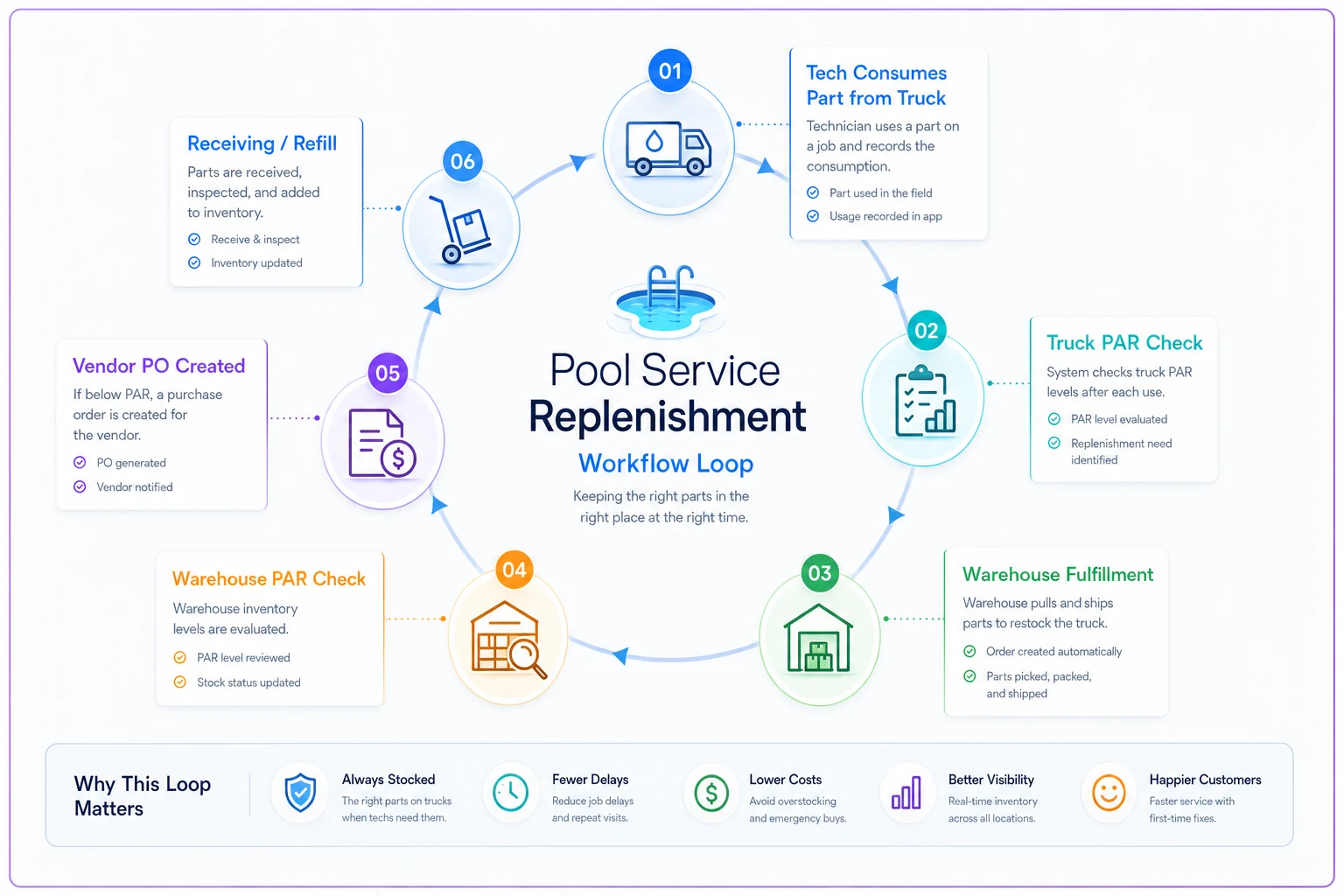
Every step feeds the next. The whole thing is a loop, not a to-do list. Break any single link—say, techs don't log draws—and the loop silently fails while everything looks fine until the day a truck shows up short.
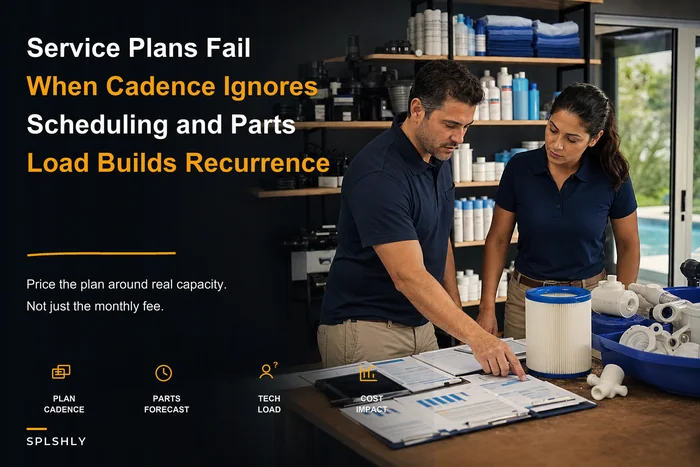
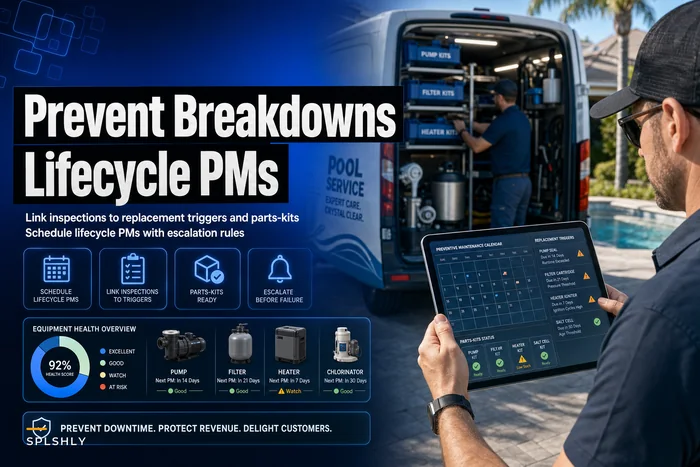
This is also where inventory connects to the rest of the operation. Your parts availability has to line up with what you've promised customers on their service plans, which we covered in why aligning service plans to scheduling and parts prevents recurring-revenue headaches. And your critical-parts buffer should be informed by your equipment replacement forecasting—if you know from your preventive maintenance schedules and replacement triggers that a batch of heaters is aging into replacement range, you stock ahead instead of scrambling.
A quick checklist to pressure-test your current setup
Run through these.
-
Can you tell, right now, what's on each truck without calling the tech?
-
Do your PAR levels change between peak season and off-season, or are they static year-round?
-
Which of your SKUs are actually critical—meaning a stockout kills a job—versus just annoying?
-
Do you have a backup vendor for every critical part, or a single point of failure?
-
When a part gets used, does anything automatically trigger a restock, or does someone have to notice?
-
Do you know your vendors' real fill rates, or just their promised lead times?
-
Is any of your working capital sitting in inventory that hasn't moved in 90+ days?
If you can't answer clearly, that's your weak seam:
Real scenario: a 6-truck operation drowning in "safe" inventory
A mid-size residential pool service running six trucks had what looked like a stocking problem—techs were hitting stockouts on filter cartridges and pump seals several times a week during summer. Their fix had been to keep buying more of everything. By the time anyone looked closely at it, they were carrying somewhere around $60k–$70k in inventory, and a big chunk of it hadn't moved in months.
The actual problem wasn't quantity. It was that the trucks had no defined PAR levels, so techs over-grabbed critical parts "just in case," which drained the warehouse buffer, which triggered panic reorders, which piled up more stock nobody tracked. Meanwhile the genuinely critical seals were still stocking out because there was no backup vendor when the primary was slow. After splitting inventory into the three tiers, setting seasonal PARs on both trucks and warehouse, and putting a real SLA against the critical parts (including a second supplier), things shifted over a season. Working capital tied up in inventory dropped by roughly a third. Critical-part stockouts went from several a week to a handful over the entire peak season. The trucks weren't carrying dead weight anymore, and the back office stopped placing rush orders. Nothing about the fix was exotic—it was just making the three systems talk to each other and stocking each part according to what it actually costs to run out.
When this level of coordination makes sense—and when it doesn't
If you're running one or two trucks and you personally know every part on the shelf, a full SLA matrix and tiered replenishment loop is probably overkill. You're the coordination layer, and you're fast enough. A simple reorder list works fine until it doesn't.
The tipping point usually hits somewhere around three to four trucks. That's when no single person can hold the whole picture in their head anymore, trucks start becoming inventory black holes, and the "just order more" reflex starts eating serious cash. If you're past that point and still running inventory by memory and gut, that's the sign to formalize.
One more thing: don't build a heavy tiering system before you've figured out which parts are actually critical. If you tier everything as critical, you've just made overstocking official policy. The whole value is in the differences between tiers—if there are no real differences, skip it.
Where software earns its place—quietly
None of this requires software to be true. You can run tiers, SLAs, and a replenishment loop on spreadsheets if you're disciplined. But the coordination gets hard to hold together by hand once you're managing multiple trucks, seasonal PAR swings, and vendor lead times all at once. The two things that break manually are visibility (what's actually on each truck right now) and timing (catching a reorder trigger before you're stocked out, not after).
That's the practical case for AI-assisted operational software: it watches the draws, the PAR levels, and the vendor lead times in the background and flags the reorder before you'd have noticed it yourself—grouping suggestions by vendor, adjusting PARs as the season shifts, and keeping truck and warehouse counts reconciled. It's not doing anything you couldn't do by hand. It's just closing the seams between systems that, at scale, humans tend to miss.
The reason stockouts and frozen working capital coexist in so many pool operations is that inventory gets managed as one big pile instead of three connected systems with different jobs. Split it by consequence, let the tiers shift with the season, put real SLAs against the parts that can't run out, and wire the replenishment so each layer feeds the next. Do that, and you stop choosing between stranded techs and dead cash—you get to spend less on inventory and run out less often, which shouldn't feel possible until you see how much waste was hiding in the gaps.
Ready to elevate your pool service business?
Join hundreds of pool service professionals using Splshly to save time, optimize routes, and enhance customer satisfaction.