

The most dangerous thing on a pool truck isn't the tech's driving record. It's the plastic tub in the back where someone tossed a leaking jug of muriatic acid two feet from an open bag of cal-hypo, then drove 40 minutes in 98-degree heat with the windows up.
Chlorine gas doesn't care about your years of experience. It forms when an oxidizer contacts an acid, and it happens fastest in warm, enclosed spaces — which describes basically every service vehicle in July. Most pool techs already know these chemicals shouldn't mix. What's usually missing is a written, enforceable standard for how they're stored, transported, documented, and cleaned up when things go sideways.
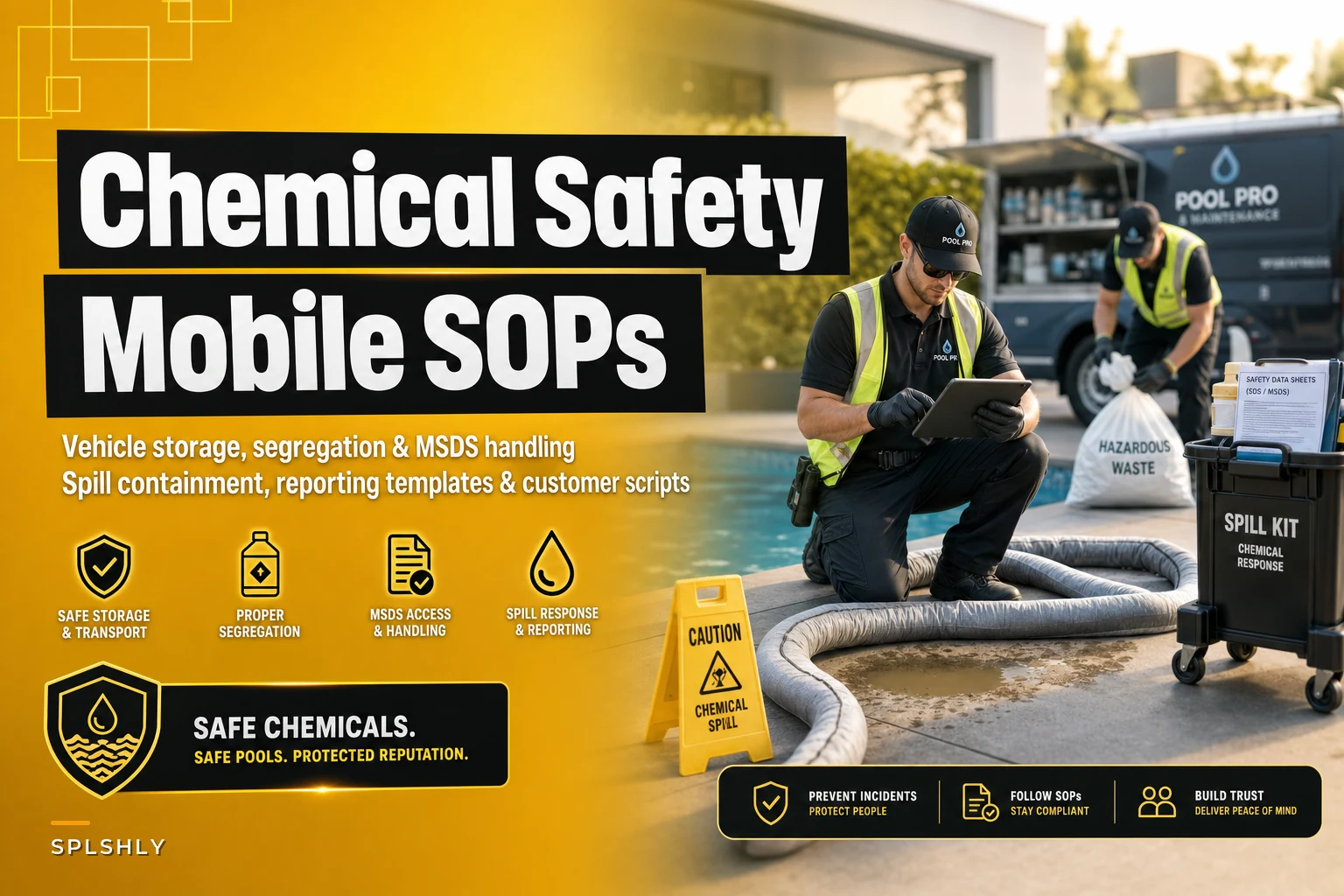
This is a tight, practical SOP you can hand to a new hire on day one. No theory. Just the layout rules, segregation logic, documentation templates, and spill steps that actually reduce liability.
The Two Failure Points Nobody Writes Down
Before getting into the SOP itself, it's worth being honest about where incidents actually start. In real operations, chemical problems almost never come from a tech deliberately mixing products. They come from two quiet failures.
Failure one: proximity over time. A tech loads the truck correctly on Monday. By Thursday, jugs have shifted, a lid has loosened, and an oxidizer container is now sitting in a puddle of acid residue nobody noticed. Nothing exploded on contact — the reaction built slowly as vapors accumulated.
Failure two: no paper trail. Something spills, the tech mops it up with a shop rag, and moves on. Three weeks later a customer's dog gets sick, or a neighbor complains about fumes, and there's zero documentation of what happened, when, or what was done. Now it's your word against theirs, and insurers don't love "we think we cleaned it."
Both failures are cheap to prevent and expensive to ignore. Everything below targets these two points specifically.
Vehicle Storage Layout: The Non-Negotiable Zones
Your truck bed or van interior needs to be divided into physical zones that make cross-contamination structurally difficult — not just discouraged.
Eliminate missed appointments and dispatch delays.
Splshly ensures every pool service is scheduled, tracked, and completed efficiently.
- Unified scheduling dashboard
- Automated customer reminders
- Technician route optimization
No credit card required
-
Oxidizer zone — cal-hypo, dichlor, trichlor tabs, lithium hypochlorite. Anything that releases chlorine or oxygen.
-
Acid zone — muriatic/hydrochloric acid, dry acid (sodium bisulfate), pH decreasers.
-
Neutral/equipment zone — algaecides (check labels), clarifiers, test kits, tools, PPE.
The oxidizer and acid zones should never share a wall or a drip path. A leaking acid jug on a higher shelf must not be able to drip onto anything in the oxidizer zone. That means acids go in the lowest position, in a secondary containment tray, and oxidizers go elsewhere entirely — ideally a separate ventilated compartment.
One thing worth calling out specifically: techs who "temporarily" set a returned or partially-used container in the wrong zone because they're in a hurry. That temporary placement is where most near-misses live. The rule has to be that there's no such thing as a temporary spot — everything goes back to its zone before the truck moves.
Segregation quick-reference
| Product Type | Zone | Storage Rule | Never Store Near |
|---|---|---|---|
| Cal-hypo / dichlor / trichlor | Oxidizer | Sealed, dry, upright, ventilated | Any acid, oil, or organic material |
| Muriatic acid | Acid | Lowest shelf, in containment tray | Any oxidizer, metals |
| Dry acid (bisulfate) | Acid | Dry, sealed | Oxidizers |
| Algaecides / clarifiers | Neutral | Upright, label-checked | Varies — read SDS |
| Test reagents | Neutral | Original packaging | High heat, direct sun |
The heat variable deserves its own note. A closed van in summer can hit 130–140°F inside. That accelerates off-gassing from tabs and degrades reagent accuracy. If a vehicle can't stay reasonably ventilated, reduce the oxidizer quantities per truck and restock more frequently instead of hauling a week's supply that bakes all day.
MSDS / SDS Handling: Make It Findable in 20 Seconds
Every product on the truck needs a current Safety Data Sheet, and the test of whether your system works is simple: if a tech is standing over a spill, can they pull up the correct SDS in under 20 seconds without calling the office?
A binder in the shop fails this test. Techs are in the field, not in the shop. What actually works:
-
Keep a laminated one-page SDS summary card for each carried product in a marked pouch inside the cab — not the storage area, where a spill could destroy it.
-
Maintain a digital copy accessible from the tech's phone — a shared folder or your operations app — so the full SDS is available even if the card goes missing.
-
Assign one person to review SDS currency quarterly, since manufacturers update formulations and hazard statements more often than people assume.
The summary card should show only what matters in an emergency: product name, hazards, first-aid basics, spill response, and PPE required. The full 16-section SDS is for compliance and the office; the card is for the guy with acid on his boot.
This is also where centralized documentation pays off. When SDS files, product lists per truck, and expiration tracking live in one shared system instead of scattered binders, the office can confirm what's on any vehicle at any moment — which matters a lot during an incident investigation.
Spill-Containment Steps: The Field Sequence
A spill SOP fails when it's a paragraph nobody memorized. It has to be a short, ordered sequence a tech can run under stress. Post it where the PPE lives.
The containment sequence:
-
Stop and assess. Is it acid or oxidizer? Is anyone exposed? If chlorine gas is present — sharp smell, eye/throat irritation — get upwind and clear people first. Containment is secondary to not breathing it.
-
PPE on. Chemical gloves, eye protection, and for acid spills of any size, respiratory protection if fumes are present.
-
Contain before you clean. Use the truck's spill kit — absorbent socks or a berm — to stop the spread. Never chase a spill with water first; water can spread acid or react with oxidizers.
-
Neutralize or absorb per SDS. Acids get a neutralizer or inert absorbent; oxidizers get inert absorbent only. Don't combine cleanup materials from two zones.
-
Bag and label waste. Contaminated absorbent goes in a labeled disposal bag, not the customer's trash.
-
Ventilate and verify. Confirm the area is safe before leaving.
-
Document immediately (next section).
Every truck needs a dedicated spill kit that's actually checked, not just assumed to be stocked. A pattern that shows up constantly: spill kits get raided for shop rags and absorbent over the season, so when a real spill happens the kit is half-empty. The kit should be on the same restocking discipline as the rest of the truck — and if you're already building consistent restock and QA habits, the same thinking behind maintenance workflows and QA checks with measurable acceptance criteria applies directly to spill-kit readiness.
Restock spill kits on the same schedule as chemical restocks to avoid kit depletion during an incident.
A quick visual of the field sequence helps techs run the steps under stress.
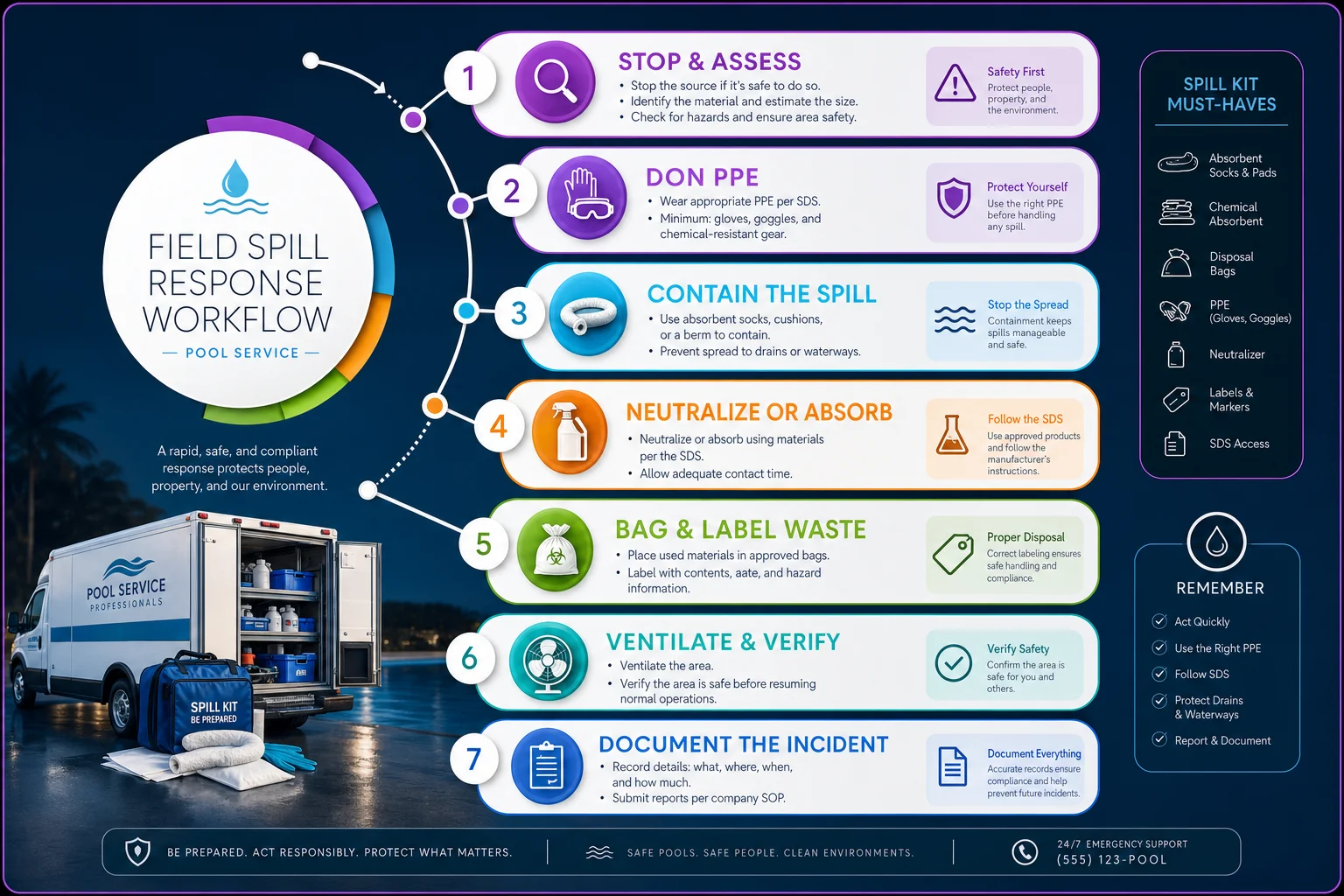
Keep this graphic laminated in the cab near the PPE.
Incident Reporting: Templates That Actually Hold Up
Here's the uncomfortable truth about liability: a small spill that's fully documented is a minor event. The same spill with no documentation can become a lawsuit you can't defend. The difference is a five-minute form.
Every incident — even a "minor" splash — should generate a report with these fields:
-
Date, time, exact location (customer address, area of property)
-
Product involved and approximate quantity
-
What happened in plain language (one or two sentences)
-
Who was present — tech, customer, bystanders, pets
-
Actions taken — containment steps, PPE used, cleanup method
-
Injuries or exposure — yes/no, description
-
Photos — before cleanup, during, after
-
Follow-up needed — customer notification, disposal, equipment replacement
The photos matter more than people expect. The same discipline that protects you on repair disputes protects you here — if you've already set up mandatory photo shot lists and caption templates for techs, extend that same habit to chemical incidents. Timestamped photos of a contained, cleaned area are hard evidence that you handled it correctly.
Paper forms fail because they get filled out later — or never. When the incident form lives on the tech's phone and takes a couple of minutes to complete on-site with photos attached, completion rates go way up. Reports that would've been forgotten by the time the tech got back to the shop actually get filed.
Customer Communication Scripts: Say the Right Thing, Once
When a spill or exposure involves the customer's property, what the tech says in the next 60 seconds shapes whether this becomes a review problem, an insurance claim, or a non-event. Techs shouldn't be improvising this under stress.
> "I had a small spill of [product] and I've cleaned and contained it fully. There's no risk to you or your pets, but I want to let you know so there are no surprises. I'm documenting it and my office will have a record. Is there anything you'd like me to walk you through?"
> "There was a spill of [product] and I want to make sure everyone's safe first. If you or your pet had any contact, here's what to do: [first aid per SDS], and if there's any irritation, please seek medical advice. I'm reporting this right now and my office will follow up with you today."
Two rules the tech must never break: don't speculate about fault, and don't promise financial coverage on the spot. "My office will follow up with you today" is the correct handoff. It buys time, keeps the customer informed, and puts the liability conversation with someone who can actually make those calls.
A Realistic Before/After
Consider a mid-sized operation running six trucks, roughly 300–350 accounts. Over one summer they had two minor acid spills and one near-miss with cal-hypo stored too close to an acid jug that had leaked in transit. None caused serious injury, but one customer left a scathing review about fumes on their patio, and there was no record of what the tech actually did — so the owner ate the reputational hit and spent hours reconstructing events.
They rebuilt the system over about a month: zoned truck layouts with acid containment trays, laminated SDS cards in every cab, a mandatory on-phone incident form with photos, and printed spill sequences posted by the PPE. The following season they had a comparable number of small spills — you don't eliminate them entirely — but every one was contained, documented in a few minutes, and communicated to the customer with a script. Zero disputes escalated. When their insurer asked for chemical-handling documentation at renewal, they had it ready.
The spills didn't really change. The aftermath did — from days of scrambling to a filed form.
When to Enforce This Hard — and When You're Overbuilding
Not every operation needs the same level of structure, and it's worth being honest about that.
Enforce it strictly if you carry cal-hypo and acid on the same trucks, run multiple techs, operate in hot climates, or have had any near-miss. This is the profile where a single incident can generate real liability. Seasonal operations with rotating staff fall squarely in this category — new and temporary techs cause the most storage mistakes simply because the segregation logic isn't yet second nature.
You may be overbuilding if you run a solo operation carrying tiny, sealed quantities and restocking daily from a properly segregated shop. You still need SDS access and a basic spill kit, but three-zone truck partitions for two jugs is probably more structure than the risk warrants.
The SOP isn't for the veteran who already does this instinctively. It's for the person on week two, who hasn't yet learned which shortcuts are fine and which ones end badly. That's who the written standard actually protects — and by extension, it protects you.
Make It Stick
A chemical SOP that lives in a drawer protects no one. The version that works is the one printed in the truck, loaded on the phone, and reinforced until zoning and documentation are automatic. Keep the SDS cards current, keep the spill kits stocked against a real checklist, and treat every incident form as non-optional — including the "minor" ones, because those are exactly the ones that become expensive later.
The goal isn't a perfect record with zero spills. Spills happen in this trade. The goal is that when one does, your tech contains it correctly, documents it in minutes, says the right thing to the customer, and hands you a clean paper trail. That's the whole difference between a routine Tuesday and a claim you're still fighting six months from now.
The goal isn't a perfect record with zero spills. Spills happen in this trade. The goal is that when one does, your tech contains it correctly, documents it in minutes, says the right thing to the customer, and hands you a clean paper trail. That's the whole difference between a routine Tuesday and a claim you're still fighting six months from now.
Ready to elevate your pool service business?
Join hundreds of pool service professionals using Splshly to save time, optimize routes, and enhance customer satisfaction.