


Most pool service companies track customer complaints as their main quality metric. By the time a customer complains, you've already lost them mentally. They're shopping around, telling neighbors about issues, questioning whether they should switch providers.
But there's a bigger problem happening before complaints even surface. Inconsistent service creates invisible operational damage that builds up over months. Routes take longer because techs spend extra time fixing problems from previous visits. Chemical costs spike when you're constantly rebalancing pools that weren't properly treated. Equipment fails prematurely because maintenance steps get skipped. Your office staff wastes hours fielding "did the tech show up?" calls.
The real cost of inconsistent pool service delivery goes beyond angry customers
I watched a pool service operation in Phoenix struggle with this exact issue as they tried to grow. They had 12 techs servicing around 850 pools weekly. On paper, everything looked organized - route sheets, basic checklists, chemical logs. But their actual service delivery was all over the place between techs, routes, and even visits to the same pool.
One tech would spend 45 minutes per pool doing thorough cleanings. Another would blast through 25 pools daily, barely skimming leaves. Some techs tested water chemistry every visit. Others eyeballed it and dumped chemicals based on gut feeling. The owner only discovered these variations when equipment started failing at certain accounts while others ran perfectly.
Why pool maintenance workflows break down as you scale
When you're running 50-100 pools with 1-2 techs, informal quality control works fine. You know each pool's quirks. You can spot problems during occasional ride-alongs. Customers call you directly when something's off.
Eliminate missed appointments and dispatch delays.
Splshly ensures every pool service is scheduled, tracked, and completed efficiently.
- Unified scheduling dashboard
- Automated customer reminders
- Technician route optimization
No credit card required
But operational reality changes dramatically around 300-400 pools. You can't personally inspect every pool weekly. New techs don't inherit years of accumulated knowledge about each account. That customer who always wants extra brushing on the waterline? The pool with the finicky pump that needs specific priming steps? Those details disappear.
The traditional approach - hiring experienced techs and hoping they maintain standards - creates a knowledge silo problem. Your best tech knows exactly how to service the country club's competition pool. But when they're sick or quit, that knowledge walks out the door. The replacement tech shows up, does a standard cleaning, and suddenly you're dealing with an algae bloom during a swim meet.
Scale introduces coordination failures you never anticipated. Tech A services a pool Monday and adds shock treatment. Tech B covers that route Thursday due to scheduling changes, doesn't know about Monday's treatment, and adds more chemicals. By Saturday, the homeowner's kids have burning eyes and you're getting angry calls.
Even simple operational changes become complex at scale. Switching from liquid chlorine to tabs should be straightforward. But without proper workflows, half your techs make the switch while others keep using liquid. Some pools get double-dosed. Others get nothing. Chemical inventory becomes chaos because nobody knows what anyone else is actually using.
Process maps that capture real pool service operations
Effective process maps go beyond "clean pool, add chemicals, leave." They capture decision points, variations, and edge cases that occur in actual field operations.
Take basic pool cleaning. A useful process map identifies specific steps and decision branches:
Pre-arrival phase:
-
Check previous visit notes for specific issues
-
Verify special instructions for this account
-
Confirm equipment and chemical inventory
Initial assessment (2-3 minutes):
-
Visual inspection of water clarity and color
-
Check equipment operation (pump pressure, flow rate)
-
Note visible debris levels and types
-
Identify any new damage or concerns
Service delivery sequence:
-
Empty skimmer baskets (note debris type/volume)
-
Empty pump basket if accessible
-
Skim surface (full coverage or spot cleaning based on debris)
-
Brush walls and steps (frequency varies by pool finish)
-
Vacuum (manual, automatic, or skip based on conditions)
-
Clean tile line (weekly, biweekly, or as needed)
-
Backwash filter (based on pressure differential, not schedule)
Chemical management:
-
Test water (which tests, in what order)
-
Calculate chemical adjustments
-
Add chemicals (sequence matters for compatibility)
-
Document amounts added
Equipment checks:
-
Inspect o-rings and gaskets
-
Check timer settings
-
Verify chlorinator/salt cell operation
-
Test GFCI outlets monthly
Here's a quick visual of how a process map ties these steps together.
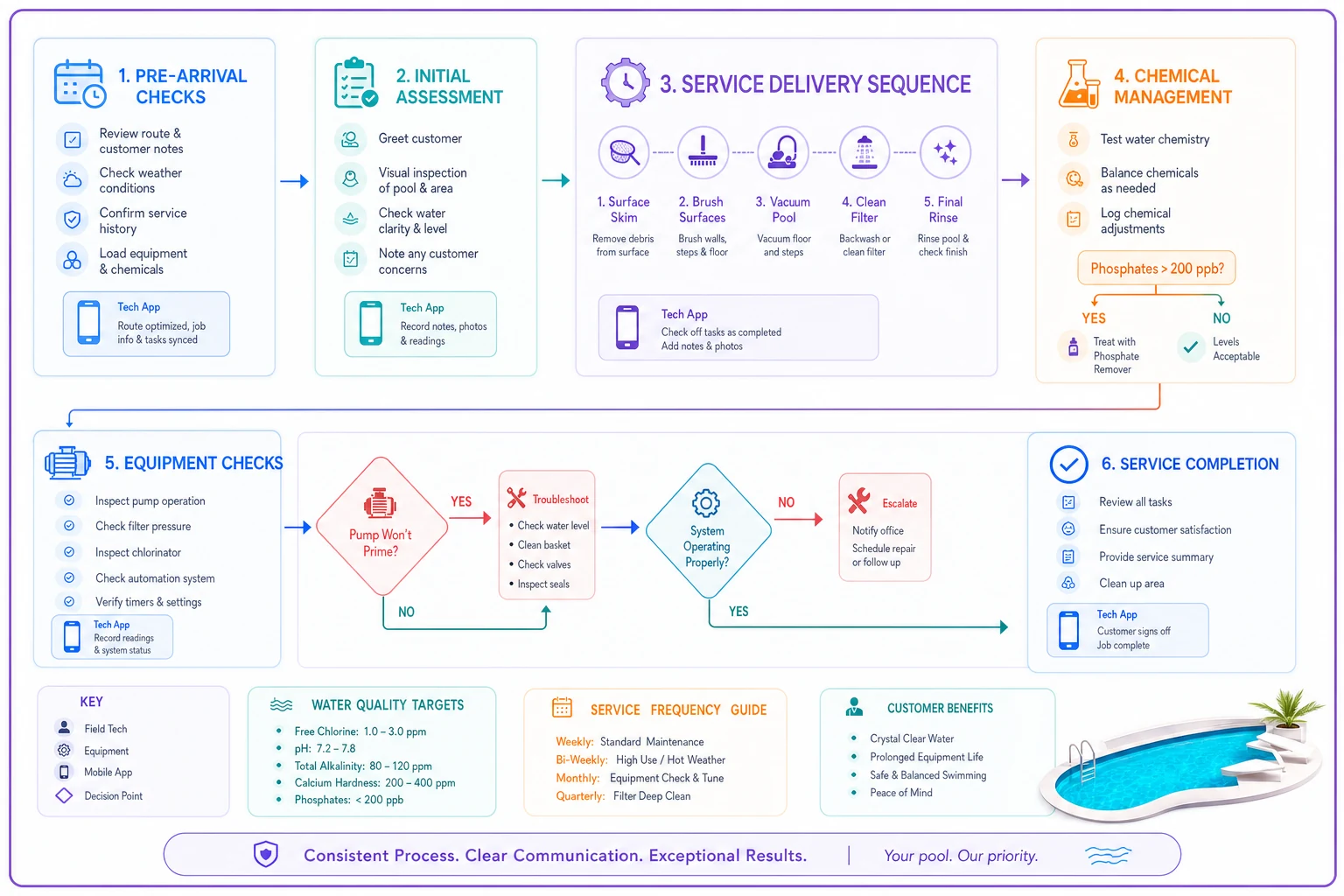
The map should show decision branches. If phosphates test above 200 ppb, what's the protocol? If the pump won't prime after three attempts, what's next? These decision points separate consistent service from chaos.
Measurable acceptance criteria that techs actually understand
Vague standards like "pool should look clean" guarantee inconsistent results. Different techs interpret "clean" differently. Customers have varying expectations. Weather and usage affect appearance.
Measurable acceptance criteria eliminate interpretation:
| Parameter | Residential Range | Commercial Range |
|---|---|---|
| Free chlorine | 2.0-4.0 ppm | 3.0-5.0 ppm |
| pH | 7.4-7.6 | 7.4-7.6 |
| Total alkalinity | 80-120 ppm | 80-120 ppm |
| Calcium hardness | 200-400 ppm | 200-400 ppm |
| Cyanuric acid | 30-50 ppm (outdoor) | 30-50 ppm (outdoor) |
| Salt | 2,800-3,200 ppm | 2,800-3,200 ppm |
Physical cleanliness metrics:
-
No visible debris larger than a dime on pool bottom
-
Tile line free of visible calcium/scale buildup
-
No algae visible on walls, steps, or corners
-
Water clarity
can see main drain clearly from deck
-
Skimmer baskets less than 50% full after cleaning
Equipment operation standards:
-
Pump pressure within 2 PSI of baseline for that pool
-
Flow rate maintains manufacturer minimum (varies by pool)
-
Automatic cleaner completes full pattern in 2-3 hours
-
Heater reaches set temperature within specified time
-
Salt cell produces chlorine at expected rate
Time standards by pool type:
-
Standard residential (under 20,000 gallons)
25-35 minutes
-
Large residential (over 20,000 gallons)
35-45 minutes
-
Basic commercial
45-60 minutes
-
Complex commercial (multiple bodies of water)
60-90 minutes
These criteria create objectivity. A tech can't argue they "cleaned the pool" if debris remains on the bottom. A supervisor can measure performance against specific standards, not general impressions.
QA sampling frequency based on risk and performance
Checking every pool every week wastes resources. Never checking pools guarantees problems. Smart QA sampling balances risk and efficiency.
Start with risk categorization:
High-risk pools (inspect 25-30% weekly):
-
New accounts (first 8 weeks)
-
Commercial properties
-
Pools with recent equipment problems
-
Accounts with complaint history
-
Pools serviced by new techs
-
Properties with special requirements
Medium-risk pools (inspect 10-15% weekly):
-
Standard residential accounts
-
Pools serviced by experienced techs
-
Accounts without recent issues
-
Basic equipment setups
Low-risk pools (inspect 5% weekly):
-
Long-term stable accounts
-
Simple pools with reliable equipment
-
Experienced tech routes
-
Customers who actively maintain pools between visits
Adjust sampling based on performance trends. If a tech's pools consistently pass QA, reduce their inspection rate. If problems emerge, increase sampling immediately.
A Phoenix operation I worked with used this approach across 850 pools. They inspected roughly 170 pools weekly - about 20% overall. High-risk pools got checked every 3-4 weeks. Low-risk pools might go 2-3 months between inspections. This focused approach caught problems before customers noticed while keeping QA manageable.
Enforcement beyond checklists: making standards stick
Checklists alone don't ensure quality. Techs check boxes without doing work. Papers get wet, illegible, or lost. Nobody reviews them until problems surface.
Photo documentation requirements:
-
Before/after photos of each pool
-
Close-ups of any issues discovered
-
Chemical test strip results with date/time stamp
-
Equipment pressure gauge readings
-
Uploaded immediately via mobile app
Time and location tracking:
-
GPS verification of arrival/departure
-
Minimum time requirements per pool type
-
Automated alerts for rushed visits
-
Route deviation notifications
Chemical inventory reconciliation:
-
Expected chemical usage per route
-
Actual chemical consumption tracked
-
Variance reports flag unusual patterns
-
Prevents both overuse and skipping treatments
Customer feedback loops:
-
Post-service automated surveys
-
QR codes for instant feedback
-
Regular account reviews
-
Complaint pattern analysis by tech/route
Progressive enforcement structure:
-
First violation
Coaching conversation with specific examples
-
Second violation
Formal write-up with improvement plan
-
Third violation
Route reassignment or reduction
-
Fourth violation
Termination proceedings
But enforcement isn't just punishment. Recognize consistent quality with monthly bonuses for QA scores above 95%, preferred route assignments for top performers, additional training opportunities, and public recognition in team meetings.
An operation in Scottsdale implemented this multi-layer approach after losing three major commercial accounts. Within four months, their callback rate dropped from around 12% to under 3%. More importantly, their techs started taking pride in consistent scores, competing to maintain the highest QA ratings.
Technology integration without overwhelming field teams
Modern pool maintenance workflows benefit enormously from operational software, but only when implemented thoughtfully. Dumping complex technology on techs who barely use smartphones guarantees failure.
Start with basic digital workflows:
Digital route sheets with pool-specific details:
-
Previous service notes visible
-
Special instructions highlighted
-
Chemical history for past 4 weeks
-
Equipment baseline readings
-
Photo history of pool condition
Mobile water testing and calculation:
-
Digital test kit integration
-
Automatic chemical calculations
-
Dosage recommendations based on pool volume
-
Inventory deduction from truck stock
-
Historical trending of chemistry changes
Real-time communication tools:
-
Issue reporting with photos
-
Instant notification to office/management
-
Customer communication templates
-
Route changes and updates
-
Equipment problem escalation
Start slow with implementation. Begin with digital route sheets. Once techs are comfortable, add photo requirements. Then introduce digital water testing. Finally, implement full QA and inventory tracking.
Start with digital route sheets and roll out features gradually.
AI-powered operational platforms can now analyze patterns across your entire operation. They identify which pools consistently need more chemicals, which equipment fails frequently, which techs rush through certain stops. This analysis happens automatically, flagging issues before they become complaints.
For example, the system might notice that pools on Tech A's Thursday route consistently show high pH readings on the following visit. Investigation reveals that Tech A services those pools late afternoon when sprinklers run, diluting chemical additions. Simply adjusting the route order solves a problem you didn't know existed.
Workflow adjustments for seasonal changes and pool types
Static workflows ignore the reality that pool service needs vary dramatically by season, weather, and pool type. A workflow perfect for summer fails completely during spring pollen season.
Seasonal workflow modifications:
Spring (heavy debris/pollen):
-
Increase skimming frequency
-
Double-check filter pressure
-
More frequent basket cleaning
-
Adjust chemical protocols for organic load
-
Extended service times expected
Summer (high usage/heat):
-
Focus on chlorine stability
-
More frequent water testing
-
Check cyanuric acid levels
-
Monitor salt cells for scaling
-
Adjust for bather load
Fall (leaves and temperature swings):
-
Extended debris removal
-
Check heater operation
-
Adjust chemical feeders for temperature
-
Prepare for winterization
-
Clear drain covers frequently
Winter (reduced usage/rainfall):
-
Monitor for dilution after rain
-
Reduce chemical additions
-
Check freeze protection systems
-
Minimal cleaning needed
-
Focus on equipment maintenance
Pool type variations matter just as much. Salt water pools need cell operation checks every visit and monthly cleaning cycles. Infinity edge pools require catch basin cleaning weekly and leveler operation monitoring. Indoor pools focus on air quality issues and require more frequent shocking due to chloramine buildup.
Creating accountability without micromanaging techs
Good techs quit when they feel micromanaged. Bad techs exploit freedom. The balance requires systems that ensure quality while respecting professional autonomy.
Build accountability through transparency, not surveillance. Performance dashboards visible to all show individual QA scores, route completion rates, chemical usage efficiency, customer satisfaction ratings, and equipment problem resolution time. Techs see their metrics compared to team averages, not constant individual criticism.
Team-based goals with individual contribution work better than pure individual metrics. Overall customer retention rate, total callback percentage, chemical cost per pool, equipment failure rates, and new account referrals create natural peer pressure when team bonuses depend on collective performance.
Problem ownership approach means the tech who services a pool owns any issues. They're required to participate in resolution, explain root cause and prevention, and follow up on the next visit to ensure the fix worked. This creates natural accountability - techs learn that rushing through service means dealing with problems later.
Scaling quality control as your operation grows
Quality control systems that work for 200 pools fail at 500 pools and completely collapse at 1,000 pools. The progression requires fundamental shifts in approach.
Under 250 pools (owner-driven QA):
Owner knows every pool personally through direct observation and ride-alongs. Informal feedback and coaching with manual tracking of issues. Personal relationships maintain quality.
250-500 pools (supervisor-based QA):
Dedicated service supervisor role with formal inspection schedules. Written standards and procedures with basic digital tracking. Structured training programs become essential.
500-1,000 pools (system-based QA):
Multiple supervisors or QA roles using statistical sampling methods. Digital workflow management with automated reporting and alerts. Data-driven decision making replaces gut feeling.
Over 1,000 pools (technology-enabled QA):
AI-powered pattern detection and predictive problem identification. Automated workflow optimization with real-time performance monitoring. Integrated customer feedback loops process data continuously.
Each transition point requires different infrastructure, staffing, and technology. Trying to manage 800 pools with systems designed for 200 pools creates chaos. But implementing enterprise systems too early wastes resources and confuses staff.
Measuring the real impact of consistent service delivery
Consistent service delivery creates measurable improvements across multiple operational metrics. A Tempe operation tracking service consistency saw retention increase from roughly 82% to 94% annually after implementing structured workflows. That's an extra 100 customers retained per year on an 850-customer base, worth approximately $120,000 in annual revenue.
Route efficiency improves when techs follow consistent workflows and routes run predictably. The same operation reduced average route completion time by 45 minutes daily through consistency alone. That's 3.75 hours weekly per tech - enough to service 6-8 additional pools without adding staff.
Chemical costs decrease through proper testing and dosing protocols. They reduced chemical costs by roughly 18% - around $22 per pool annually. Across 850 pools, that's nearly $19,000 in savings from avoiding over-treatment and panic shocking.
Equipment lifespan extends with consistent maintenance. Preventing premature failure on just 20 pumps annually saves $16,000-24,000 at $800-1,200 per pump replacement.
Callback rates plummet from structured workflows. Callbacks cost $45-60 per visit in labor and fuel, plus opportunity cost. Reducing callbacks from 12% to 3% saves approximately $35,000 annually on an 850-pool route.
Worker's comp claims reduce when techs aren't rushed. Proper time allocation and consistent workflows reduced injury claims by about 60% in operations I've analyzed, preventing costly incidents from lifting chemicals improperly or slipping on wet decks.
Common pitfalls when implementing pool maintenance workflows
Even well-designed workflows fail when implementation ignores operational realities.
Creating workflows in isolation:
Owners or managers design workflows without tech input, missing crucial field realities. That "quick" filter cleaning takes 20 minutes on certain equipment. The "simple" chemical calculation becomes complex with unusual pool volumes. Build workflows with experienced techs, test them in real conditions, revise based on actual field experience.
Implementing everything at once:
Dropping 50-page procedure manuals on techs guarantees failure. They'll ignore most of it, cherry-pick easy parts, and revert to old habits within weeks. Phase implementation over 3-4 months - start with core cleaning workflows, add chemical protocols next, layer in equipment checks, finally implement QA and documentation.
Ignoring seasonal workload reality:
Workflows designed for calm October fail during March pollen storms. Techs abandon procedures when every pool needs double the normal time. Build seasonal flexibility into workflows, define minimum acceptable standards for high-volume periods, plan resource allocation for peak seasons.
Focusing on punishment over improvement:
Using QA primarily to catch and punish mistakes creates a culture of hiding problems. Techs skip difficult pools, falsify reports, and blame equipment or customers for issues. Frame QA as professional development, celebrate improvements, share best practices across the team.
The path to consistent pool service isn't complicated, but it requires deliberate systems thinking. Most pool service operations grow organically, adding techs and pools without updating their quality control systems. By the time problems surface, they're dealing with angry customers, high turnover, and operational chaos. Building proper workflows and QA systems from the start - or retrofitting them during controlled growth phases - prevents these predictable failures and creates a foundation for profitable scaling.
Ready to elevate your pool service business?
Join hundreds of pool service professionals using Splshly to save time, optimize routes, and enhance customer satisfaction.