


Most pool techs already take photos on the job. The problem isn't volume — it's that the photos are useless the moment someone else needs to act on them. A manufacturer rejects a warranty claim because there's no serial visible. A parts supplier can't confirm the right impeller because nobody shot the model plate. The homeowner argues the motor was "fine" because your photo shows a clean-looking motor housing and nothing else.
The gap between "I took a picture" and "I took the right picture, with the right data attached" is where money leaks. Warranty denials, re-trips to grab a serial you missed, procurement delays while someone squints at a blurry nameplate — these are all downstream symptoms of not having equipment diagnostic photo standards tied to the specific thing you're photographing.
This isn't about taking more photos. It's about taking fewer, more deliberate ones — matched to the failure type — and capturing the metadata that makes them actionable for warranty, procurement, and dispute resolution.
Why generic photo rules fall apart at the equipment level
A general "take before/after photos" rule works fine for pool surface cleaning. It completely falls apart for equipment failures, because a pump claim, a filter claim, and an electrical fault each require fundamentally different evidence.
-
Pump failures often hinge on whether it's a mechanical seal, bearing, or motor winding issue — and whether the unit ran dry. That's a story told by specific angles and readings, not one hero shot.
-
Filter failures are usually about internal components (laterals, manifolds, grids, cartridges) and pressure history. A photo of the outside of a tank tells the supplier almost nothing.
-
Electrical failures need evidence of the fault and the conditions — scorch patterns, meter readings, breaker state — plus enough context to rule out "the customer's wiring did this."
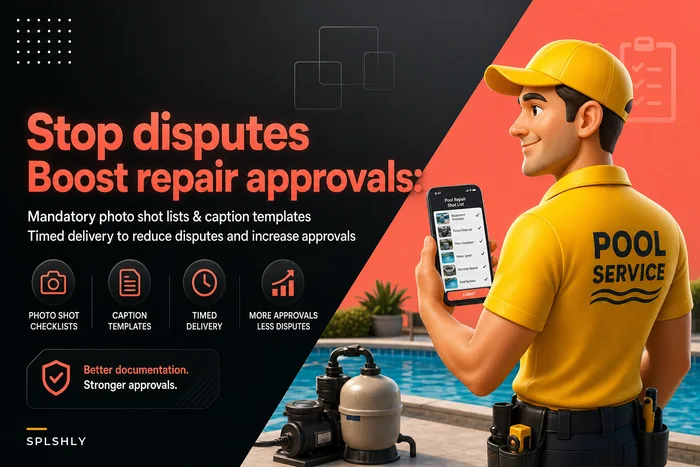
If your shot list doesn't branch by equipment type, techs default to instinct. And instinct produces inconsistent evidence that different people interpret differently. We've covered the broader discipline of this in the mandatory photo shot lists and caption templates post — this one goes a layer deeper into the equipment-specific requirements.
The metadata that actually determines whether a claim gets paid
This is the part most shot lists skip entirely. The photo is only half the evidence. The metadata attached to it is what closes the loop with a manufacturer or supplier.
Eliminate missed appointments and dispatch delays.
Splshly ensures every pool service is scheduled, tracked, and completed efficiently.
- Unified scheduling dashboard
- Automated customer reminders
- Technician route optimization
No credit card required
A typical rejected claim looks like this: a tech submits eight clear photos of a failed variable-speed motor. The manufacturer asks for the serial number and date of install. Nobody captured it on-site. The tech is now driving 40 minutes back to a house to photograph a label — or worse, the warranty window argument starts because there's no documented failure date.
The non-negotiable metadata, by category:
| Metadata field | Pump | Filter | Electrical |
|---|---|---|---|
| Serial number (clear, readable) | Required | Required | Required |
| Model / part number plate | Required | Required | Required |
| Date code / manufacture date | Required | Required | Required |
| Meter reading (voltage/amperage) | If motor suspect | — | Required |
| Pressure gauge reading (PSI) | Helpful | Required | — |
| Pump run-hours (if VSP display) | Required | — | — |
| Timestamp + GPS of capture | Required | Required | Required |
| Visible failure evidence | Required | Required | Required |
| Context/installation shot | Required | Required | Required |
Timestamp and location matter more than people expect. When a homeowner disputes when something failed, a geotagged, timestamped photo from the visit settles it instantly. When a manufacturer questions whether the part came off the pool they warrantied, GPS context helps.
One practical note: readable serials are harder than they sound. Faded plates, tanks installed in cramped equipment pads, labels facing a wall. Techs need to know that a half-legible serial can get a claim kicked back — so a wipe-down and a second raking-light angle isn't optional, it's part of the shot.
Equipment-specific mandatory shot lists
Below are the shot lists we'd consider the minimum for each failure type. The goal isn't to shoot everything — it's to capture the specific frames a warranty adjuster or parts supplier will ask for anyway, so nobody has to go back.
Wipe-down and a second raking-light angle isn't optional, it's part of the shot.
Pump failures
-
Full unit in context — pump on the pad, plumbing connected, so the install can be verified.
-
Serial/model plate, straight-on and readable — wipe it first. If faded, shoot a second raking-light angle.
-
VSP display reading — run hours, error code, and status if the unit still powers on.
-
Mechanical seal / wet end — if disassembled, the failed seal or impeller close-up.
-
Motor nameplate — HP, service factor, voltage.
-
Evidence of root cause — scorched windings, melted seal, sand/debris in volute (dry-run indicator), corrosion.
-
Voltage/amp reading at the motor — if a motor failure is suspected.
Filter failures
-
Full tank in context — with the pressure gauge visible in frame.
-
Pressure gauge close-up — the actual PSI reading, not "it was high."
-
Model/serial plate on the tank.
-
Tank opened — internal view showing the suspected failure.
-
Failed component close-up — cracked manifold, collapsed lateral, torn grid, channeled cartridge.
-
Comparison shot — failed component next to the replacement or a reference, if available.
Electrical failures
-
Panel/equipment as found — breaker position, any visible scorching, before touching anything.
-
Meter reading at the fault point — voltage and/or amperage, clearly showing the reading and what's being measured.
-
Close-up of fault evidence — burnt terminals, melted insulation, corroded connections, tripped breaker.
-
Serial/model of the affected component — timer, control board, relay, salt cell.
-
Wiring context — enough frame to show the fault is in the equipment, not customer-side wiring. This one protects you in liability disputes.
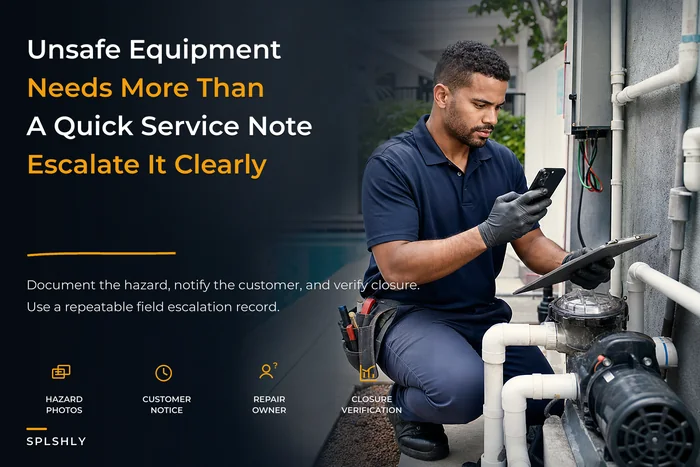
Electrical shots overlap heavily with safety documentation. If a fault crosses into unsafe territory, the unsafe pool equipment documentation and escalation checklist covers the escalation side well — the photo evidence feeds directly into it.
Caption templates: the fastest way to make a photo defensible
A photo without a caption forces the next person to interpret what they're looking at. A photo with a tight, standardized caption is self-explanatory six months later when the claim is still open.
Keep captions boring and structured. Consistency is the goal, not prose.
Pump template:
> [Equipment: Pentair IntelliFlo VSP] [Serial: #######] [Issue: motor failure — dry run, scorched windings] [Reading: 0 RPM, Error E-04] [Date: 2026-03-14] [Tech: initials]
Filter template:
> [Equipment: Hayward C4030 cartridge filter] [Serial: #######] [Issue: cracked manifold, bypassing] [Reading: 32 PSI pre-clean] [Date: ...] [Tech: ...]
Electrical template:
> [Equipment: salt cell power supply] [Serial: #######] [Issue: burnt relay terminal] [Reading: 0V output at terminal] [Date: ...] [Tech: ...]
Same pattern across all three: equipment identity, serial, plain-language issue, the key reading, date, tech. When captions follow the same skeleton every time, whoever assembles the claim can do it without calling the tech to ask "which pool was this again?"
How this speeds procurement and claims
The evidence doesn't just resolve disputes — it compresses the time between "part failed" and "replacement ordered."
-
Tech identifies the failure and shoots the equipment-specific list, capturing serial and model plate first.
-
Captions get applied on-site while context is fresh.
-
The package — photos plus metadata — gets attached to the job before the tech leaves the property.
-
Whoever handles procurement reads the serial/model directly off the captioned plate shot and orders the exact part. No guessing, no return trips for the wrong impeller.
-
If it's a warranty item, the complete evidence package submits same-day, with failure date documented, instead of waiting on a follow-up visit.
Visual workflow of the evidence-to-procurement process:
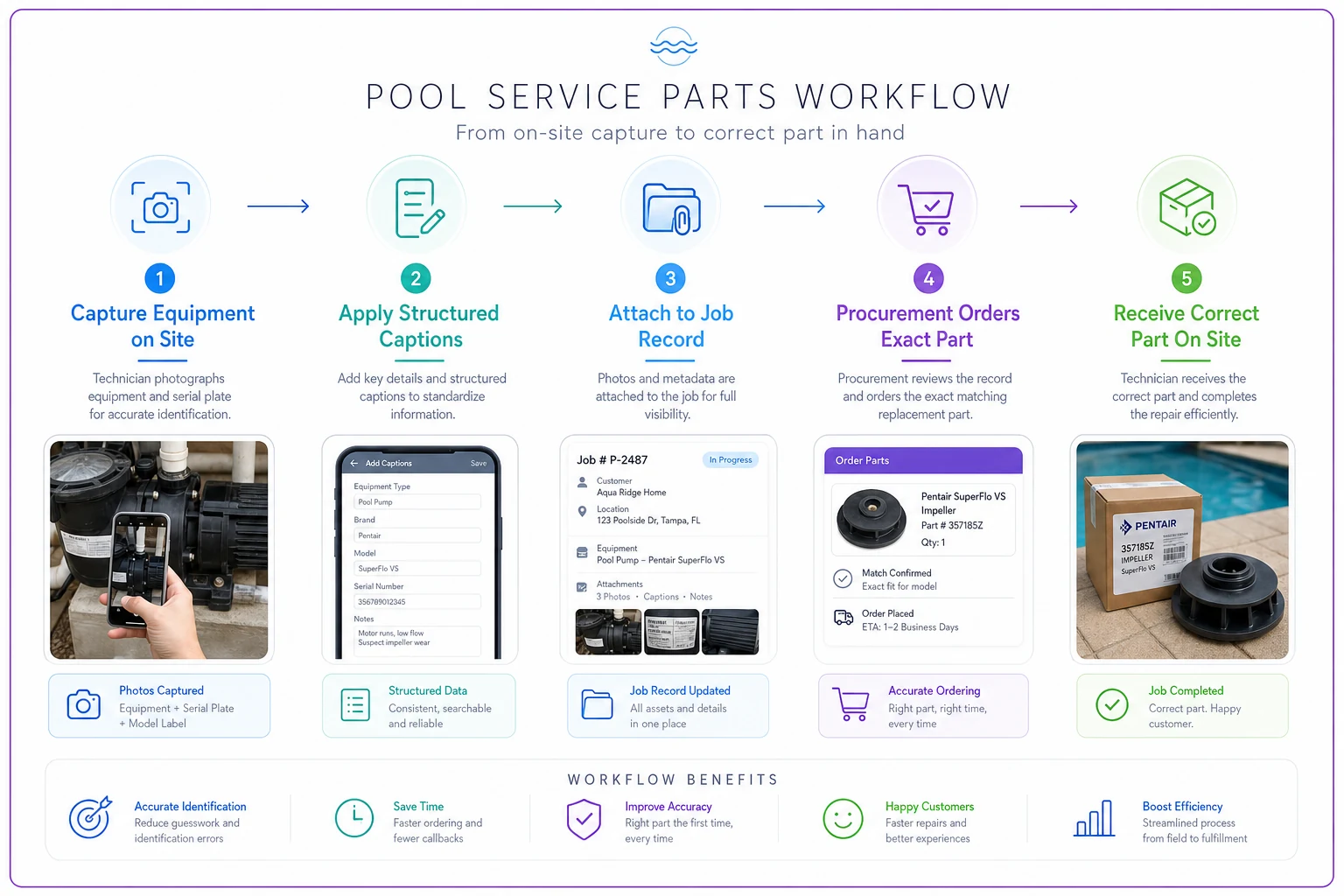
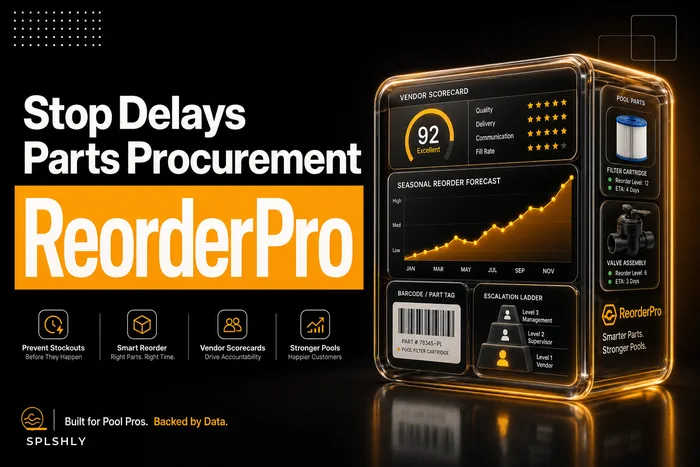
That fourth step — ordering the exact part the first time — is where a surprising amount of margin lives. Wrong-part orders and re-trips eat days. If you want the procurement side of this in depth, the procurement playbook for pool parts and reorder triggers pairs directly with this photo discipline: good evidence feeds fast ordering.
This is also where operational software earns its keep quietly. A platform that enforces the equipment-specific shot list — refusing to let a tech close a pump repair without a readable serial photo and a run-hours reading — removes the "I forgot" failure mode entirely. Some AI-assisted platforms can flag when a serial photo is too blurry to read before the tech leaves, or auto-populate caption fields from the captured plate. The value isn't the technology itself; it's that the evidence package is complete before anyone discovers it's missing something.
A real scenario
A mid-sized residential service company — around 9 techs, heavy warranty volume on variable-speed pumps — was getting roughly one in four warranty claims kicked back on first submission. Almost always for the same reasons: missing serial, no documented failure date, or a plate photo too blurry to read.
Each kicked-back claim meant a follow-up visit or a back-and-forth with the manufacturer that stretched resolution by one to two weeks. On their volume, that was a steady drip of delayed reimbursements and a handful of claims that simply timed out of the warranty window because the documentation lagged.
They rolled out equipment-specific shot lists with required serial and reading capture. Within a couple of months, first-submission approval climbed above 85%. The bigger win wasn't even the approval rate — it was eliminating re-trips to grab a serial, which were eating a noticeable chunk of productive tech hours each week. Procurement also stopped guessing on parts, because the captioned model plate was right there in the job record.
When this level of rigor makes sense — and when it's overkill
When it's worth it: Any operation with meaningful warranty volume, commercial accounts, or a history of homeowner disputes. If you're submitting even a few warranty claims a month, the cost of a single denied claim or timed-out window usually exceeds the effort of standardizing shots.
When it's lighter-touch: Pure cleaning routes with little equipment repair work don't need the full electrical and filter branching. A simplified serial-plus-context standard is enough.
Who should not overthink this: A solo operator doing a handful of repairs a month can run the shot lists off a laminated card in the truck. You don't need software to start — you need the discipline to shoot the serial first, every time, before you start tearing anything apart.
The thing that separates companies that get warranty claims paid from the ones that eat the cost isn't photography skill. It's having a defined set of shots tied to the specific equipment, the metadata captured in the moment, and captions that mean the same thing to everyone who reads them later. Start with the pump list — that's where the most expensive failures and the most warranty dollars tend to live — then build out from there.
Ready to elevate your pool service business?
Join hundreds of pool service professionals using Splshly to save time, optimize routes, and enhance customer satisfaction.