


Most techs already know how to spot a problem. A pump housing that's cracked and weeping, a bonding wire that's been cut, a gas heater that lights with a whump you can feel in your chest — those get noticed. Where things fall apart isn't detection. It's what happens in the 20 minutes after, and then in the days after that.
The dangerous condition gets photographed on somebody's personal phone. The homeowner gets a verbal "hey, don't run this until it's fixed." A note goes on the work order that says needs repair, called it in. Then three weeks later the same pool is running the same equipment, nobody knows who owned the follow-up, and if anything goes wrong there's no paper trail proving the tech ever flagged it.
That gap — between seeing an unsafe condition and documenting, escalating, and closing it in a way that holds up — is what this checklist is built to fix. It's a documentation and escalation workflow, not a legal instrument and not a substitute for training. That boundary needs to be clear before anything else.
First, the boundary: internal escalation is not official red-tagging
There is no single nationwide "red-tag" standard for pool equipment. What you're allowed to do, who has authority to formally condemn or lock out equipment, what disclosures are required, and what happens to a permit or a pool's operating status — all of that is governed by your local authority having jurisdiction (AHJ), adopted codes, state and municipal rules, manufacturer instructions, and your own employer's policy.
This document draws a hard line:
-
Internal unsafe-equipment escalation is your company's process for documenting a hazard, informing the customer, and driving a repair to closure. That's what this checklist covers.
-
Official red-tagging / condemnation / lockout-tagout is a regulated action defined by codes and authorities. That's what your association training, code references, and AHJ define.
Think of it this way: this checklist gets the facts recorded and the repair moving. It does not tell you whether a given condition legally requires shutdown, who is authorized to tag it, or what notice the law requires. When those questions come up — and they will — you go to:
| Question | Where the authority lives |
|---|---|
| Does this condition legally require the pool/equipment to be shut down? | Adopted local/state code + AHJ |
| Who is authorized to formally red-tag or condemn? | AHJ / jurisdiction rules |
| What's the correct isolation/lockout procedure for this unit? | Manufacturer documentation |
| What am I permitted and required to tell the customer? | Employer policy + applicable law |
| What are the electrical/bonding/grounding requirements? | Adopted electrical code + qualified electrician |
| How long must we keep these records? | Employer policy + insurer/legal guidance |
If this checklist ever seems to conflict with any of those sources, the other source wins. Treat everything below as a way to organize your evidence and your handoffs — not as a ruling on what the code requires.
> On review: A field workflow like this should be run past qualified pool-equipment safety, electrical, code/compliance, insurance-risk, and legal professionals in your operating regions before you standardize it company-wide. The structure is portable. The specific thresholds, disclosures, and retention rules are not — they depend on where you work.
The workflow, start to finish
Before the section-by-section detail, here's the whole loop in one view so it's clear how the pieces connect. Each stage produces a record the next stage depends on. Break one link and the whole chain gets weaker.
Eliminate missed appointments and dispatch delays.
Splshly ensures every pool service is scheduled, tracked, and completed efficiently.
- Unified scheduling dashboard
- Automated customer reminders
- Technician route optimization
No credit card required
-
Assess the condition against observable triggers → decide stop-work vs. monitor vs. escalate.
-
Capture evidence in a standardized set (photos, IDs, condition, timestamps, acknowledgement).
-
Notify the customer in plain language, in writing, with the recommended next step.
-
Escalate into a work order with a named owner, priority, repair pathway, and follow-up date.
-
Repair & verify with completion docs, post-repair testing where appropriate, and closure approval.
-
Audit at the manager level so nothing sits open and every record is complete.
Diagram of the full workflow:
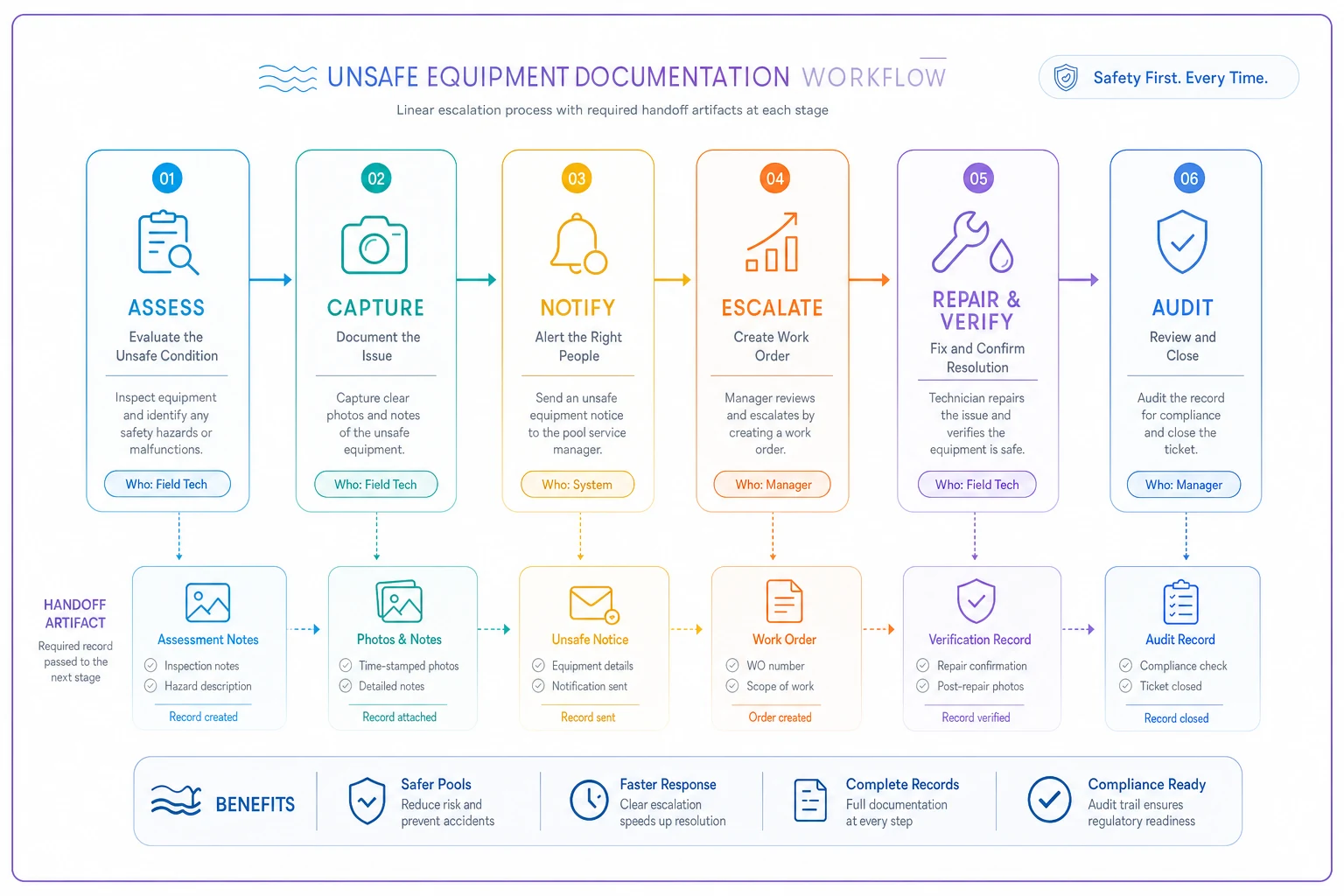
The single most common failure isn't in any one of these steps — it's in the handoffs between them. The tech assesses but doesn't capture. Captures but doesn't notify in writing. Notifies but nobody owns the escalation. That's why the checklist treats each stage as producing a required artifact.
Stage 1 — Immediate field assessment
The goal here is a fast, repeatable read on what you observe — not a diagnosis of root cause, and not a code ruling. Observable conditions are what you can defend later. "I thought the pump was probably fine" is not defensible. "Housing cracked, water leaking onto energized equipment, visible arcing marks on the timer" is.
Observable-condition checklist (mark each: OK / Concern / Stop-work):
-
Visible electrical damage — scorching, melted insulation, exposed conductors, water intrusion at panels, timers, or controls
-
Bonding/grounding compromised — cut, corroded, or disconnected bonding wire; missing lugs
-
Gas appliance concerns — gas smell, soot, delayed ignition, damaged venting, corroded heat exchanger evidence
-
Pump/motor — cracked housing, active leaking near electrical, seized shaft, burning smell, abnormal noise/vibration
-
Suction/entrapment safety — missing, broken, or non-compliant drain cover; single-drain suction concern
-
Automation/controls — erratic behavior, unresponsive safety interlocks, damaged sensors
-
Structural/physical hazard — unstable equipment pad, fall hazards, standing water on energized paths
Stop-work / escalation triggers. Treat these as reasons to stop, isolate if you're trained and it's safe to do so, and call up the chain — not as an exhaustive legal list:
-
Any energized equipment in contact with or exposed to water
-
Any suspected gas leak or combustion venting failure
-
Any suction-entrapment concern on a pool in use
-
Any bonding/grounding defect on equipment that's still operating
-
Anything outside your training or licensure (electrical, gas)
When to contact a supervisor or qualified specialist: the moment a trigger is present, before leaving the site, and before making any promise to the customer about what happens next. If the condition involves electrical or gas work beyond your scope, the next call is to a qualified electrician or licensed gas professional — not a best-guess field fix.
The mistake that shows up most often: techs skip the "call before you leave" step because they don't want to look uncertain in front of the customer. That one habit creates most of the downstream mess.
Stage 2 — Evidence capture
Evidence is what turns "the tech mentioned something" into a defensible record. The standard is consistency — every unsafe-condition report should capture the same fields the same way, so a manager reviewing it three weeks later doesn't have to reconstruct anything.
Required capture fields:
-
Photos wide shot of the equipment pad for context; close-up of the specific defect; the equipment data/serial plate; any manufacturer warning labels; the surrounding area if it affects the hazard. Include something for scale where it matters.
-
Equipment identification type, make, model, serial number, approximate age if known.
-
Site details service address, equipment location on site, pool type (residential/commercial), whether the pool is in use.
-
Observed condition factual description in plain terms — what you see, not what you assume caused it.
-
Date and time of observation.
-
Technician name and, if applicable, license/credential.
-
Customer acknowledgement field confirmation that the customer was informed of the observed condition and the recommended next step (name, date/time, method).
Photograph the data plate every time.
Two things worth calling out. First, photograph the data plate every time — the number of escalations that stall because nobody recorded the model or serial is genuinely frustrating, and it's a ten-second fix. Second, keep condition descriptions observational. Write "bonding wire disconnected at pump lug," not "improper installation by prior contractor." The second version is a conclusion you may not be able to support, and it invites disputes you don't want.
Stage 3 — Customer communication
This is where good documentation protects you and sloppy communication creates problems. The fix is a written, plain-language notification that documents four things and nothing you can't back up.
> Unsafe Equipment Notice > Date/Time: Technician: > Address / Equipment: Make/Model/Serial: > > Condition observed: During today's service, I observed the following condition: ___. This is being documented and reported to our office for follow-up. > > Recommended next step: __ (e.g., inspection/repair by a qualified specialist; do not operate the equipment until evaluated). > > Access / operation note (where applicable): __ (e.g., we recommend the equipment not be operated until repaired; note any access restriction relevant to safety). > > Authorization: Repair work may require your authorization and a separate estimate. Our office will contact you regarding next steps and cost. > > Customer acknowledgement: (name) confirms they were informed of the above on (date/time) via _ (in person / phone / email / text).
A few rules that keep this clean:
-
Plain language, no diagnosis theater. State the observed condition and the recommended step. Don't editorialize about who's at fault or what it "definitely" is.
-
Written beats verbal, always. A text or emailed copy with a timestamp is worth ten "I told them in person" claims.
-
Don't overstate your authority. You are reporting a condition and recommending a step. Unless your role and jurisdiction authorize more, you are not condemning the pool. Let your employer policy and the AHJ define what you're actually allowed to say about mandatory shutdown.
The customer communication step is also where companies most often improvise when they shouldn't. Having a standard written template removes the temptation to wing it — and removes the ambiguity about what was actually said.
Stage 4 — Work-order escalation
A documented hazard with no owner is just an anxious note. Escalation is where the record becomes a task somebody is accountable for. Every escalated condition should carry these fields:
| Field | What it captures | Why it matters |
|---|---|---|
| Owner | Named person responsible for driving to closure | "The office" is not an owner. A name is. |
| Priority level | e.g., P1 safety / P2 urgent / P3 scheduled | Sorts real hazards from routine repairs |
| Recommended repair pathway | In-house tech / licensed electrician / gas pro / manufacturer service | Prevents out-of-scope field fixes |
| Parts / contractor dependencies | Specific parts, lead times, subs needed | Surfaces delays before they blow the follow-up date |
| Target follow-up date | Concrete date, not "ASAP" | The thing audits check against |
| Linked evidence | Photos, condition report, customer notice | Keeps the whole record in one place |
The pattern that quietly kills follow-through: priority gets set to "high," but no follow-up date and no named owner get attached. "High priority" with no date and no owner is how a P1 hazard sits open for a month. If you take one thing from this stage, make it every escalation gets a name and a date.
Equipment-specific pathways matter here too. A cracked automation board, a heat exchanger concern on a gas heater, and a suspected suction-entrapment defect are not the same repair or the same authority. Validate your isolation and repair language against the current manufacturer documentation for the specific unit — pumps, heaters, electrical controls, gas appliances, suction systems, and automation gear all have their own procedures, and "how we usually do it" is not a substitute for the manual on a safety condition.
Stage 5 — Repair-completion verification
Closing the loop is not "the tech says it's fixed." Verification produces its own record so that closure is provable.
Closure record fields:
-
Repair documentation what was done, parts replaced, who performed it (and license where relevant)
-
Post-repair testing / inspection record where appropriate — e.g., verifying bonding continuity by a qualified person, confirming safe ignition and venting on a gas appliance, confirming drain-cover compliance, confirming controls/interlocks respond correctly
-
Customer update confirmation the customer was informed the condition is resolved
-
Closure approval sign-off by the escalation owner (or a manager for P1 items) that the record is complete and the item can be closed
The distinction that matters: repair done ≠ verified safe ≠ closed. Those are three separate states. A part can be swapped without the underlying hazard being confirmed resolved. On a safety escalation, closure should require the verification record, not just an invoice.
For electrical and gas conditions especially, "who verified it" should be a qualified person, and that name belongs in the record. Closure on a P1 item without a named verifier is not really closure — it's an assumption, and assumptions are where liability quietly builds.
Stage 6 — Manager audit checklist
None of the above survives contact with a busy season unless someone reviews it on a schedule. The manager audit is the backstop that catches the records that quietly didn't get finished.
-
Every open unsafe-condition report has a named owner and a target follow-up date
-
Every report has complete evidence (photos, equipment ID, observed condition, timestamps, customer acknowledgement)
-
No P1 safety item is past its follow-up date without an escalation note
-
Overdue items are flagged and reassigned, not silently rolled forward
-
Exceptions (customer declined repair, access denied, parts delay) are documented with what was communicated and when
-
Closed items include the verification/closure record, not just an invoice
-
Records are retained per employer/insurer/legal retention guidance
Two audit behaviors worth building in. Report overdue follow-ups by exception, not by digging — the goal is that overdue safety items surface automatically, not that a manager has to go hunting. And handle "customer declined the repair" as its own documented path. A customer refusing a safety repair is a real scenario with real risk, and how your company documents and responds to it should be defined by employer policy and legal guidance — not improvised in the field.
The audit only works if it's actually on the calendar. Quarterly reviews won't catch a P1 that went sideways in week two.
Where this workflow tends to break at scale
A two-truck operation can run this on paper and mostly get away with it, because one person remembers everything. The cracks appear as you grow, and they're predictable:
-
More techs, more capture inconsistency. Everyone documents "their way." Photos live on personal phones. Condition descriptions range from a paragraph to two words.
-
Handoffs multiply. With a dispatcher, an office, and subs in the mix, the number of places an escalation can stall goes up fast.
-
Follow-up dates get lost in the general pile. A P1 hazard and a "customer wants a new light someday" end up in the same undifferentiated queue.
-
Nobody owns closure. The tech assumes the office is handling it; the office assumes the tech will re-flag it next visit.
This is where standardizing the records pays off more than standardizing the people. When the unsafe-condition report is a fixed form with required fields, when escalations force an owner and a date, and when overdue safety items surface on their own, the workflow stops depending on any individual's memory.
A lot of pool-service platforms and field-service tools can enforce that structure — required photo fields, mandatory work-order owners, automatic overdue flags, and a single record that ties the photos, the customer notice, and the closure together. Some operations use AI-powered operational software to automate the flagging and follow-up routing so nothing waits on someone remembering to check. The tool isn't the point, though. The point is that the record is complete and the handoff has an owner. Do that on paper if you have to; just don't leave it to memory.
A realistic scenario
A mid-size residential service company running around 8 trucks kept hitting the same problem: hazards were being found but not reliably closed. In a typical stretch they'd log maybe 15–20 unsafe-condition flags a month across the crews. On review, roughly a third had no follow-up date, and a handful each month couldn't even be actioned because the model or serial number was never recorded — someone had to schedule a second trip just to read the data plate.
They didn't change what techs looked for. They changed the record. Unsafe-condition reports became a fixed form with required photos (including the data plate), a mandatory named owner, a required follow-up date, and a weekly manager review of anything open past its date. Within a couple of months the "can't action it, missing info" cases basically stopped, and open safety items weren't sitting for weeks anymore because overdue ones surfaced every week instead of hiding in the general repair backlog.
Nothing dramatic. No revenue miracle. Just the difference between hazards that get documented and closed versus hazards that get mentioned and forgotten — which, on the safety side, is the difference that actually matters.
Training appendix — illustrative scenarios (clearly labeled)
These examples are illustrative only. They exist to show how the workflow's stages connect, not to tell you whether a given condition legally requires shutdown or red-tagging in your jurisdiction. Real decisions depend on your codes, your AHJ, the manufacturer's documentation, and your employer's policy.
Scenario A — Bonding wire disconnected at operating pump (illustrative). Tech observes a disconnected bonding lug on a running pump. Assess: stop-work trigger (grounding/bonding defect on operating equipment). Capture: wide shot, close-up of the lug, data plate. Notify: written notice, recommend not operating until evaluated by a qualified electrician. Escalate: P1, owner named, pathway = licensed electrician, follow-up date set. Verify: qualified person confirms bonding continuity post-repair before closure.
Scenario B — Gas heater with delayed ignition and soot (illustrative). Assess: combustion concern — outside most techs' scope. Capture: photos of soot, venting, data plate; note the gas smell if present. Notify: written notice, recommend evaluation by a licensed gas professional, do not operate. Escalate: P1, pathway = licensed gas pro / manufacturer service. Verify: qualified person confirms safe ignition and venting per manufacturer documentation.
Scenario C — Broken main-drain cover on a pool in use (illustrative). Assess: suction-entrapment safety trigger. Capture: photos, cover markings/model. Notify: written notice with access/operation recommendation per policy. Escalate: P1, pathway = compliant replacement. Verify: confirm compliant cover installed before closure.
Where the real answers live — fill these in for your company:
-
Employer policy (your company's unsafe-equipment, disclosure, and retention procedures)
-
Manufacturer documentation (isolation, service, and safety instructions for the specific units you service)
-
Jurisdictional resources (your AHJ, adopted local/state codes, electrical and gas requirements)
-
Association training (recognized industry education on service, safety, diagnostics, and red-tagging)
These placeholders aren't filler. They're the actual work — and they're different for every company depending on where you operate and what you service.
The bottom line, without the tidy bow
Detecting an unsafe condition is the easy part. The value — and the protection — is in the record and the handoff: consistent evidence, a written customer notice, an escalation with a real owner and a real date, and a closure that's actually verified, not just invoiced. Build that as a repeatable workflow and hazards stop slipping through the cracks between people.
Keep the boundary straight. This is your internal escalation and documentation process. It organizes facts and drives repairs to closure. The questions of whether something must be shut down, who is authorized to red-tag it, and what the law requires you to disclose — those belong to your codes, your AHJ, the manufacturer, your employer's policy, and your association's training. Use this checklist to make sure the facts and the follow-through are never the weak link.
Keep the boundary straight. This is your internal escalation and documentation process. It organizes facts and drives repairs to closure. The questions of whether something must be shut down, who is authorized to red-tag it, and what the law requires you to disclose — those belong to your codes, your AHJ, the manufacturer, your employer's policy, and your association's training. Use this checklist to make sure the facts and the follow-through are never the weak link.
Ready to elevate your pool service business?
Join hundreds of pool service professionals using Splshly to save time, optimize routes, and enhance customer satisfaction.