


Most pool-service inventory plans are built on the calendar. Stock up in May, top off through July, wind down in September. That works until the weather stops cooperating — a 9-day heat run in early June, or a rain system that dumps on half your route three days straight. Suddenly your chlorine demand is 30–40% off plan and you're either running out of cal-hypo mid-week or you've got shock sitting in the warehouse slowly degrading while the season slips by.
This article is about one narrow thing: building a short-horizon rule set that ties 7- and 14-day weather anomalies to temporary reorder multipliers and expedited replenishment, so your chemical ordering actually responds to what's coming instead of what already happened.
Why calendar-based reordering quietly fails in heat and rain
Chemical demand isn't linear with time — it's driven by water chemistry under load, and water chemistry under load is driven by weather. A standard residential pool loses chlorine roughly in proportion to UV exposure, water temperature, and bather activity. All three spike together during a heat anomaly.
Here's the part most reorder systems miss. When air temps run 6–8°F above seasonal normal for a week straight:
-
Free chlorine burns off faster, so dosing per visit climbs
-
Higher water temps accelerate algae bloom risk, pushing you toward preventive shock
-
Bather load jumps because people are actually swimming, adding organic demand
-
CYA-stabilized pools need more chlorine to hit the same free-available level
A 7-day heat anomaly doesn't nudge your chlorine demand — on the hot end of a route it can push cal-hypo and liquid chlorine consumption up 25–45% versus the same calendar week in an average year.
Rain does the opposite in one direction and the same in another. Heavy rain dilutes stabilizer, drops chlorine levels, forces rebalancing, and washes contaminants in — spiking demand for acid, alkalinity-up, and shock right after the system passes. But it also compresses your service window, so you're doing heavy rebalancing visits across fewer available days. The chemicals need to already be on the truck before that happens.
The calendar can't see any of this coming. A weather-anomaly rule set can.
The core idea: anomaly windows drive temporary multipliers
You already have a baseline PAR level for each chemical, whether it's formalized or living in someone's head. If you've set up tiered truck stocking and seasonal PARs, this layers right on top — it doesn't replace it.
Eliminate missed appointments and dispatch delays.
Splshly ensures every pool service is scheduled, tracked, and completed efficiently.
- Unified scheduling dashboard
- Automated customer reminders
- Technician route optimization
No credit card required
The rule set works like this. You watch two forecast horizons — a 7-day near window and a 14-day planning window — and compare the forecast to the seasonal normal for your area. When the anomaly crosses a threshold, you apply a temporary multiplier to the affected chemicals' reorder point and order quantity, and in some cases you flip to expedited replenishment.
A temperature anomaly of +5°F over 7 days doesn't mean panic-order everything. It means chlorine group reorder point ×1.3 for the next 10 days. The multiplier is temporary, scoped to the specific chemicals the weather actually affects, and it expires on its own.
A starting multiplier table you can adapt
This is a reasonable starting point for a warm-climate residential route. Tune the thresholds to your own normals — a +5°F anomaly means something very different in Phoenix than in Seattle.
| Weather condition (vs seasonal normal) | Horizon | Chlorine group multiplier | Acid / balancers | Shock | Action |
|---|---|---|---|---|---|
| +4 to +6°F | 7-day | ×1.25 | ×1.0 | ×1.2 | Raise reorder point, normal lead time |
| +7°F or more | 7-day | ×1.4 | ×1.0 | ×1.35 | Raise reorder point, flag for expedite |
| +4 to +6°F sustained | 14-day | ×1.3 | ×1.1 | ×1.25 | Pre-order next cycle early |
| Heavy rain (>1.5 in forecast) | 7-day | ×1.15 (post-event) | ×1.4 | ×1.5 | Stage acid/shock on trucks before system |
| Heat + humidity combo | 7-day | ×1.35 | ×1.1 | ×1.4 | Expedite chlorine + shock |
| -4°F or more (cool anomaly) | 14-day | ×0.8 | ×0.9 | ×0.85 | Lower reorder point, avoid overbuy |
Notice the cool-anomaly row at the bottom. The rule set isn't only about avoiding stockouts — a two-week cool spell in shoulder season is exactly when operators overbuy out of habit and end up with degraded product sitting around. The multiplier cuts both ways, and that's what keeps waste under control.
Walking through how the trigger actually fires
The thresholds mean nothing if the ordering decision doesn't happen in time. Here's what the workflow actually looks like:
-
Pull the forecast anomaly. Each morning (or twice a week minimum), compare the 7- and 14-day forecast highs against your local seasonal normal for those dates. The gap is your anomaly value.
-
Match to the rule. Find which threshold band the anomaly falls into for each horizon.
-
Apply the multiplier to the current on-hand check. Take your normal reorder point for chlorine, acid, shock — multiply by the band's factor. Then compare against actual on-hand plus already-in-transit.
-
Decide normal vs expedited. If on-hand will dip below the adjusted reorder point before your next scheduled delivery arrives, flag it. If the gap is big enough that normal lead time won't cover it, trigger expedited replenishment.
-
Scope the order to affected chemicals only. Don't bump everything. A heat anomaly doesn't change your DE or filter-cartridge demand. Keep the order tight.
-
Set an expiry. Record when the multiplier ends so it doesn't silently inflate your baseline into the next cycle.
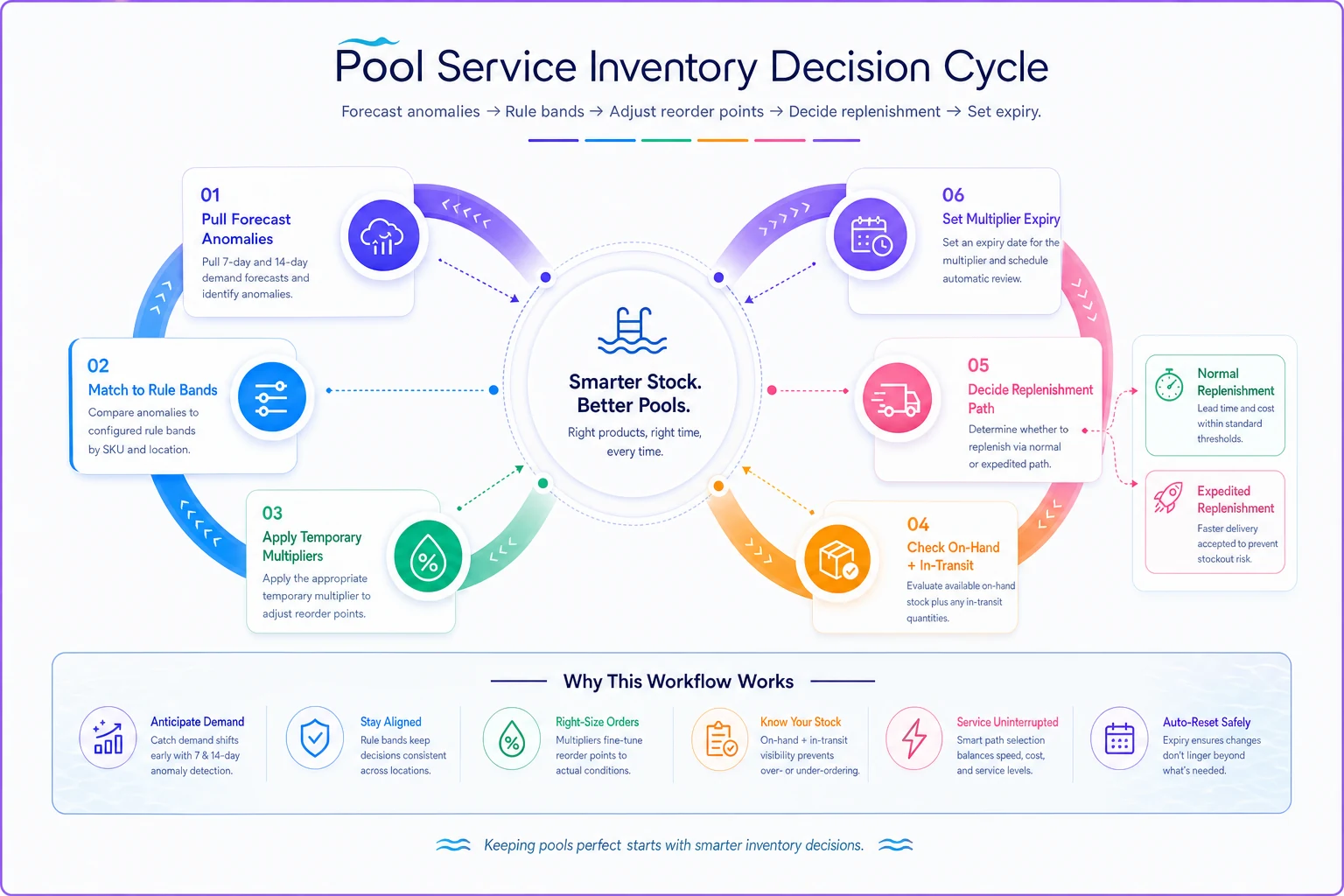
The part operators get wrong most often is step 4. They raise the reorder point correctly but still order on normal lead time, so the higher trigger fires too late to do anything useful. During a heat anomaly, the whole point is beating the lead time — demand is arriving faster than your supplier moves.
A real scenario
A mid-size operator running around 310 accounts across a hot inland territory kept hitting the same wall every June. Their chlorine ordering was tied to a weekly standing order sized off the prior year's average. In a normal year it held up fine.
Then a 10-day heat run would land — highs 7–9°F over normal — and by day 6 they'd be rationing cal-hypo across techs, pulling from one truck to cover another, and buying retail chlorine at roughly double cost to finish the week. Call it an extra $700–$900 in panic retail buys plus a handful of rescheduled accounts each time. Over a season with two or three of those runs, that's somewhere in the $2k–$3k range, plus the account-trust damage from thin or missed visits.
After building a simple anomaly rule — nothing fancy, just a spreadsheet pulling the 7-day forecast and flagging when the heat band crossed +6°F — they started bumping the chlorine order 8–10 days ahead of the heat landing. The standing order got a temporary ×1.35 during flagged windows and dropped back automatically after. Retail panic buys mostly disappeared. The mid-week truck-to-truck scrambling stopped. They also caught the reverse: a cool, wet stretch in late August where old habits would've had them overbuying, and the rule flagged it to hold.
Nothing dramatic. Just ordering against the weather that was coming instead of the calendar they wrote in spring.
The expedited-replenishment side
Multipliers handle the volume. Expedited rules handle the timing. These are separate decisions, and conflating them is where operators get hurt.
Your expedite trigger should fire when the adjusted reorder point can't be covered by normal supplier lead time before the anomaly peaks. That means you need to know two numbers cold: your normal lead time per chemical, and your supplier's expedite options and surcharge. If you've worked through a real procurement playbook with SLAs and reorder triggers, you already have these documented. If you don't, that's the prerequisite — weather rules can't help if you don't know how fast your vendor actually moves.
A practical expedite checklist during a flagged heat window:
-
Confirm on-hand plus in-transit against the adjusted reorder point
-
Check whether normal delivery lands before the anomaly peak day
-
If not, price the expedite surcharge against the cost of a stockout (retail buys + rescheduled accounts)
-
Pre-stage affected chemicals on trucks before the window, not during it
-
Notify techs which chemicals are under temporary higher-dosing conditions so field use matches the plan
That last point matters more than it sounds. If dispatch bumps the order but techs are still dosing to the old mental model, you're either over-applying or under-applying. The field and the warehouse have to be reading the same anomaly.
When this makes sense — and when it doesn't
Worth building if:
-
You run enough accounts that a heat run genuinely moves your chemical demand (roughly 150+ residential, or a mix that includes commercial)
-
Your climate has real anomaly swings, not just steady seasonal heat
-
You've been burned by at least one mid-season chlorine stockout
-
You already have baseline PARs to multiply against
Probably overkill if:
-
You run a small, tight route where you can eyeball demand and restock same-day
-
Your supplier is a 20-minute drive with deep stock, so lead time isn't a real constraint
-
You're in a climate with very low week-to-week variance
Who should not do this yet:
-
anyone who hasn't nailed down baseline consumption per chemical first. Weather multipliers amplify your baseline — if the baseline is off, you'll just be wrong faster. Get your normal PARs and consumption rates solid before layering weather logic on top.
Get your normal PARs and consumption rates solid before layering weather logic on top.
Common mistakes with weather-driven reorder rules
Treating every chemical the same. Heat moves chlorine and shock. It barely touches filter media or DE. Blanket multipliers waste cash and warehouse space on products the weather didn't actually affect.
Forgetting the expiry. A temporary ×1.3 that nobody turns off becomes the new normal. Three anomalies later you're chronically overstocked. Every multiplier needs an end date baked in from the start.
Reacting to a single hot day. The horizon matters. One 95°F spike in an otherwise normal week isn't worth acting on. Sustained deviation over the 7-day window is the signal — a single day is just noise.
Ignoring the rain side. Everyone builds the heat rule and skips the rain rule, then gets caught short on acid and shock the day after a storm system passes. Rain demand is just as real, it just shows up on different SKUs with different timing.
Where this fits in the bigger inventory picture
Weather-driven triggers aren't a standalone system — they're a short-horizon overlay on your seasonal planning. The seasonal numbers set your floor and ceiling; the anomaly rules handle the two-week wobble the season can't predict. If you want to see how the seasonal baseline should be structured underneath this, the peak-season operations benchmark covers the capacity and truck-stock foundation these rules sit on top of.
Plenty of operators run this on a spreadsheet and a weather tab, which is a perfectly fine starting point. As account counts grow, the manual version gets heavy — someone has to check the forecast, recalculate multipliers per chemical, cross-reference on-hand, and decide on expedited ordering every few days, during exactly the season when everyone's already slammed. That's where workflow software that pulls the forecast anomaly and flags the reorder adjustments automatically starts earning its keep, because the weakest link in any manual version is a busy owner forgetting to check the 7-day window on the Tuesday it mattered most.
The tooling is secondary though. The logic is the asset. Get the thresholds, the chemical scoping, and the expedite timing right on paper first — then whether you run it by hand or automate it is just a function of how many accounts you're carrying.
The short version
Stop ordering chlorine against the calendar when weather is what actually drives demand. Watch the 7- and 14-day anomaly, apply temporary multipliers to the chemicals weather actually moves, flip to expedited replenishment when normal lead time can't beat the heat, and set every multiplier to expire so it doesn't inflate your baseline.
Do that consistently and the mid-June stockout scramble — along with the shoulder-season overbuy quietly degrading in your warehouse — mostly goes away.
Do that consistently and the mid-June stockout scramble — along with the shoulder-season overbuy quietly degrading in your warehouse — mostly goes away.
Ready to elevate your pool service business?
Join hundreds of pool service professionals using Splshly to save time, optimize routes, and enhance customer satisfaction.