

Peak season staffing almost always breaks in the same spot. You hire a temp to survive the July wave, hand them a route, and by week two you're either cleaning up something they quoted wrong or re-servicing pools they half-finished. The problem isn't the temp. It's that most pool operators treat a 6-week seasonal hire exactly like a permanent one — slow ramp, vague authority, no QA plan — except there's no time for any of it.
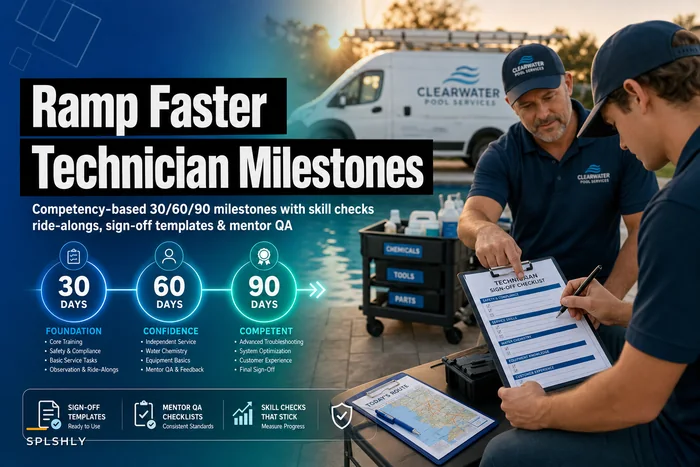
A temp working a peak wave needs a completely different operating model. Short onboarding. Hard limits on what they can decide. A real person watching their work. A QA rhythm that assumes mistakes will happen early. This post is about building that micro-ops setup specifically — not general training. If you want the long-arc version for permanent staff, that's covered in the 30/60/90 competency milestones piece. Temps are a different animal.
Why the standard ramp fails for temporary staffing in pool service
The usual onboarding assumes you'll recoup training cost over a year or two. With a temp, you've got maybe 30–45 working days before they're gone. If your ramp takes three weeks, you've spent half their tenure just getting them to baseline productive.
There's also an authority mismatch nobody really plans for. A permanent tech earns judgment over time — you let them decide when a pump needs replacing, when to upsell a filter clean, when to waive a trip fee. A temp inherits none of that trust but gets dropped into the same customer-facing situations. So they either freeze and call you forty times a day, or they improvise and quote a variable-speed pump install at a number you'd never accept.
What shows up repeatedly across seasonal operations is that failures cluster in three places: pricing decisions the temp wasn't qualified to make, QA gaps nobody caught until the customer complained, and bad habits picked up from whoever happened to be free during shadowing — usually the fastest tech, not the most correct one. Fix those three things and the temp is net-positive by day four or five instead of week three.
The 3-day crash onboarding
The whole point of a crash onboarding is sequencing. You're not teaching everything. You're teaching the minimum needed to run a supervised route, and deliberately leaving complex stuff behind a "call first" rule.
Eliminate missed appointments and dispatch delays.
Splshly ensures every pool service is scheduled, tracked, and completed efficiently.
- Unified scheduling dashboard
- Automated customer reminders
- Technician route optimization
No credit card required
Here's the structure that actually holds up during a wave:
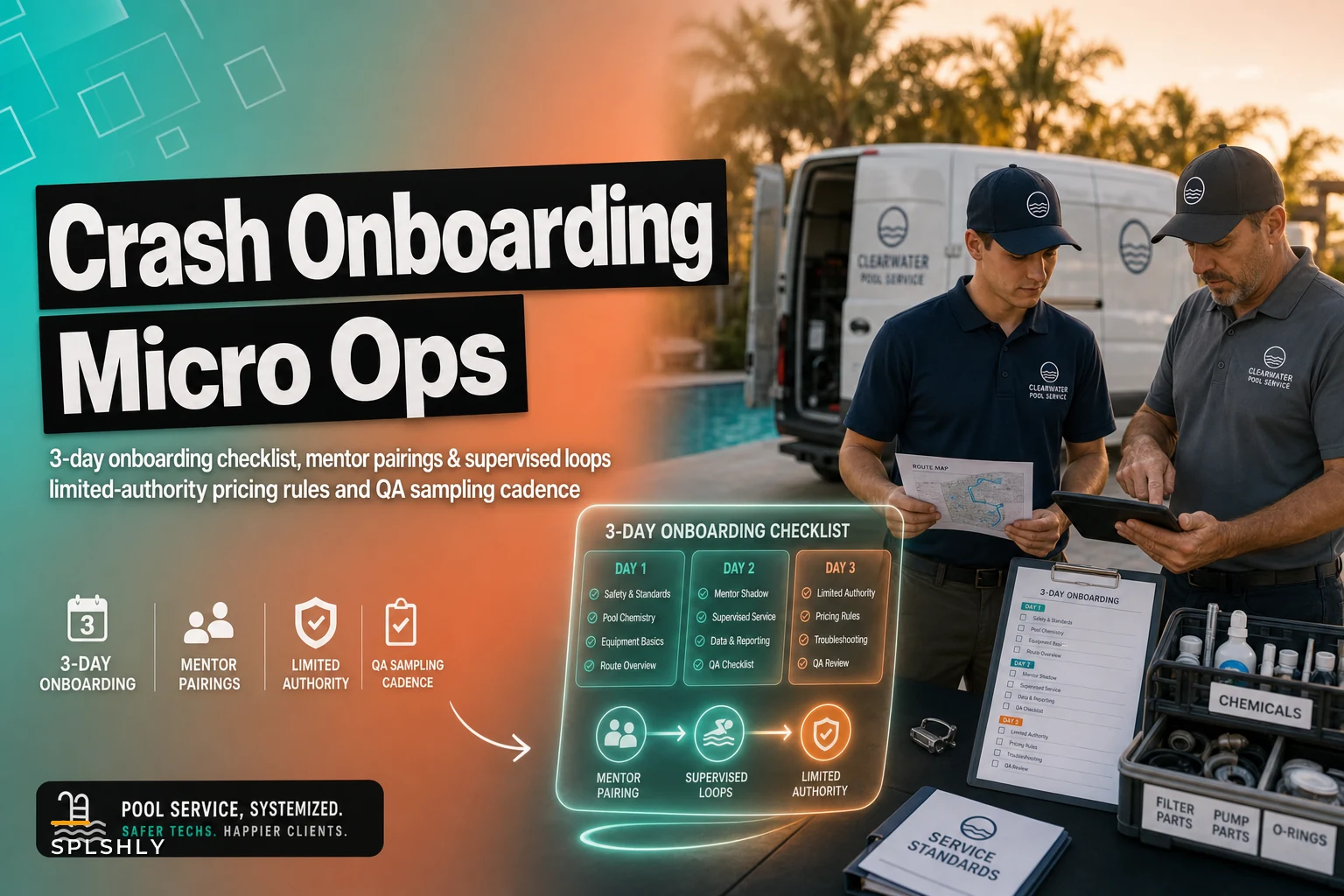
Day 1 — Route mechanics and the non-negotiables. Pure muscle memory. Chemical testing procedure, your logging format, photo requirements, how to read the day's stop list, truck stock layout. No pricing, no diagnostics beyond "is the water clear or not." End the day with the temp running 3–4 stops while the mentor stands right there watching them do the actual work.
Day 2 — Supervised solo loop. The temp runs a short route — 6 to 8 pools, all standard recurring service, nothing with known equipment issues. The mentor either rides along or meets them at two checkpoints. The goal is catching procedure drift early: skipped brushing, wrong reagent order, sloppy photos. Correct it in the field, not after.
Day 3 — Independent route with a tight leash. Full standard route, solo, but with the limited-authority rules fully in force (more on those below) and a mid-day photo check. By end of day 3 you should know whether this person can run recurring work unsupervised. Most can. The ones who can't, you've found out fast and cheap.
Keep the Day 2 checkpoints consistent times so mentors can be scheduled without disrupting other routes.
Visualize the 3-day sequence to make scheduling and mentor handoffs predictable.
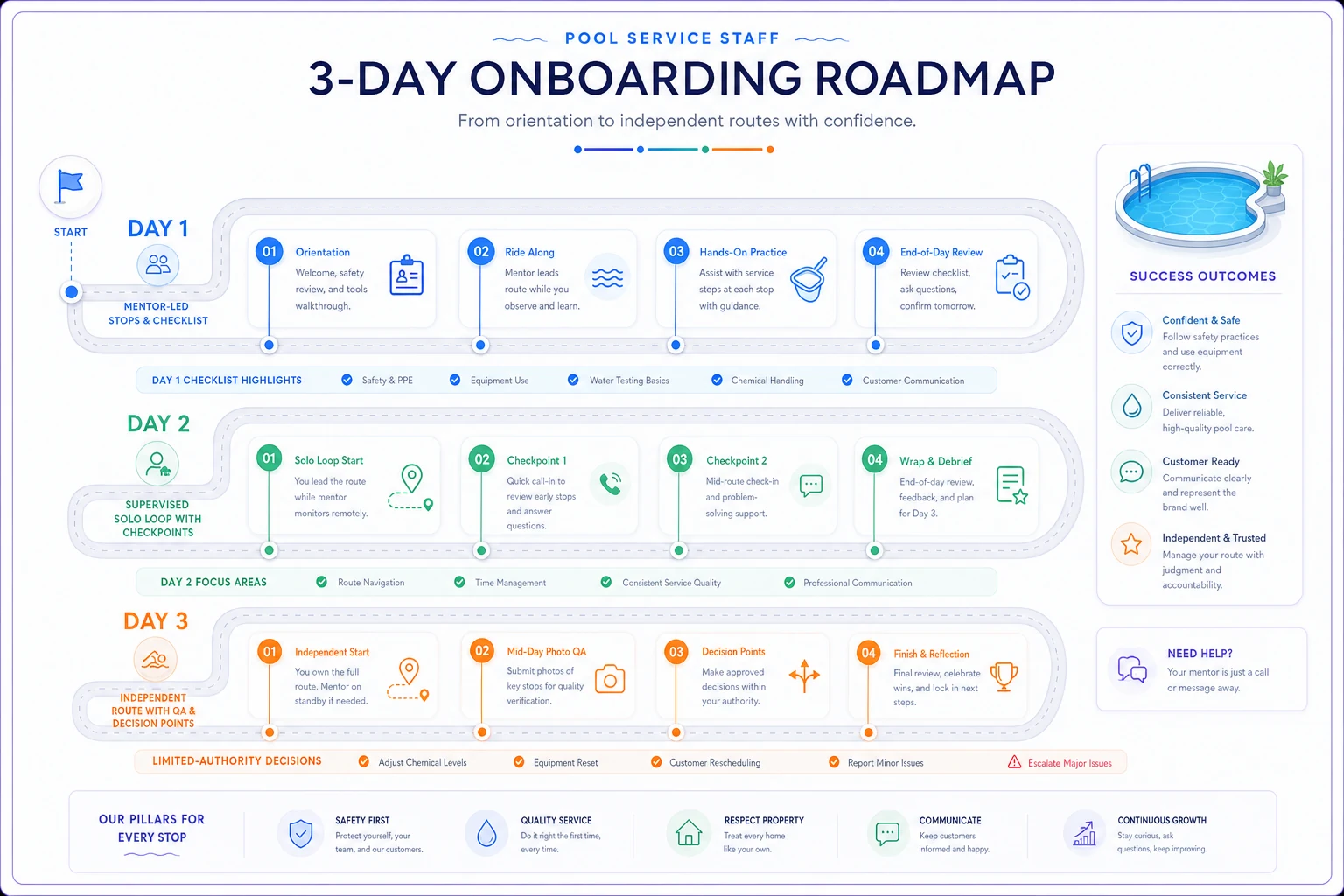
Notice what's missing: repairs, equipment diagnosis, quoting, difficult customer handling. That's intentional. A temp in a peak wave covers recurring maintenance volume so your experienced techs can take the complex work. Trying to make a temp a full-service tech in three days is where operators burn themselves.
Limited-authority pricing rules (the part most people skip)
This is the single highest-leverage thing you can set up for temp staff, and almost nobody writes it down.
The fix is a simple authority ladder — what they can handle on their own, what needs a quick approval, and what's fully off-limits.
| Decision type | Temp authority | Rule |
|---|---|---|
| Standard recurring service | Full | Just do it, log it |
| Consumables under ~$25 (basket, o-ring, DE) | Swap if in truck stock | Log part + photo, flat-rate price only |
| Trip fee waivers / discounts | None | Never offered by temp |
| Minor repairs ($25–$150) | Approval required | Photo + call dispatch for go/no-go |
| Equipment quotes (pumps, filters, heaters) | None | "A specialist will quote this" — book callback |
| Anything the customer disputes | None | Escalate, don't negotiate |
The phrase to drill into every temp: "That's a specialist quote — I'll have someone get you a number today." It's polite, it protects your margin, and it doesn't make the temp look powerless. It makes them look like part of a real company with actual process behind it.
Consider this kind of situation: a temp gets asked about a pump replacement, wants to be helpful, and says "probably around $600 installed." Your actual number for that variable-speed unit plus labor is closer to $950. Now you're either eating $350 or being the company that "changed the price." Multiply that a few times across a season and the limited-authority rule pays for the entire onboarding effort by itself.
For the consumables tier, the critical control is flat-rate pricing only. The temp never calculates anything. A cracked basket is $X, an o-ring kit is $Y, a DE refill is $Z — printed on a laminated card in the truck. Remove every opportunity to do mental math at the equipment pad and you remove most pricing errors.
Mentor pairings: pair for correctness, not availability
The default mistake is pairing the temp with whoever has a gap in their schedule. That's usually your fastest tech, and fast techs almost always have shortcuts that work fine for them but transfer badly to a beginner.
A temp copies whatever they see in those first three days. If the mentor skips brushing on "easy" pools, the temp will too — except the temp doesn't have the judgment to know which pools are actually easy. Bad habits transfer fast and they're hard to unlearn in a short tenure.
-
Pick your most consistent tech, not your fastest. Consistency is what you're trying to clone.
-
One mentor per temp for all three days. Rotating mentors means rotating definitions of "correct," which confuses a new person and makes QA ambiguous.
-
The mentor owns the day-3 sign-off. They either certify "this person can run a recurring route" or they don't. That accountability changes how seriously they treat the pairing.
-
Give the mentor a small stipend or a reduced route. Stack mentoring on top of a full route and mentoring quietly disappears — the temp ends up self-taught.
One thing worth watching: the best mentors aren't always your most senior people. Sometimes a tech who ramped up recently is a better teacher because they still remember what's actually confusing. Seniority and teaching ability are different skills.
QA sampling cadence for temps
You cannot QA a temp the same way you QA a trusted tech. A permanent tech might get spot-checked once every week or two. A temp needs front-loaded, high-frequency sampling that tapers as they prove out.
A cadence that catches problems before customers do:
-
Day 1–3 Every stop reviewed (mentor is right there anyway).
-
Week 1 solo Check roughly half their stops via photo audit same-day. Catch drift immediately.
-
Week 2 Drop to around 30%, randomized, but include at least one in-person pop-in.
-
Week 3+ Settle to ~20% if quality holds. If any week shows repeated misses, bump sampling back up — don't let it slide.
The sampling has to be same-day early on. A photo audit done Friday on Monday's work is useless — the customer already saw the problem. The value is catching the skipped brushing or wrong chlorine level while you can still send someone back quietly.
What you're specifically sampling for with temps:
-
Photo completeness (equipment and water state documented)
-
Chemical readings inside acceptable bands
-
Brushing and skimming actually done, not just claimed
-
Any pricing or promise made that violated the authority rules
-
Stops marked complete without supporting evidence
That last one is the sneaky problem. Temps under wave pressure will sometimes mark a pool serviced to keep pace. Same-day photo evidence is the only thing that reliably catches it.
A real scenario
A mid-size residential operator running 7 trucks brought on 3 temps for a hot stretch — roughly a 6-week wave with volume up around 35% over their normal load. First season, they onboarded the temps like regular hires and got burned: two mispriced repairs that cost a few hundred dollars each, and a cluster of re-service calls in weeks two and three from skipped steps nobody caught.
The next season they ran the micro-ops version: 3-day crash onboarding, laminated flat-rate cards, strict "specialist quote" rule on anything above consumables, consistent mentor pairings, and same-day photo QA at roughly 50% for the first week.
The difference wasn't dramatic in a flashy way — it was just quieter. Re-service calls on temp routes dropped to a handful instead of a steady drip. No pricing surprises, because no temp quoted anything above their authority tier. The owner's phone stopped blowing up with "what do I do here" calls because the authority ladder had already answered most of those questions before they could even come up.
The temps were covering real recurring volume by day four or five, and experienced techs were freed up for repair and equipment work that actually carries margin. The onboarding investment was a few hours of mentor time and some laminated cards.
When this makes sense — and when it doesn't
This setup is worth it when:
-
You bring on temps for predictable peak waves every year.
-
Your recurring maintenance volume is high enough to hand temps standard routes while permanent techs take complex work.
-
You already have documented procedures and photo requirements to anchor the QA.
This is overkill when:
-
You're hiring one temp for a two-week fill. The structure costs more than it saves at that scale — just have them ride along.
-
Your operation has no standard procedures yet. Fix that first; a temp can't follow rules you haven't written.
Who should NOT run temps on solo routes at all: If your book is heavy on commercial accounts, finicky equipment, or customers who expect a consistent named technician, a temp on a 3-day ramp is the wrong move. Keep them in a support role — truck stocking, basic residential, ride-alongs — and let permanent staff hold the relationships.
Tying it into your seasonal plan
Temp micro-ops isn't a standalone decision. It only works if you've already figured out how many temps you need and when the wave actually hits — which is really a capacity and cashflow question, the kind of planning covered in the seasonal capacity and cashflow piece. And if your peaks are storm-driven rather than purely seasonal, the activation timing changes, which ties into the storm surge playbook where temporary staffing and temporary pricing both come into play.
A temp in a peak wave is not a junior version of a permanent tech. They're a specialized resource with a narrow job — absorb recurring volume, accurately, under supervision, without making decisions above their authority. Build the micro-ops around that reality and temps become a genuine capacity buffer instead of a source of cleanup work. Build it around a generic onboarding and you'll spend your whole peak season fixing problems you created on hiring day.
A temp in a peak wave is not a junior version of a permanent tech. They're a specialized resource with a narrow job — absorb recurring volume, accurately, under supervision, without making decisions above their authority. Build the micro-ops around that reality and temps become a genuine capacity buffer instead of a source of cleanup work. Build it around a generic onboarding and you'll spend your whole peak season fixing problems you created on hiring day.
Ready to elevate your pool service business?
Join hundreds of pool service professionals using Splshly to save time, optimize routes, and enhance customer satisfaction.