
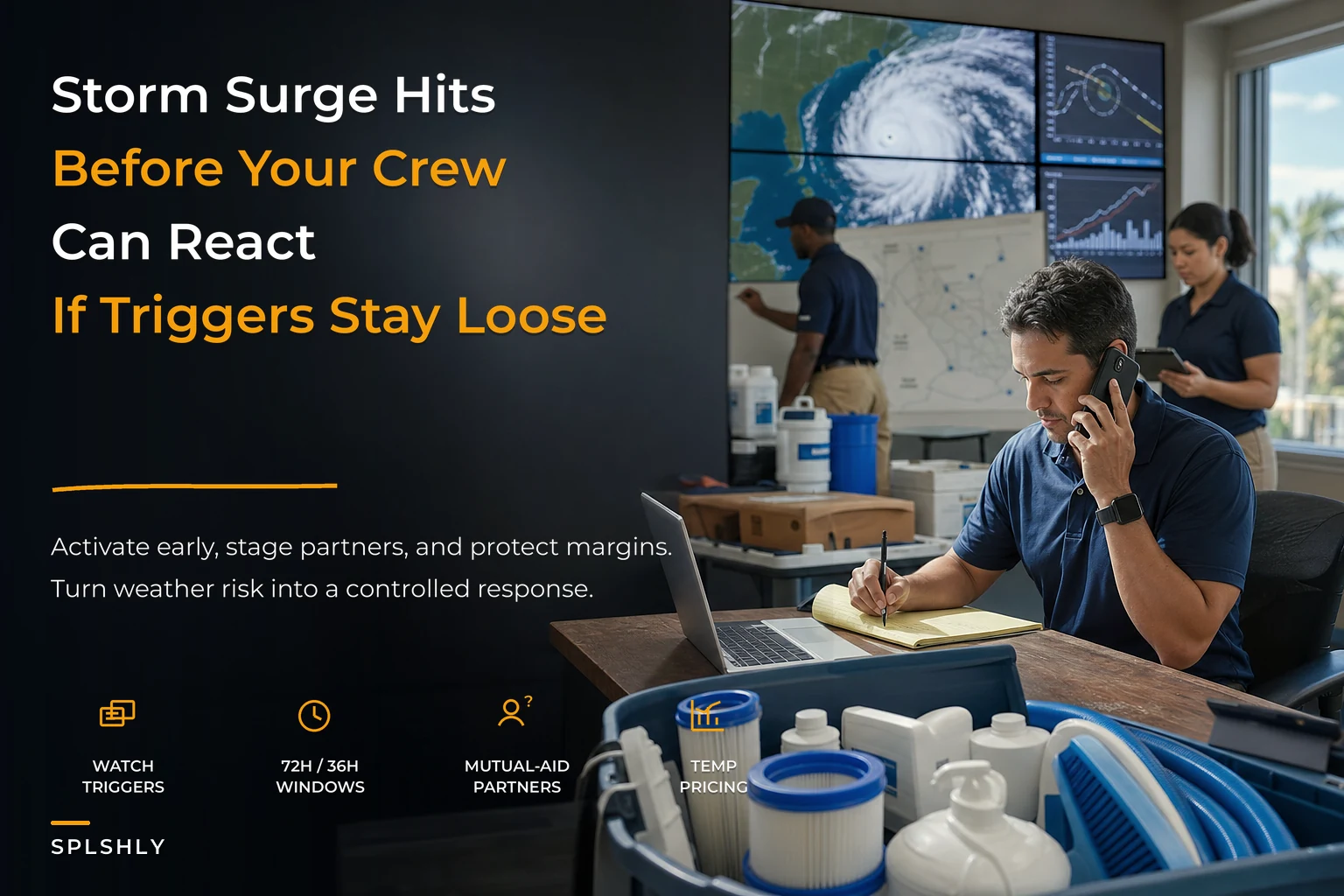

Most pool service companies treat storm response like it's a surprise every single time. The forecast shifts, the phones blow up, and the owner spends the first half of the day making decisions that should've been locked in months ago. A checklist tells you what to do. A playbook tells you when it turns on, who does what, and how you get paid — before the wind ever picks up.
That's the gap this covers. Not another intake sheet for dispatchers — there's already solid material on the post-storm triage and scheduling side if that's what you need. This is the operational backbone underneath it: the surge triggers that flip your company into storm mode, the mutual-aid contracts that give you extra hands, the triage logic that keeps chaos from swallowing dispatch, temporary pricing that keeps you solvent, and parts-kitting rules that let a crew leave the shop already loaded for what they'll actually find.
The core problem: you're improvising decisions that should already be made
When a named storm rolls through a service area, a pool company's workload doesn't go up 20%. It can spike 4x to 6x over a two-week window, then collapse back down. Green pools, tripped breakers, flooded equipment pads, cracked skimmers, debris-clogged pumps, contaminated water everyone wants drained today. The demand is enormous and compressed into a short window.
What breaks: the business that was running smoothly at 300 accounts suddenly has 180 emergency requests stacked on top of the normal recurring route. The owner is answering calls, techs are guessing at priority, and someone quotes a full pump replacement at normal pricing while the distributor's shelves are already cleared out three counties over.
A checklist doesn't fix this because it assumes someone has time to read it and make judgment calls in the moment. During a surge, nobody has that time. What you need are pre-authorized triggers — rules that make the decision for you the moment conditions are met.
Program-level surge triggers: deciding before you have to decide
A surge trigger is a defined condition that, when hit, automatically kicks off a specific set of operational changes. The whole point is removing hesitation. If the trigger fires, storm mode is on. No meeting, no debate.
Eliminate missed appointments and dispatch delays.
Splshly ensures every pool service is scheduled, tracked, and completed efficiently.
- Unified scheduling dashboard
- Automated customer reminders
- Technician route optimization
No credit card required
| Trigger Level | Activation Condition | What Turns On |
|---|---|---|
| Watch (T-72h) | NWS watch issued for service area, or sustained forecast of 3"+ rain | Freeze new non-urgent bookings, top off truck kits, confirm mutual-aid partners on standby |
| Warning (T-36h) | Warning issued, or mandatory evacuation zones announced | Reschedule all routine maintenance, open triage center, activate temporary pricing schedule, pre-stage parts |
| Impact (0–48h post) | Storm passes / all-clear to travel | Triage-only dispatch, mutual-aid crews report, damage documentation protocol live |
| Recovery (48h–14d) | Emergency backlog under a set threshold | Reintroduce recurring routes on rolling basis, wind down surge pricing, reconcile mutual-aid hours |
The value here isn't the exact numbers — your market's flood profile and crew size will shift them. The value is that each level has a single owner who can flip it, and everyone on the team already knows what changes the instant it does. When a tech hears "we're at Warning," they know routine stops are off and the kit list changed. No explanation needed.
Companies that write triggers around forecast conditions rather than actual damage consistently get ahead of the rush. By the time damage is visible, distributors are cleaned out and every competitor is calling the same suppliers. The T-72h watch trigger exists so your parts and pricing moves happen while shelves are still stocked.
Here's a quick visual of the trigger-to-action workflow:
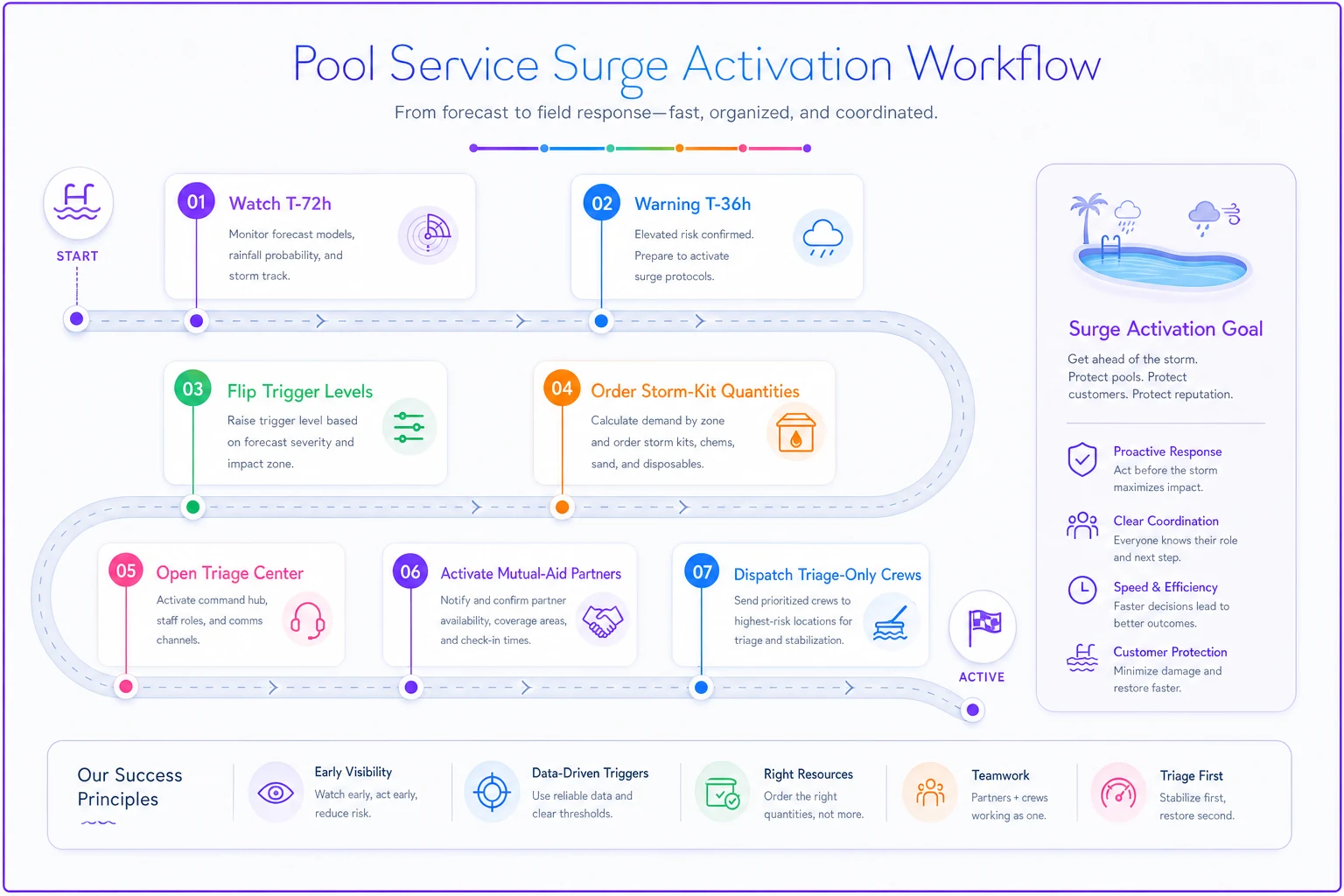
When the workflow is this obvious and pre-authorized, decision latency disappears and you execute instead of debating in the middle of a surge.
Mutual-aid partner contracts: the part almost nobody sets up in advance
This is the piece that separates companies that survive a bad season from ones that burn out their crew and lose accounts to slow response.
A mutual-aid partner is another pool service company — usually 100-plus miles away, outside your likely impact zone — that agrees to send techs and trucks when you activate, in exchange for you doing the same when their region gets hit. Storms are geographic. Your disaster is their quiet Tuesday, and vice versa.
What needs to be in the contract:
-
Activation notice window — how much lead time you owe them (usually 48–72h)
-
Daily rate or hourly rate per tech + truck, and who covers fuel and lodging
-
Insurance and licensing — confirm they're covered to work in your state; this trips up a lot of cross-state arrangements
-
Scope limits — are their techs doing full repairs, or triage-and-stabilize only?
-
Materials handling — do they bring parts, pull from your stock, or invoice you at cost?
-
Reciprocity terms — the mirror obligation when their region activates
-
Payment timeline — net-15 or net-30, because cash is tight for everyone post-storm
A realistic arrangement: two partner companies each keep a signed agreement on file, rate set at a flat daily per tech plus mileage, capped at 10 days per activation, with a hard rule that stabilization work takes priority over revenue repairs. When the trigger fires, one phone call activates it.
What people miss: mutual-aid crews aren't just extra bodies. They're rested bodies. Your own techs are exhausted and personally affected — a lot of them have storm damage at their own homes. Bringing in outside crews for the brutal first 72 hours keeps your core team from breaking down before the real recovery work even starts.
Standing up a triage center: routing chaos through one point
During normal operations, dispatch runs on your usual rhythm. During a surge, that rhythm collapses under call volume, and the single biggest failure point is letting requests flow in through five different channels with no ranking system.
A triage center is less a place than a function: one coordinated intake-and-prioritization hub that every request passes through before a truck rolls. Calls, texts, portal requests, walk-ins — all of it funnels to the same triage logic.
The prioritization has to be pre-defined, because during a surge nobody should be debating whether a green pool outranks a tripped GFCI. A tiering approach that works:
-
Safety-critical — electrical hazards near water, chemical exposure, structural failure threatening people. These jump the entire queue.
-
Contamination / health — sewage backflow, dead-animal contamination, water so far gone it's a health risk for the household.
-
Equipment-at-risk — flooded pumps and motors that are salvageable if addressed within 24–48 hours but destroyed if ignored.
-
Cosmetic / restoration — green water, debris, general cleanup with no equipment or safety stakes.
The thing most dispatchers learn the hard way: the loudest customer is rarely the highest priority. The person screaming about a green pool is Tier 4. The quiet older customer who mentioned "the box by the pump is making a buzzing sound" is Tier 1 you almost missed. Triage means someone is actively asking the diagnostic questions that surface real risk — the same disciplined thinking behind a solid diagnostic flowchart for prioritizing pool problems, just applied to a flood of intakes instead of one pool.
The triage center is also where mutual-aid crews get their assignments. You don't want out-of-town techs deciding priority in a market they don't know. They get routed and fed jobs; triage keeps the ranking logic.
Temporary pricing: staying solvent without gouging
This one makes owners nervous, and it should. Get it wrong in one direction and you go broke doing emergency work at standard margins while paying overtime and premium parts prices. Get it wrong in the other direction and you look like a price-gouger in a community that will remember it for years.
The right approach is a pre-published temporary pricing schedule that activates with your Warning-level trigger and winds down at Recovery. Because it's pre-defined and rule-based, it's defensible — you're not making up numbers based on how desperate a customer sounds.
A few principles that hold up:
-
Separate emergency-response pricing from repair pricing. A storm-response dispatch fee covering the priority visit, assessment, and immediate stabilization is fair and easy to explain. Marking up parts is where you get into trouble.
-
Pass through distressed material costs at cost-plus-normal-margin, not inflated. If pumps cost more because supply is tight, show it honestly.
-
Cap surge pricing on essential safety work. Keeping Tier 1 safety response at or near normal rates protects your reputation and, in many states, keeps you clear of anti-gouging statutes.
-
Time-box everything. The pricing schedule expires automatically at Recovery so it doesn't quietly become your new normal.
A realistic structure: normal service rates stay put, plus a flat storm-response visit fee during the active window, plus overtime-adjusted labor for after-hours emergency work, with parts at your standard margin over actual — higher — distributor cost. Communicate it plainly. A short note to your account base when Warning activates does more to protect you than any legal disclaimer.
This mirrors what happens with any cost-spike pricing response: companies that pre-decide their pricing rules stay calm and profitable, while the ones improvising either eat the losses or torch their reputation.
Parts-kitting rules: loading trucks for what a storm actually breaks
Your everyday truck stock is built for routine maintenance and common repairs. Storm damage has a completely different parts profile, and if crews roll out with normal kits, you get the exact problem you spend all year trying to avoid — return trips, during the one window where return trips are catastrophically expensive.
Storm work concentrates around a predictable failure set: flooded and fried pump motors, tripped and damaged GFCIs and breakers, clogged and broken skimmers and baskets, cracked returns, debris-shredded filters, and heavy chemical demand for shocking neglected and contaminated water.
A storm-kit rule means you have a pre-assembled surge configuration that gets loaded when the Warning trigger fires, on top of or replacing standard stock. It's not a suggestion — it's a defined kit that a warehouse person or lead tech assembles against a checklist.
-
Replacement pump motors in your two or three most common HP ratings for the area
-
Electrical
GFCIs, breakers, wire nuts, weatherproof connectors, spare timer mechanisms
-
Skimmer and return components
baskets, lids, diverters, common fittings, PVC and couplings
-
Filter media and cartridges in your area's dominant filter types
-
Bulk shock and chlorine at surge quantities — routine kits never carry enough
-
Debris-handling gear
heavy-duty nets, submersible pump for draining, wet-vac
-
Documentation supplies
since insurance claims follow storm work, every crew needs the ability to photograph and log damage on-site
Kit to the two or three most common pump motor HP ratings first — they'll burn fastest during a surge.
The rule that separates smooth operations from constant restocking: kit to the failure pattern, not the average day. A normal week might need one motor across the whole fleet. During a surge, a single truck can burn through three motors in a day. If your kitting quantities are set to normal PARs, every crew is back at the shop by noon — and the shop is already chaos.
This is why the parts side connects directly to the trigger side. The T-72h Watch trigger exists partly so you order storm-kit quantities while distributors still have stock. Waiting until damage is confirmed means kitting from empty shelves.
When a full activation playbook actually makes sense (and when it doesn't)
Not every pool company needs this level of structure, and it's worth being honest about that.
This makes sense when:
-
You operate in a hurricane, tropical-storm, or serious flood-prone region where surge events are a recurring reality, not a once-in-a-decade thing
-
You've grown past the point where the owner can personally manage every emergency decision — usually somewhere north of 200–300 accounts
-
You've already lost accounts, money, or crew to a badly-handled storm season and don't want a repeat
This is probably overkill when:
-
You're in a low-storm-risk inland market where a serious weather event hits maybe once every several years
-
You're a small owner-operator handling everything personally with a light account load, where a simple checklist and a couple of good supplier relationships genuinely cover it
-
Your account base is so geographically concentrated that a single storm either misses you entirely or takes out everything at once with no phased response possible
The honest middle ground: even smaller shops in storm regions should at minimum have the surge triggers and a mutual-aid arrangement written down somewhere. Those two pieces alone prevent the worst outcomes. The triage center and full parts-kitting rules matter more as you scale.
A realistic activation scenario
Consider a mid-sized company running roughly 340 accounts in a coastal county. A tropical storm is forecast to make landfall in three days.
Before they built a playbook, a comparable event two seasons earlier played out like this: the owner spent the first two days answering phones and dispatching by gut. Techs made three or four return trips each because trucks weren't kitted for storm damage. They ran out of pump motors on day two and couldn't get more for a week. Pricing was inconsistent — one customer got charged full rate, another got a favor, and a few felt gouged and complained publicly. They lost roughly a dozen accounts over the following month and the crew was burned out for six weeks.
With triggers, mutual-aid, and pre-staged kits in place, the same class of storm looked different. The Watch trigger fired at T-72h; routine bookings froze and storm-kit quantities were ordered while supply held. At Warning, the triage center opened, temporary pricing went live with a plain-language notice to customers, and a mutual-aid partner from two states inland confirmed two trucks. Post-impact, outside crews took the brutal Tier 1 and Tier 2 stabilization work for the first three days while the core team handled higher-value repairs on rested legs. Return trips dropped sharply because trucks were loaded for what crews actually found.
The difference wasn't some dramatic revenue jump. They held onto their accounts, protected margins on emergency work instead of eating overtime at standard rates, and their techs weren't running on fumes a month later. In a surge business, not losing is the win.
Bringing it together
One-off checklists keep failing pool companies during storms because they assume calm judgment at the exact moment judgment is impossible. A real playbook does the opposite — it front-loads every hard decision into triggers, contracts, pricing schedules, and kitting rules that fire automatically, so your team executes instead of improvises.
Build the triggers first. Line up at least one mutual-aid partner in the off-season, because you cannot create that relationship mid-crisis. Define your triage tiers so the loudest caller doesn't outrank the dangerous one. Pre-publish pricing so you're solvent and defensible. Kit your trucks to the storm's failure pattern, not an average Tuesday.
Do that once, refine it after each season, and storm response stops being the thing that nearly breaks your company every year. It becomes just another operating mode — one you flip on deliberately, with everything already in place.
One-off checklists keep failing pool companies during storms because they assume calm judgment at the exact moment judgment is impossible. A real playbook does the opposite — it front-loads every hard decision into triggers, contracts, pricing schedules, and kitting rules that fire automatically, so your team executes instead of improvises.
Build the triggers first. Line up at least one mutual-aid partner in the off-season, because you cannot create that relationship mid-crisis. Define your triage tiers so the loudest caller doesn't outrank the dangerous one. Pre-publish pricing so you're solvent and defensible. Kit your trucks to the storm's failure pattern, not an average Tuesday.
Do that once, refine it after each season, and storm response stops being the thing that nearly breaks your company every year. It becomes just another operating mode — one you flip on deliberately, with everything already in place.
Ready to elevate your pool service business?
Join hundreds of pool service professionals using Splshly to save time, optimize routes, and enhance customer satisfaction.