


The Memorial Day rush hits every pool service business the same way. Your phone won't stop ringing with opening requests, your regular routes are already packed, and you're turning down $400 service calls because there's literally nowhere to put them. Your techs are grinding 60-hour weeks, cash is tied up in chemical inventory, and you're scrambling to find anyone who can tell the difference between cyanuric acid and muriatic.
Then August rolls around. Half your seasonal clients have gone quiet, your full-time techs are back at the shop by 2 PM, and you're still paying for that extra truck you leased in April. The $30k you thought would be sitting in reserves got eaten by overtime and rush chemical orders back in June.
This boom-bust cycle destroys pool service businesses. Not because owners don't see it coming—everyone knows summer is busy. The problem is most owners plan for "busy" as a single condition instead of mapping out the actual capacity curves, cash positions, and staffing models needed for each phase of the season.
Why generic seasonal planning falls apart
Seasonal capacity planning for pool services isn't just about hiring more people in summer. The demand curve has multiple peaks and valleys that don't line up with your fixed costs, available labor, or cash flow timing.
A typical 40-route operation might see weekly service requests jump from 160 in March to 410 in late May, then stabilize around 280 through July before dropping to 190 by September. But that's just volume. The mix of work shifts too—equipment repairs spike in April, algae calls explode in July, closing requests cluster in October.
Your cost structure doesn't flex the same way revenue does. Full-time tech salaries stay constant whether they're running 8 stops or 14. Chemical orders require upfront cash even though customers pay 30 days later. Insurance and truck payments hit the same every month regardless of how many pools you're servicing.
And the labor market works against you. Every pool company needs techs in May. By the time you realize you're short, the decent temporary workers are already committed elsewhere. You end up overworking your core team—burning them out before the real heat hits—or hiring whoever's available and hoping they don't damage customer relationships you spent years building.
The traditional response—hire a couple of extra people in April and hope for the best—creates its own mess. Those extra techs need training, trucks, and routes. If demand doesn't come in exactly as expected, you're carrying overhead you can't afford. If it exceeds expectations, those green techs can't handle complex repairs anyway.
Scenario-based models beat single-point forecasts
Seasonal capacity planning requires multiple scenarios tied to specific triggers—not a single projection. You need distinct plans for high-growth, normal, and slow seasons, with clear indicators that tell you which scenario you're in and when to shift.
Eliminate missed appointments and dispatch delays.
Splshly ensures every pool service is scheduled, tracked, and completed efficiently.
- Unified scheduling dashboard
- Automated customer reminders
- Technician route optimization
No credit card required
Start with route-level forecasting instead of company-wide estimates. Each route has different seasonal patterns depending on pool types, neighborhoods, and service contracts. Your commercial route might stay steady all season while residential ones spike and crash. New construction areas might not see pools open until June, while established neighborhoods start calling in April.
Map three scenarios for each route:
High-demand scenario assumes weather breaks early, stays hot, and pools get heavy use. Service calls climb 40% above baseline by mid-May. Equipment failures spike from extended run times. Chemical consumption jumps around 25% as customers try to keep pools party-ready every weekend.
Normal scenario follows historical patterns—gradual ramp-up through May, steady demand June through August, gradual decline in September. Service calls track within 10% of last year. Chemical usage stays predictable.
Slow scenario accounts for cool springs, rainy summers, or economic softness. Opening requests drag into June. Customers skip weekly services when pools aren't being used. Repair approvals get delayed as homeowners defer spending.
For each scenario, calculate specific capacity needs. If Route 12 normally handles 35 stops but high-demand projects 48, you need roughly 37% more capacity. That might mean adding a partial route, extending hours, or routing overflow to adjacent territories.
The key piece: define trigger points that tell you which scenario is actually playing out. If opening requests hit 80% of high-scenario projections by April 15, start executing that plan. Don't wait until you're already underwater.
Cash reserves and pricing rules for seasonal swings
Pool service businesses fail in September, not May. They run out of cash after the summer rush ends but before final payments come in. The math is rough—you might generate 65% of annual revenue between May and August, but your costs spread more evenly across the year.
Build cash reserve targets tied to your scenarios. Track daily cash position against benchmarks, not just monthly P&L. A healthy June might show $45k profit on paper while your bank account sits at $3k because you pre-bought chemicals and haven't collected from half your openings yet.
Pricing rules need seasonal triggers too. That $75 opening special makes sense in March when you're trying to lock in route density. By May 20th, openings should be $125 minimum because you're trading off higher-margin service work. Emergency algae treatments in July? That's $200, not the $95 you charge in April.
Specific thresholds worth building in:
-
When weekly route capacity hits 85%, new service agreements increase 15%
-
After May 15, opening appointments carry a $50 rush charge
-
Equipment repairs after June 1 include a 20% peak season surcharge
-
Chemical delivery fees double when truck capacity exceeds 90%
These aren't arbitrary markups. They reflect real opportunity costs. Every tech-hour spent on a low-margin opening in late May is an hour not available for profitable repair work.
| Trigger | Adjustment |
|---|---|
| When weekly route capacity hits 85% | New service agreements increase 15% |
| After May 15 | Opening appointments carry a $50 rush charge |
| Equipment repairs after June 1 | Include a 20% peak season surcharge |
| When truck capacity exceeds 90% | Chemical delivery fees double |
Your cash reserve target also varies by month and scenario. In a high-demand scenario, you might need $55k entering May to fund chemical inventory, overtime, and equipment rentals before customer payments catch up. Normal scenario might work with $35k. Slow scenario could function with $20k, but you'd need tighter payment terms.
Flexible labor models beyond "hire for the peak"
The standard advice to hire seasonal workers in April misses crucial flexibility needs. Pool service demand doesn't just go up and down—it shifts between service types, technical complexity, and geographic concentration.
Instead of adding full-time techs, build a bench system with graduated involvement levels. Start with part-time pool store employees who can run basic routes on Saturdays. They already know chemicals and equipment—they just need route training. When demand spikes, they shift from store to field. When it drops, they go back to retail.
Build relationships with technical schools and certification programs. Students finishing pool operator courses need field hours. You provide experience, they provide surge capacity during critical weeks. Structure it as an educational internship, not just cheap labor.
Your temporary labor rules should specify exactly when each tier activates. Not "when we're busy" but "when Route 8 exceeds 42 stops for two consecutive weeks" or "when repair callbacks exceed 3 per day." This removes panic hiring and gives your team predictable reinforcement.
The approach that gets overlooked: cross-train your existing team for role flexibility. Your best chemical delivery driver might handle basic cleanings during peak weeks. Your senior tech might shift to pure diagnostics while newer techs cover routine maintenance. Your office manager could run the easy commercial route on Fridays.
Cross-train delivery drivers for basic route stops so peak demand doesn't force you into last-minute hires.
Pay structures need to support that flexibility. Hourly techs might get route completion bonuses during peak season. Salaried techs might earn overtime for weekend emergency calls. Part-time bench workers might get retention bonuses for staying available through the season.
A realistic model for a 6-tech operation: 4 full-time techs year-round, two part-time pool store employees working Saturdays May through August, one technical school intern for 8 weeks at peak, two on-call former employees picking up overflow routes as needed. That's roughly 40% surge capacity without adding permanent overhead.
Technology that actually helps capacity planning
Most pool service software tracks what already happened, not what's coming. You can see last month's route density but not next week's projected bottlenecks. You know current tech utilization but not when you'll need to call in bench capacity.
The systems-first approach to scaling operations matters here. Capacity planning only works when your core systems—routing, inventory, billing—already run smoothly. Otherwise you're trying to forecast chaos.
Modern operational platforms with AI automation can analyze route patterns, weather forecasts, and historical data to surface capacity issues weeks before they become problems. They'll flag when specific routes are trending toward overload, when chemical consumption is outpacing projections, or when cash positions are about to hit critical thresholds.
Here's a workflow showing how route and inventory data feed triggers and automated responses.
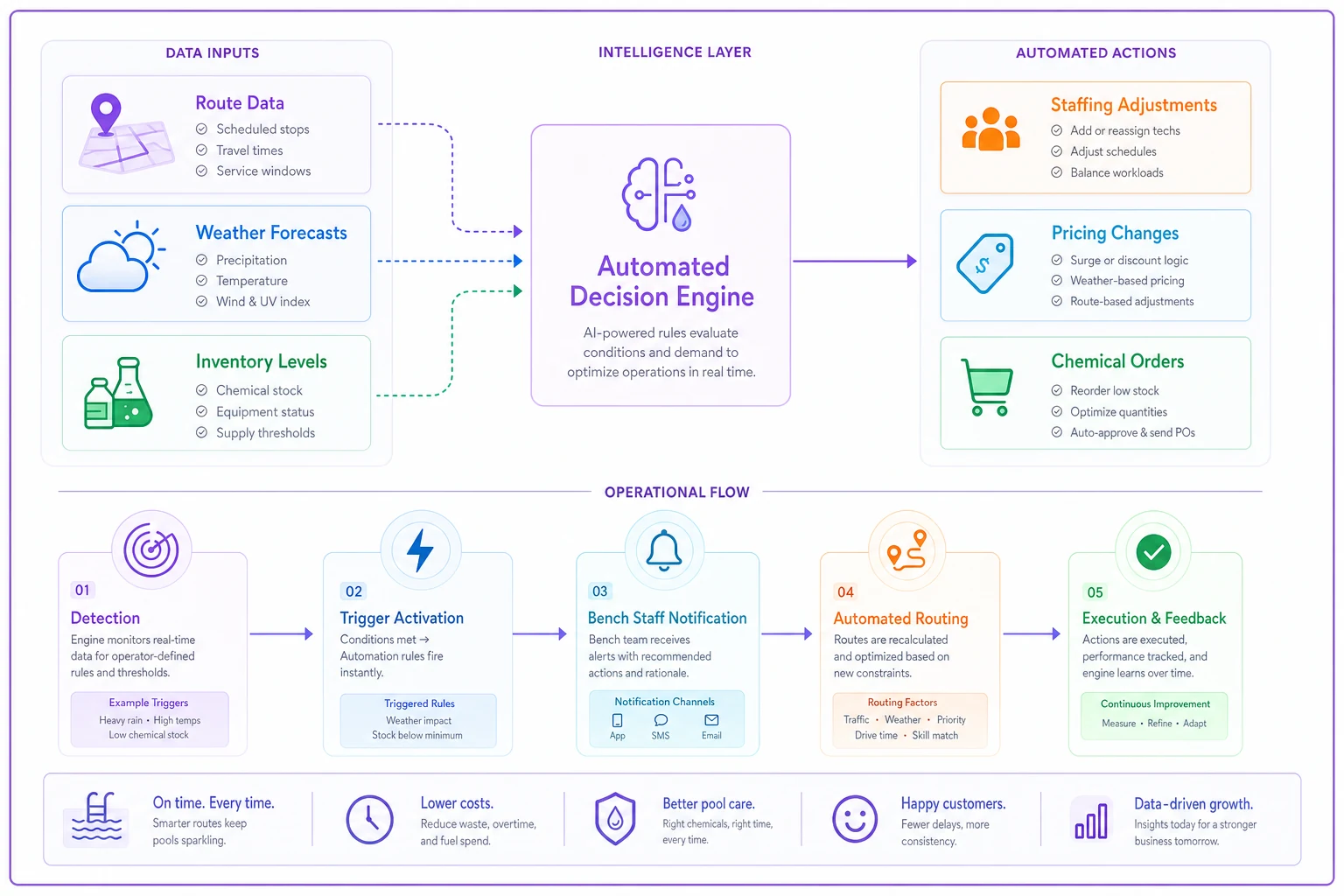
More practically, these systems can automatically trigger your scenario responses. When opening requests hit your high-demand threshold, the platform initiates bench staff notifications, adjusts pricing rules, and modifies route capacity limits without someone manually watching for it.
The automation also handles coordination tasks that fall apart during season rushes—temporary staff get route assignments and customer notes automatically, overflow appointments route to available capacity without manual intervention, chemical orders adjust based on actual consumption rather than guesswork. During peak periods, AI-assisted tools can handle initial customer communications, schedule appointments within capacity constraints, and collect necessary information before a human even needs to get involved. That keeps your phone from melting down during the Memorial Day weekend rush.
Building next season's model from this season's data
Seasonal planning gets better through iteration. This year's actuals become next year's baseline. But you need to capture the right information while it's happening—not try to reconstruct it in November.
Track decision points and outcomes. When you activated bench labor, did it happen at the right trigger point? Were your cash reserves sufficient when you actually needed them? Did pricing adjustments manage demand or just frustrate customers?
Your KPI dashboard should include seasonal planning metrics:
-
Forecast accuracy by route and week
-
Trigger point effectiveness (too early, too late, about right)
-
Bench labor utilization vs. cost
-
Cash reserve adequacy at critical dates
-
Revenue per tech-hour by service type and period
Document what broke despite planning. Maybe your chemical supplier couldn't fulfill rush orders even with advance notice. Maybe bench labor wasn't actually available when you needed them. Those failures inform next year's adjustments.
Don't just track numbers—capture context. Weather patterns, local events, and economic conditions all affect demand. That spike in late June might look random until you realize it lined up with a heat wave that came three weeks early.
The compound effect of seasonal capacity planning
A 45-route pool service operation enters March with clear scenario triggers tied to specific dates. Opening bookings are tracking 15% above normal scenario by March 25. The owner activates high-demand protocols: part-time staff get scheduled for Saturday training, pricing increases take effect April 1, chemical orders go up 30%.
By mid-April, cash reserves sit at $52k—right on target for high-demand scenario. The first bench tech starts shadowing routes. Truck stocking levels shift to peak-season PARs. Route capacity caps at 42 stops to protect service quality.
May rushes arrive and feel manageable. Bench labor is already trained. Pricing adjustments have naturally throttled demand to match capacity. Cash position stays healthy despite higher chemical costs because payment terms were tightened in advance.
Through summer, the operation runs at 95% capacity without grinding down core staff. Temporary workers handle overflow, not critical services. Customer satisfaction stays intact because expectations were set accurately.
By September, revenue is up roughly 20% over the previous year—and more importantly, cash reserves are solid entering the slow season. The core team isn't burned out. Customer relationships are intact heading into next year.
When seasonal planning makes sense (and when it doesn't)
This level of planning works for established businesses with predictable seasonal patterns. If you've been operating less than two years, you don't have enough baseline data yet. Focus on surviving seasons first, optimizing them later.
Businesses under 20 routes might not need complex scenario planning. Owner-operator flexibility naturally handles most demand variation. But once you're managing multiple crews and $30k+ in monthly overhead, seasonal planning stops being optional.
Geographic location matters too. Phoenix pool services face completely different patterns than Minneapolis. Year-round markets might see vacation-driven seasonality. Tourist areas can have inverted demand curves.
The investment in planning pays off when:
-
Seasonal revenue swings exceed 30%
-
You're regularly turning away profitable work during peak season
-
Cash crunches happen predictably despite profitable operations
-
Your team hits burnout cycles every summer
-
Customer churn spikes during your busiest periods
It's probably not worth the complexity if:
-
Your market has minimal seasonality
-
You're still building basic operational systems
-
Your model focuses on commercial or HOA contracts with steady demand
-
You're intentionally staying small and owner-operated
The investment in planning pays off when the conditions above align with your operations and goals.
Turning seasonal chaos into competitive advantage
Most pool service businesses treat seasonality as an unavoidable burden. They hire and hope, spend and scramble, survive and repeat. But seasonality is predictable. Demand curves repeat. Cash cycles follow patterns. Labor markets move in knowable ways.
The businesses that build real seasonal capacity planning—multiple scenarios, graduated labor models, dynamic pricing rules—don't just survive summer. They capture more profitable work, hold onto their teams, and enter slow seasons with reserves intact.
This isn't about predicting the future perfectly. It's about preparing for multiple futures systematically. When you have specific plans for high, normal, and slow scenarios with clear triggers and pre-defined responses, you stop reacting and start managing.
Your competitors will still scramble every May, burning through cash and staff. You'll be executing a plan built in February, adjusted in March, and refined from last year's data. That's how seasonal chaos becomes competitive advantage.
The pool service businesses doing well right now aren't necessarily the ones with the most trucks or biggest territories. They're the ones that turned seasonal patterns into operational systems—staffing proactively, pricing strategically, managing cash intentionally. They treat capacity planning as a core competency, not emergency response.
Summer will always be busy. But busy doesn't have to mean broken.
Ready to elevate your pool service business?
Join hundreds of pool service professionals using Splshly to save time, optimize routes, and enhance customer satisfaction.