

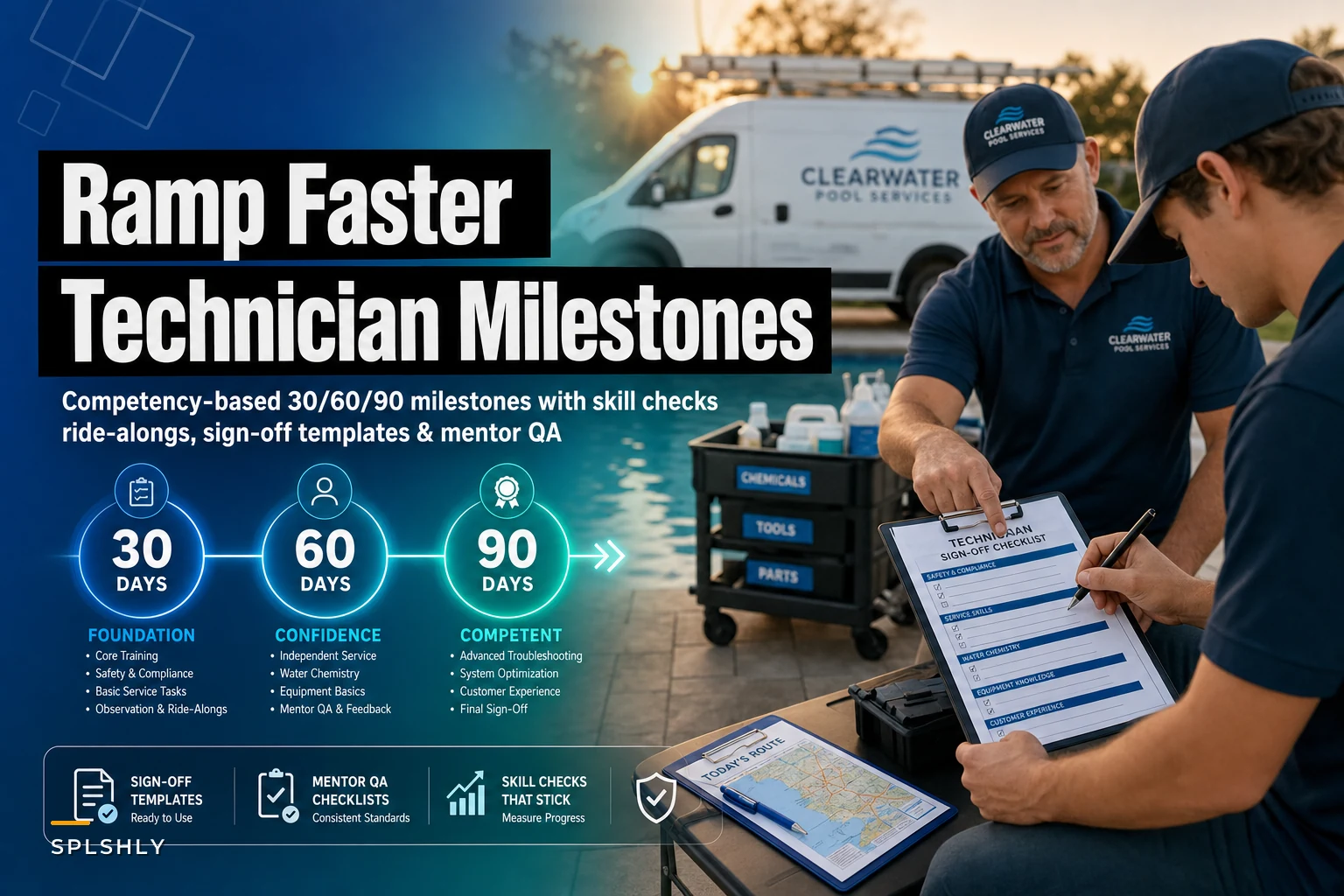

Most pool service owners don't have a real onboarding problem. They have a guessing problem. A new tech rides along for a week or two, seems fine, and then one Monday you hand them 14 stops because you're short-staffed. Three weeks later a customer calls because the salt cell readings have been ignored, the DE filter is packed solid, and nobody caught it because there was never a moment where someone actually confirmed the tech knew how to do those specific things. More ride-alongs won't fix that. Knowing which skills have been verified—and which haven't—will. That's what a proper pool technician onboarding checklist built around 30/60/90 competency milestones gives you: a paper trail of what a person can actually do, not how long they've been employed.
Why "he's been here a month" tells you nothing
Time-based ramp-up is the default because it's easy. You assume that after 30 days someone is roughly competent, after 60 they're solid, after 90 they're independent. Tenure and skill drift apart constantly though.
A tech who came from a competitor might already know how to backwash a sand filter blind but has never touched the automation system your commercial accounts run. Meanwhile a green hire with zero experience picks up water chemistry fast but freezes every time a pump won't prime. If you ramp both on the same 30/60/90 clock, one is bored and underused while the other is quietly failing on jobs you assumed were covered.
The failures don't show up during onboarding. They show up six to eight weeks later, buried inside a route, on accounts nobody's checking closely. By then the callback damage is done and the tech has built habits that are much harder to correct.
The milestone system isn't about when. It's about which specific tasks have been demonstrated and signed off, and by whom.
What a competency-based milestone actually contains
Each milestone is a bundle of verifiable skills tied to a check. Not "understands filtration"—that's useless because you can't sign off on a vague thing. Instead: "Can disassemble, clean, and reassemble a cartridge filter and correctly log pressure differential before and after." That's testable. Either they did it in front of you or they didn't.
Eliminate missed appointments and dispatch delays.
Splshly ensures every pool service is scheduled, tracked, and completed efficiently.
- Unified scheduling dashboard
- Automated customer reminders
- Technician route optimization
No credit card required
| Weak milestone (time-based) | Strong milestone (competency-based) |
|---|---|
| "Week 4: comfortable with chemistry" | "Balances a green-to-clean shock treatment and calculates chemical doses for a 20k-gallon pool within 10% of target" |
| "Month 2: knows equipment" | "Identifies and clears a no-prime pump condition; explains 3 likely causes before opening anything" |
| "Month 3: ready for solo route" | "Runs a 10-stop route solo with photo documentation on every stop and zero missed skimmer baskets on QA audit" |
The right-hand column is something a lead tech can watch, verify, and sign. The left column is a vibe.
The 30/60/90 breakdown that actually works
Below is the structure most small pool operations can run without a training department. Adjust the specific skills to your account mix—a company heavy on commercial and automation will weight things differently than a residential-only route.
Days 1–30: Safety, routine, and not damaging anything
-
Chemical handling and storage safety, including spill response
-
Water testing accuracy—can they get repeatable readings, not just any reading
-
Standard maintenance stop
skim, brush, empty baskets, test, dose, log
-
Basic filter service (cartridge and DE)
-
Correct photo documentation on every stop
-
Reading and following the route notes for each account
By day 30 the sign-off question is simple: Can this person complete a routine residential stop correctly, safely, and with proper documentation while supervised?
Days 31–60: Diagnostics and independent routine work
-
Pump priming issues and basic diagnosis
-
Salt system checks, cell cleaning, output adjustment
-
Heater basics—recognizing normal vs. call-the-lead situations
-
Identifying when a repair is beyond routine and escalating properly
-
Handling a customer conversation without over-promising or misdiagnosing
The escalation skill matters more than people expect. A tech who knows what they don't know and calls it in is worth far more than one who guesses and turns a $200 repair into a $1,400 equipment replacement.
Days 61–90: Full route ownership and judgment
-
Runs a complete route solo with no QA misses on audit
-
Diagnoses common green-water and cloudy-water causes and prioritizes correctly
-
Manages time across a full 10–14 stop day without cutting corners
-
Handles an unexpected problem (broken valve, dead pump) without panic
-
Documents everything cleanly enough that billing and the next tech have what they need
By 90 days, the real sign-off question is: Would I let this person represent the company on any account without checking behind them? If the honest answer is no, they're not at 90-day competency yet—regardless of the calendar.
The ride-along schedule that prevents the "hand-off cliff"
The most common ramp mistake isn't too little training—it's the sudden jump from full supervision to full independence. One day the lead is in the truck, the next day the new tech is alone with 12 stops. Skills that held up under observation fall apart under real time pressure.
-
Week 1–2 Lead drives and demonstrates; new tech shadows and does 2–3 stops under direct watch.
-
Week 3–4 New tech runs every stop; lead observes and only steps in when needed.
-
Week 5–6 New tech runs a short solo route (6–8 stops); lead runs a QA audit that same afternoon on 2–3 random stops.
-
Week 7–8 Full solo route; lead spot-checks 1–2 stops twice that week.
-
Week 9+ Independent, with the same QA cadence as every other tech.
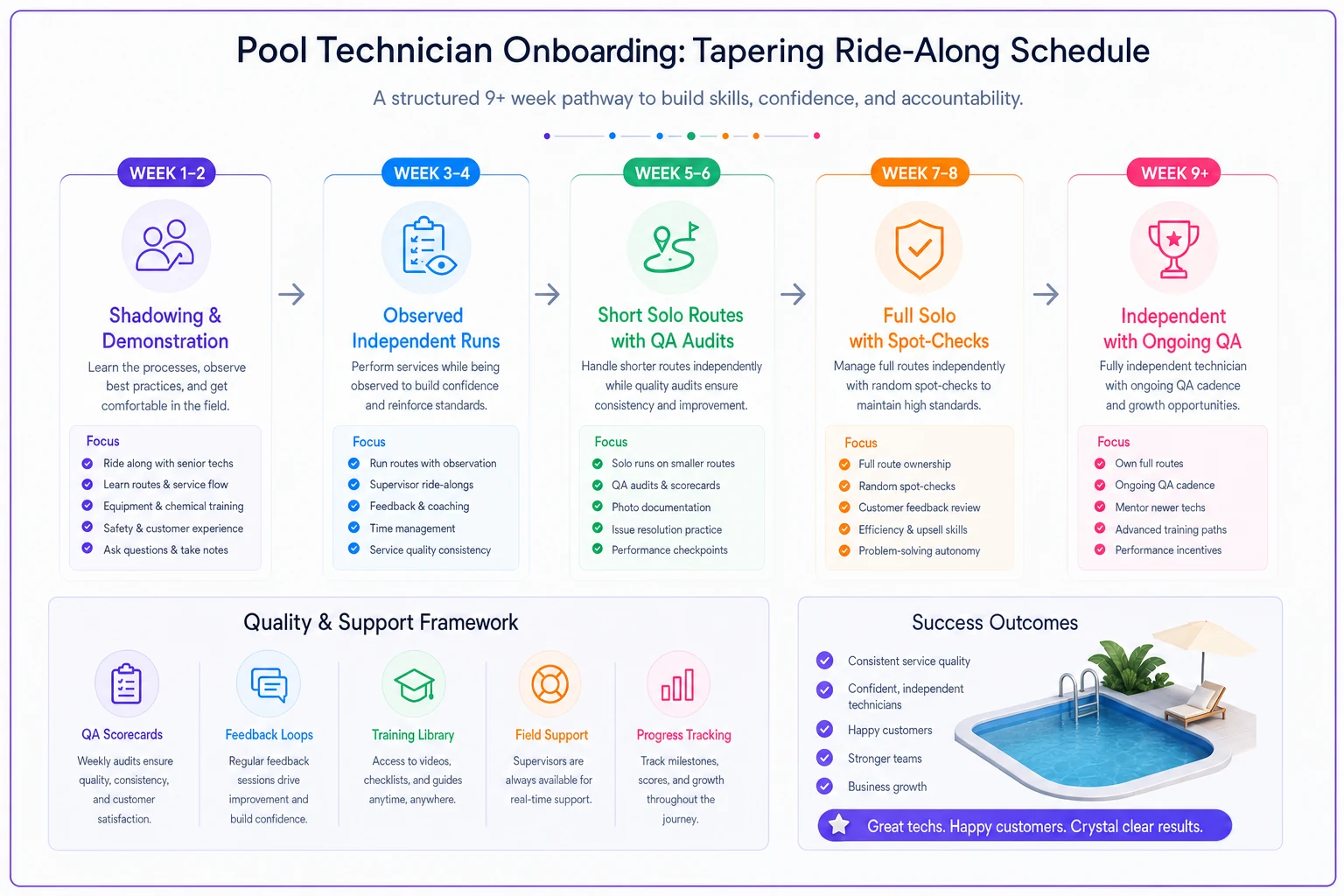
Here's a quick visual of that tapering schedule.
The week 5–6 audit is the piece most operations skip, and it's the one that catches quiet failures before they reach a customer. You're not looking for perfection—you're looking for whether the skills you signed off on are holding up when nobody's riding along.
The sign-off form: keep it boring and specific
A sign-off form does two things. It forces the lead to actually verify a skill instead of assuming it, and it creates a record so that if something goes wrong three months later, you can see exactly what was and wasn't confirmed.
-
The specific task (not a category)
-
Pass/needs-work checkbox
-
Who verified it (initials)
-
Date verified
-
A notes field for anything worth watching
A minimal 30-day sign-off block might read:
-
☐ Balanced chemistry within tolerance on a live pool — verified by on
-
☐ Completed cartridge filter clean unassisted — verified by on
-
☐ Correct spill-response steps stated and demonstrated — verified by on
-
☐ Full photo set captured on 5 consecutive stops — verified by on
The key discipline: a milestone isn't passed until every line is signed. No partial credit, no "close enough." A tech sitting at 30 days with two unsigned items is still a 30-day-milestone-in-progress tech, and they don't get bumped to a heavier solo load until those close.
Keep the sign-off lines tightly scoped so a lead can verify them quickly during a QA audit.
The key discipline: a milestone isn't passed until every line is signed. No partial credit, no "close enough." A tech sitting at 30 days with two unsigned items is still a 30-day-milestone-in-progress tech, and they don't get bumped to a heavier solo load until those close.
A real scenario
A residential-heavy pool company running around 320 accounts across three trucks kept losing new hires in the second month—not to quitting, but to callbacks. Two of their last three hires had generated enough re-service visits in weeks 6–9 that the owner was personally re-driving routes to fix things. Onboarding was "ride along until you feel ready," which in practice meant the leads made the call based on gut feel.
They switched to competency milestones with signed checks and a tapering ride-along. Nothing fancy—a printed form per new hire and a mandatory QA audit at week six. Callbacks tied to new techs dropped noticeably, and the owner stopped burning his own Saturdays cleaning up other people's work. Ramp time to true solo readiness actually got slightly longer on average—closer to 10–11 weeks than the 6 they'd been rushing—but the accounts stopped bleeding.
The lesson there: faster isn't the goal. Predictable is the goal. A verified 10-week ramp beats a hopeful 6-week ramp that collapses in month two.
Where a system helps—and where it doesn't
You can run this on paper, and plenty of small operations should start there. But paper breaks down in a few predictable places: sign-off forms get left in trucks, nobody remembers which tech has which skills checked when you're building routes, and the week-6 QA audit gets skipped because there's no reminder pushing it.
-
The system knows a tech only has their 30-day skills signed off, so it won't slot them into commercial automation stops they haven't been checked on.
-
QA audit reminders fire automatically at the right week instead of relying on a lead to remember.
-
Photo documentation from ride-alongs and solo stops ties back to the sign-off record, so "did they actually do this correctly" isn't a memory exercise.
The value isn't the software doing the training—it's making sure nobody skips a step and nobody gets handed work they aren't signed off for.
When this level of structure is overkill
If you're a one-truck owner-operator who hires maybe one helper a year and trains them personally every day, a formal 30/60/90 system is probably more overhead than it's worth. You already are the QA process.
It starts to matter the moment you can't personally watch every new tech's stops—usually around the second or third truck. That's the point where "he seems fine" stops being verifiable and callbacks start showing up on accounts you never see. If you're hiring seasonally for summer surge and those hires are touching customer pools within days, structured sign-offs go from nice-to-have to genuinely protective.
The bottom line for owners
Ramping a new pool tech isn't about how many days they've been employed. It's about which specific, testable skills someone has watched them perform and signed off on. Build your milestones around demonstrable tasks, taper the ride-alongs so there's no cliff, run one real QA audit around week six, and treat unsigned line items as unfinished work.
Do that consistently, and the second-month callback surprise mostly disappears—because you stop guessing what your new tech can do and start actually knowing.
Do that consistently, and the second-month callback surprise mostly disappears—because you stop guessing what your new tech can do and start actually knowing.
Ready to elevate your pool service business?
Join hundreds of pool service professionals using Splshly to save time, optimize routes, and enhance customer satisfaction.