


Most refunds in pool service don't happen because the tech did bad work. They happen because nobody could prove the work was good, fast enough, before the customer's frustration hardened into "just refund me."
How the money leaks out when a customer complaint has nowhere structured to go
That's the uncomfortable part. A pump swap can be flawless, the water chemistry dialed in, and you still eat a $600 credit because the complaint bounced between a tech's voicemail, a dispatcher's sticky note, and an owner who only heard about it on day nine when the customer was already threatening a chargeback. By then the evidence is stale, the timeline is fuzzy, and you're negotiating from behind.
Pool service dispute resolution isn't really about being right. It's about having a system that surfaces the problem early, attaches proof automatically, and moves the decision to the right person before the customer's patience runs out. When that system doesn't exist, every complaint becomes a coin flip — and the coin is weighted against you.
Why disputes turn into refunds even when you're in the right
Watch how a typical complaint travels and you'll see the leak points immediately.
Eliminate missed appointments and dispatch delays.
Splshly ensures every pool service is scheduled, tracked, and completed efficiently.
- Unified scheduling dashboard
- Automated customer reminders
- Technician route optimization
No credit card required
A customer texts the tech directly: "Pool's still green, this is the third visit." The tech is on a route, sees it four hours later, replies "I'll check next week." The customer, hearing nothing concrete, calls the office. The office has no record of the text thread, no photos from the last three visits, and no idea what chemicals were dosed. So they apologize and promise a callback. That callback slips. Two days later the customer disputes the last month's charge with their bank.
-
Complaints arrive through channels nobody monitors consistently (direct texts to techs, DMs, replies to invoices).
-
Proof of good work lives in someone's phone camera roll, not attached to the job.
-
There's no clock on response, so "I'll get to it" quietly becomes three days.
-
The person who can say no to a refund only finds out when it's already a fire.
The result is predictable. Small, defensible issues get resolved with cash because cash is faster than reconstructing what happened. And once a company develops a culture of "just refund it to make them go away," the refund rate creeps up quietly, month after month.
What breaks at scale
At two trucks, disputes are manageable because the owner touches everything. They remember the customer, they saw the pool last month, they can drive back out. The informal system works because it's really just one person's memory holding everything together.
At six, eight, twelve trucks, that memory doesn't scale. Now you've got techs who've never met each other, a dispatcher who wasn't on the original job, and customers who expect the same responsiveness they got when the owner personally handled them. The informal system doesn't gradually degrade — it collapses at a specific point, usually when complaint volume outruns any single person's ability to hold the context in their head.
Here's what specifically breaks:
Evidence gets orphaned. At small scale, the tech who did the work is the tech who answers the complaint. At scale, they're different people, and the second person has no photos, no chemistry logs, no notes on what the customer was told. They're defending work they didn't see.
Response times become invisible. With three complaints a month you notice a slow one. With thirty, a complaint sitting untouched for four days looks identical to one that was handled in an hour — until it becomes a chargeback and you go looking for what happened.
Refund authority blurs. When everyone can issue a credit "to keep the peace," credits get issued to keep the peace. There's no friction, no second look, no pattern-catching. You find out your refund rate doubled when you're reconciling the P&L at quarter close.
Repeat offenders hide. Without centralized tracking, you can't see that one commercial account has disputed four invoices this year, or that a specific tech's jobs generate three times the complaint rate. The signal is there — nobody's aggregating it.
This is the same coordination problem that shows up everywhere in a scaling field business, and it's closely tied to how well your maintenance workflows and QA checks are documented in the first place. If the work isn't captured with clear acceptance criteria, there's nothing to defend the dispute with.
The core idea: tiers, evidence, and a clock
A working dispute system has three moving parts, and they only work together.
-
Escalation tiers — a defined ladder so every complaint has a next step and a next person, instead of dying at whoever received it.
-
Required evidence packages — a standard set of proof (photos, logs, communication history) that must be attached before a decision, so nobody's arguing from memory.
-
Timeline SLAs — a clock on each tier, so silence never becomes the default response.
Miss any one and the other two weaken. Tiers without a clock still stall. A clock without evidence just makes you refund faster. Evidence without tiers means the proof exists but never reaches the person deciding.
Here's the workflow at a glance:
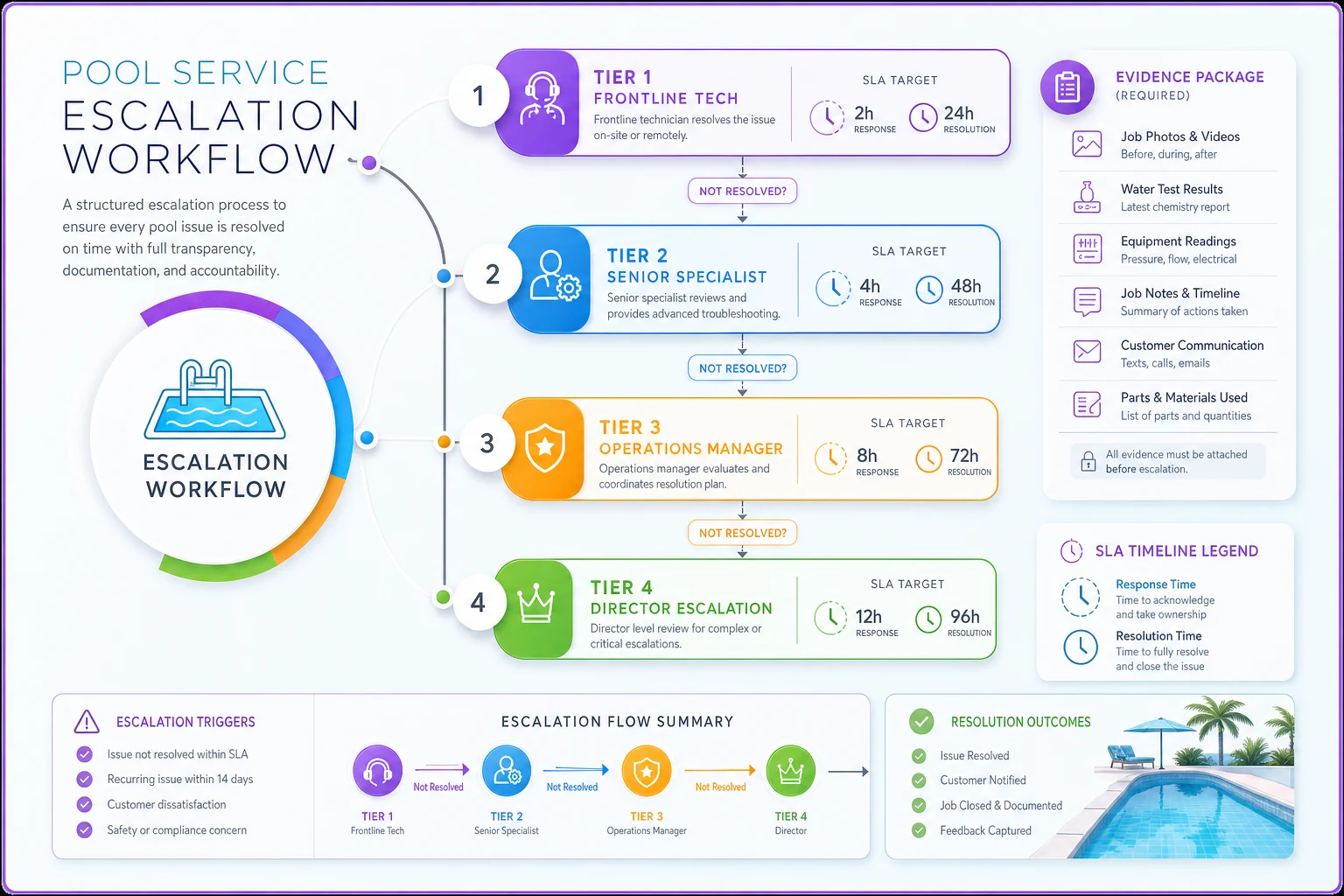
Keep the three parts working together so disputes move quickly to the right person with proof attached.
Building the escalation tiers
The point of tiers isn't bureaucracy. It's making sure the right complexity of problem reaches the right level of authority — and no further. A stuck skimmer basket shouldn't reach the owner. A commercial account threatening to cancel a $2,400/month contract absolutely should.
| Tier | Trigger | Owner | Response SLA | Resolution SLA | Refund authority |
|---|---|---|---|---|---|
| 1 – Field | Routine complaint, single visit issue | Assigned tech | Same day | 2 business days | None (fix only) |
| 2 – Dispatch/Lead | Repeat complaint, missed appt, tech can't resolve | Dispatcher or lead tech | 4 business hours | 3 business days | Up to ~$150 credit |
| 3 – Manager | Recurring account issue, service-quality dispute, refund request | Ops manager | 2 business hours | 2 business days | Up to ~$500 credit |
| 4 – Owner | Chargeback threat, contract cancellation, legal/safety angle | Owner | 1 business hour | Same day | Full authority |
The numbers aren't sacred — a smaller shop might collapse Tiers 2 and 3 into one. What matters is that each tier has a named owner, a clock, and a spending limit. The spending limit is what stops the quiet refund creep, because now issuing a credit above your tier requires escalating, which means someone else sees the pattern.
One subtle mistake worth flagging: don't let escalation feel like punishment. If techs think passing a complaint up means they screwed up, they'll hide complaints instead of escalating them. Frame Tier 1's job as triage and honest handoff, not fix everything or fail.
The evidence package: what "proof" actually means
This is where most companies are weakest, and it's also the highest-leverage fix. A complaint without an evidence package is a negotiation. A complaint with one is usually a five-minute resolution.
Every escalated dispute should carry a standard package before anyone decides on money:
-
Before/after photos from the relevant visits, timestamped and geotagged
-
Chemistry logs for the account over the disputed period (readings, doses, dates)
-
Service history — what was done each visit, by whom
-
Communication trail — every text, call note, and message with the customer, in one place
-
Tech notes on the specific issue and any prior warnings given (e.g., "advised customer heavy rain would recloud water within 48h")
The magic of a required package is that it flips the conversation. Instead of "we think we did good work," you're showing a customer their own pool's chlorine readings holding steady at 3ppm across four visits, with photos, while their complaint was that it was "never treated." Most disputes evaporate at that point — not because you argued, but because the evidence made arguing pointless.
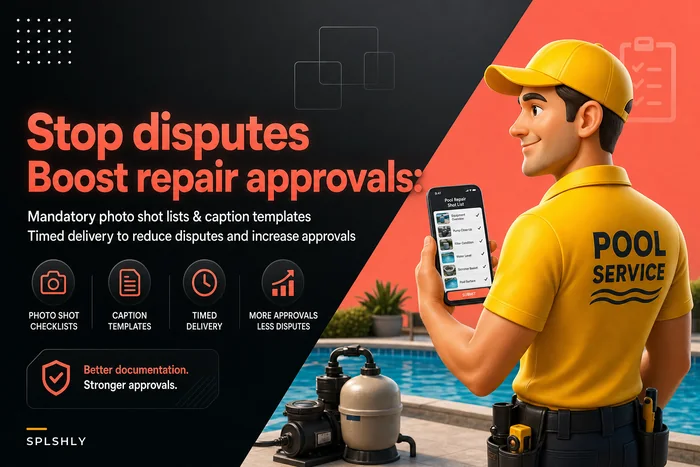
This is why photo discipline pays for itself. If your techs already follow mandatory photo shot lists and caption templates, your evidence packages are basically pre-built. The dispute system doesn't create new work — it consumes the documentation your techs are already producing. Companies that skip the photo discipline discover it precisely at the dispute stage, when it's too late to go back and photograph a pool that's since been drained and refilled.
Require timestamped, geotagged photos as part of the evidence package to avoid reconstruction later.
A practical rule: if a complaint escalates past Tier 1 and the evidence package is incomplete, that's a documentation finding, not just a dispute. It means a visit happened without proper capture, and that gap will bite you again. Track those separately.
Timeline SLAs and why the clock beats the argument
The single biggest driver of refund size isn't the severity of the problem — it's how long the customer waited before someone competent responded.
-
Hour 1–4 They want acknowledgment. A "we see this, here's who's handling it, here's when" text often defuses the whole thing.
-
Day 1–2 They want a plan. Silence here converts a fixable complaint into a refund expectation.
-
Day 3+ They want their money back. The window for a service-based resolution has mostly closed; now you're negotiating dollars.
The SLA clock exists to keep every dispute in that first window. This is why response SLA and resolution SLA are separate. Acknowledgment is cheap and fast and does most of the emotional work. The actual fix can take a couple more days as long as the customer knows it's moving.
A dispute that sits untouched isn't neutral — it's actively getting more expensive by the hour. Treat a breached response SLA as its own alert, separate from the complaint itself. The stalled ones are where refunds are born.
Scripts that resolve without reflexive refunds
Scripts get a bad reputation because bad scripts sound robotic. Good ones just make sure your least-experienced person handles a tense call the way your best person would. The goal is to resolve the actual problem before money enters the conversation.
A few patterns that work:
Lead with the evidence, gently. "I pulled up your service history — I can see we were out on the 3rd, 10th, and 17th, and your chlorine was reading in range each time. Walk me through what you're seeing so I can figure out the gap." This reframes the conversation from "you didn't do your job" to "let's solve this together," while quietly establishing that records exist.
Offer service before cash. "I'd rather make this right than just credit it — I can have a tech out tomorrow morning to re-treat and diagnose. If we can't get it sorted, we'll talk about the billing." Most reasonable customers accept a fast fix. The ones who insist on cash immediately are giving you useful signal.
Name the timeline out loud. "Here's what happens next and when." Customers escalate when they feel forgotten. A concrete next step with a real timeframe is the cheapest de-escalation you have.
For chargeback threats, get specific and calm. "Before you do that — chargebacks take weeks and I can resolve this today. Here's what I can do right now." A threatened chargeback that you resolve directly saves you not just the refund but the processor fees and the dispute-rate penalty.
When a credit is warranted, tie it to the tier limits. A dispatcher offering the max they're authorized for feels different than an owner waving away $600 — and the constraint itself often pushes toward a more creative, service-based solution.
A real scenario
A mid-sized residential-and-light-commercial pool company, around ten trucks, was running a refund rate that worked out to roughly $2,800–$3,400 a month in credits and chargebacks. Most were "green pool" and "missed visit" complaints, and almost all were resolved by refunding, because reconstructing what happened took longer than just issuing the credit.
They didn't add software first. They added structure: four escalation tiers with spending limits, a required evidence package pulled from photos and chemistry logs their techs were already (inconsistently) capturing, and a hard rule that every complaint got acknowledged within four business hours.
The first month was messy — half the evidence packages came back incomplete, which itself exposed that a chunk of visits weren't being documented properly. By month three, the pattern shifted. Complaints that used to end in refunds now ended in a same-day re-service, because the tech showing up with the chemistry history changed the whole conversation. A few customers who'd been chronic disputers quietly stopped, once it became clear the company had records.
Monthly refund spend dropped into the $900–$1,300 range. Not zero — some refunds are just correct. But close to a $2,000/month swing, most of it from resolving disputes with service and proof instead of cash. The bigger win was the two commercial accounts they kept, each worth low-four-figures monthly, that had been one bad complaint away from cancelling.
Where this ties into the rest of your operation
Dispute resolution isn't a standalone process. It sits at the end of a chain, and it's only as strong as the links before it. If your estimates and collections are loose, disputes multiply — which is why a clean quote-to-cash flow that maps estimates, parts-holds and dispatch prevents a whole category of billing disputes before they start. If your service documentation is thin, your evidence packages are empty. If your scheduling is chaotic, "missed visit" complaints spike.
This is where operational software earns its place — not by resolving disputes for you, but by making the evidence packages assemble themselves. When photos, chemistry logs, visit history, and the customer's message trail all live against the same job record, escalating a complaint means clicking one button instead of hunting through three people's phones. The SLA clock can flag the stalled ones automatically. Tier limits enforce themselves at the point a credit is issued. The value isn't automation for its own sake — it's that the proof is already attached the moment you need it, which is the exact thing that's missing when a company handles this manually.
When strict tiers make sense — and when they don't
If you're running two or three trucks and the owner still personally knows most customers, a four-tier system is overkill. You'll spend more time maintaining the structure than resolving disputes. Keep it simple: capture good evidence, respond fast, done.
The tier system starts paying off somewhere around the point where the person receiving a complaint is regularly not the person who did the work, and complaint volume crosses maybe fifteen to twenty a month. That's when informal memory fails and structure becomes cheaper than chaos.
Where it's a genuinely bad idea: if you bolt on tiers and SLAs without fixing the underlying documentation, you'll just have a faster pipeline delivering empty evidence packages to managers who still have nothing to defend with. Fix the capture first, or the escalation system just routes your ignorance more efficiently.
One caution for owners who love process: don't over-engineer the customer-facing side. Customers don't care about your tiers. They care that someone competent responded quickly and made it right. All the tier machinery should be invisible to them — it exists to make your response feel effortless and consistent, not to add hoops.
The takeaway
Refunds in pool service are mostly a symptom of a coordination gap, not a quality gap. The complaint lands somewhere, loses its evidence in the handoffs, sits too long, and gets resolved with cash because cash is faster than the truth.
Escalation tiers give the complaint a path. Required evidence packages give you something to stand on. Timeline SLAs keep the whole thing inside the window where a service fix still works. Build those three together, feed them the documentation your techs should already be producing, and most disputes stop being negotiations about money and start being quick conversations about proof. That's the difference between eating a few thousand a month in credits and keeping the accounts — and the margin — that you actually earned.
Refunds in pool service are mostly a symptom of a coordination gap, not a quality gap. The complaint lands somewhere, loses its evidence in the handoffs, sits too long, and gets resolved with cash because cash is faster than the truth.
Ready to elevate your pool service business?
Join hundreds of pool service professionals using Splshly to save time, optimize routes, and enhance customer satisfaction.