


Most pool service businesses track their money at two points: when they quote a job and when payment hits the bank. Everything in between? Usually a mess of text messages, sticky notes, and techs calling the office asking if Mrs. Henderson approved that heater repair yet.
The real profit leaks happen in those handoffs between estimate and cash. Not the big obvious stuff like a tech forgetting to invoice—the thousand small friction points where jobs stall, parts sit unordered, and approved work somehow never gets scheduled.
After building operational software for pool companies ranging from solo operators to 20-truck fleets, the pattern is consistent: businesses lose somewhere between 15-30% of potential revenue not because customers say no, but because the quote-to-cash process has more holes than a pool with a cracked shell.
Why Pool Service Quote-to-Cash Breaks Down
Pool service isn't like lawn care where you show up, cut grass, and invoice. Every job branches into multiple decision trees. A simple filter cleaning can turn into a pump seal replacement, which reveals corroded plumbing, which needs parts from three different suppliers, two of which require prepayment.
-
Estimate approvals that expire if not followed up within 72 hours
-
Parts orders that require deposits over $500
-
Equipment warranties that change the entire repair approach
-
Seasonal work that can only happen in specific weather windows
The typical pool company handles this with some combination of QuickBooks, a scheduling whiteboard, and whatever the service manager remembers from yesterday's phone calls. That works until you're running around 8-10 techs. Then the wheels fall off.
What really kills profitability is the delay cascade. A parts hold on Tuesday means the tech can't complete the job Wednesday, which pushes Thursday's schedule, which means overtime on Friday, which means rushed work that leads to callbacks the following week. One delayed approval can cost over a thousand dollars in downstream inefficiency.
Estimate Approval Templates That Actually Convert
Most pool companies send a wall of text with a price at the bottom. No urgency, no clear next step, no explanation of what happens if the customer waits.
Eliminate missed appointments and dispatch delays.
Splshly ensures every pool service is scheduled, tracked, and completed efficiently.
- Unified scheduling dashboard
- Automated customer reminders
- Technician route optimization
No credit card required
The estimate approval process needs structure at three levels:
Initial Estimate Delivery
-
What exactly are we fixing (not just "pump repair")
-
Why it needs fixing now vs later
-
What happens if we don't fix it
-
How long the repair takes
-
When we can schedule it
A pump motor replacement estimate that actually converts looks like: "Your Pentair VS pump motor (installed 2018) is pulling 18 amps instead of the normal 11 amps, indicating worn bearings. Continuing to run risks complete seizure within 2-4 weeks, which stops circulation entirely. Replacement takes 3 hours, includes new seals, earliest availability Thursday 8am. Price valid 7 days."
Follow-up Triggers
-
Safety issues (broken gate latch, missing drain cover)
Follow up same day, then daily
-
Equipment failures affecting usability
24 hours, then every 2 days
-
Efficiency upgrades or cosmetic work
3 days, then weekly
-
Seasonal prep work
1 week, then monthly
Approval Confirmation Requirements
Different jobs need different approval levels. A $200 valve replacement might just need a text "yes," but an $8,500 variable-speed pump upgrade needs written approval with specific model confirmation.
-
Under $250
Verbal approval from any adult at property
-
$250-$1,000
Written approval (text/email) from account holder
-
$1,000-$5,000
Signed estimate or email confirmation
-
Over $5,000
Signed contract with payment terms
Operational software should enforce these rules automatically—no dispatch without the proper approval level. That single change prevents the majority of payment disputes.
Parts-Hold Rules That Prevent Revenue Stalls
Parts management in pool service is particularly nasty because you're dealing with specialty items local suppliers might not stock. A Jandy valve actuator can take 5 days to arrive. A specific Hayward heater control board could be 3 weeks out in peak season.
Automatic Hold Triggers
-
Any special-order part over $200
Hold until prepaid
-
Parts requiring core exchange
Hold until core received
-
Warranty parts
Hold until warranty claim approved
-
Multi-part repairs over $1,500
Hold until 50% deposit
When possible, consolidate special-order parts into a single order to reduce lead-time exposure and simplify customer communication.
Customer Communication on Holds
-
Customer gets notified with expected arrival date
-
Scheduler blocks a tentative time slot for installation
-
Parts manager gets a reorder notification if it's a commonly used item
Your message should read something like: "Hayward heater transformer ordered from distributor, expected delivery Tuesday. Installation tentatively scheduled Wednesday 2pm—we'll confirm Monday when the part arrives. The $340 part cost will appear on your next invoice."
Hold Release Protocols
-
Verify against original order (model, quantity)
-
Match to the pending job in the system
-
Trigger dispatch scheduling for the next available slot
-
Notify the customer with a confirmed appointment
One pool company had over $23,000 in parts inventory for jobs that were never scheduled. The parts arrived, got shelved, and everyone moved on. That's pure profit sitting in the storage room.
Dispatch Triggers Connected to Field Reality
Dispatch isn't just putting techs on jobs. In pool service, it needs to account for what's on the truck, chemical levels, parts availability, and which techs hold the right certifications for commercial properties.
Field Data That Should Trigger Dispatch
-
Tech completes job early
Pull forward afternoon appointments
-
Water test shows phosphates over 500ppb
Schedule phosphate treatment within 48 hours
-
Equipment age hits replacement threshold
Generate upgrade estimate for next visit
-
Callback rate exceeds 15% for a specific tech
Route to senior tech for the next several jobs
Automated Dispatch Rules
Emergency Calls
-
Pump not running
Dispatch within 4 hours if customer has a spa, 24 hours for pool only
-
Green pool before an event
Calculate treatment time first, dispatch only if enough lead time exists
-
Suspected leak
Send leak detection specialist, not regular maintenance tech
Efficiency Routing
-
Group estimates in the same neighborhood into a single trip
-
Assign chemical deliveries to trucks already routed nearby
-
Batch warranty calls for the same equipment manufacturer
Skill Matching
-
Commercial properties
Only techs with CPO certification
-
Heater repairs
Techs with gas appliance training
-
New equipment startups
Senior techs for the first season
The Hidden Dispatch Problem
Sending techs to jobs they can't complete is one of the most avoidable efficiency killers in this business. A tech drives 25 minutes to replace a pump, arrives, and finds the customer actually wanted the automation upgrade they mentioned offhand—which requires different parts and two extra hours.
Your dispatch system needs to verify:
-
All customer questions answered before dispatch
-
Required parts confirmed on the truck
-
Enough time allocated for likely upsells
-
Previous visit notes reviewed
Your dispatch system needs to verify these items before a tech leaves the shop to avoid wasted trips and callbacks.
Automated Invoice Generation From Service Events
The gap between work completed and invoice sent is where pool companies bleed cash. A tech finishes a pump replacement at 3pm Thursday, but the invoice doesn't go out until the office manager processes paperwork Monday. That's four days of float you're giving away for no reason.
Service Event to Invoice Mapping
Standard Maintenance Visit
-
Labor
1 hour standard cleaning
-
Chemicals
Based on gallons and test results
-
Filter cleaning
If pressure exceeded 20psi
-
Minor parts
O-rings, gaskets used
Repair Jobs
-
Diagnosis fee
If customer declines repair
-
Parts
With markup rules applied
-
Labor
Actual time at hourly rate
-
Disposal fees
For old equipment
-
Trip charges
If a special trip was required
Chemical-Only Stops
-
Delivery fee
-
Chemical cost with markup
-
Container deposit if applicable
Invoice Timing Rules
-
Weekly maintenance
Batch monthly on the 1st
-
Repairs under $500
Invoice same day as completion
-
Repairs over $500
Invoice immediately upon completion
-
Chemical delivery
Invoice with next maintenance visit
-
Emergency calls
Invoice before leaving the property
The Details That Matter
Your invoices need to tell a story the customer can follow. "Pool service - $350" leads to disputes. "Replaced Pentair 1.5HP pump motor, installed new shaft seal, tested operation at 15gpm flow rate, includes 1-year parts warranty - $350" gets paid without questions.
Include on every invoice:
-
Before/after chemical readings for maintenance
-
Warranty terms for new equipment
-
Next recommended service date
-
Any observations that need future attention
These details reduce disputes and speed payment by making the value clear.
Collections Scripts That Preserve Relationships
Pool service collections is delicate. You're often dealing with long-term customers who genuinely forgot or had a card fail. Your collections process needs escalation rules that match the relationship.
Tiered Collection Approach
Days 1-7: Friendly Reminder
"Hi [Name], just a heads up that your July pool service payment of $340 hasn't processed yet. If you already sent it, please ignore this. Otherwise, here's the quick payment link: [Link]. Thanks!"
Days 8-14: Problem-Solving Tone
"Hey [Name], wanted to check if there was an issue with last month's pool service invoice for $340. Sometimes credit cards expire or emails go to spam. Happy to resend or take payment by phone at [Number]. Your next service is scheduled Thursday."
Days 15-21: Service Impact Warning
"[Name], your account is now 15 days past due ($340). We'll need to pause service after this week if we can't resolve payment. Really don't want to do that with summer coming. Can we handle this today? Call [Number] or pay here: [Link]"
Days 22-30: Final Notice
"This is a final notice regarding your past due balance of $340. Service will be suspended after Friday unless payment is received. To avoid interruption and additional restart fees, please pay immediately at [Link] or call [Number]."
Smart Collections Rules
Adjust collection intensity based on:
-
Customer lifetime value (don't alienate a $500/month commercial account over a late $50 chemical charge)
-
Payment history (first late payment in 2 years vs. chronically late)
-
Season (more aggressive before pool opening season)
-
Balance size (full-court press for $2,000+ overdue)
The Psychology of Pool Service Collections
Pool service customers often pay late not because they can't, but because the pool won't shut off like a utility and it just slips down the priority list. Your collections process needs to create urgency without sounding desperate.
What works:
-
Mentioning specific upcoming services they'll miss
-
Highlighting seasonal implications (algae risk in summer)
-
Offering payment plans for large repairs
-
Suspending service but offering one-time cleanings at premium rates
What backfires:
-
Threats about property liens (save for truly extreme cases)
-
Publicly visible notices (embarrasses the customer)
-
Immediate service suspension for otherwise good accounts
-
Refusing partial payments
Adjust your tone and escalation based on the value and history of the account to preserve relationships while protecting cash flow.
Technology Stack for Quote-to-Cash Automation
The manual version of this process requires constant oversight. Every handoff needs someone checking, following up, confirming. That's why most pool companies hit an operational ceiling around $2M revenue—the owner can't watch every handoff anymore.
AI-powered operational platforms handle these handoffs continuously, without someone having to babysit each step.
Estimate Intelligence
-
Track view rates and response times
-
A/B test estimate templates
-
Identify which techs generate the highest approval rates
-
Flag estimates pending over 48 hours
-
Suggest follow-up messages based on job type
Parts Coordination
-
Auto-order commonly used parts when inventory drops
-
Track supplier lead times and adjust accordingly
-
Generate purchase orders from approved estimates
-
Match arriving parts to scheduled jobs
-
Alert when parts arrive for unscheduled work
Dispatch Optimization
-
Route based on real-time traffic and job complexity
-
Assign based on tech skills and truck equipment
-
Adjust schedule when jobs run long or short
-
Prevent booking jobs without proper approvals
-
Generate efficiency reports by tech and route
Collections Automation
-
Send payment reminders on custom schedules
-
Adjust tone based on customer history
-
Process payments through multiple channels
-
Flag accounts approaching credit limits
-
Generate aging reports with suggested actions
The value isn't any single feature—it's that the whole pipeline moves without manual nudging at every stage.
Measuring Quote-to-Cash Performance
Track these metrics weekly to catch process breakdowns early:
| Metric | Target | Warning Sign | Action Required |
|---|---|---|---|
| Estimate to approval time | <3 days | >5 days | Review follow-up process |
| Approval to scheduling gap | <2 days | >4 days | Check dispatch capacity |
| Parts-hold duration | <5 days | >7 days | Audit supplier relationships |
| Work complete to invoice | Same day | >2 days | Automate invoice generation |
| Invoice to payment | <15 days | >25 days | Strengthen collections |
| Estimate approval rate | >65% | <50% | Review pricing and presentation |
| Collections success rate (30 days) | >94% | <90% | Adjust collections approach |
The patterns tell you where to focus. If estimates approve quickly but scheduling lags, you have a capacity problem. If invoices go out fast but payment is slow, either your terms are too generous or customers don't see the value clearly enough. Worth revisiting this table every week, not quarterly.
Common Quote-to-Cash Failure Points
The Partial Approval Trap
Customer approves the pump replacement but not the recommended valve upgrade. Tech shows up, replaces the pump, but the system still doesn't work properly because of the bad valve. Now you're back for a second trip, the customer's frustrated, and margins are shot.
Solution: Bundle related repairs with "complete system" pricing that actually costs less than two separate trips.
The Warranty Gray Zone
Equipment fails at 13 months on a 12-month warranty. Manufacturer won't cover it, customer expects you to. You eat the cost to preserve the relationship—and it keeps happening.
Solution: Build warranty buffers into your pricing and offer extended warranties as upsells.
The Disappearing Deposit
Customer pays a deposit for a large repair, work gets delayed for parts, customer forgets the deposit exists, then disputes the final invoice showing the remaining balance.
Solution: Reference deposits in every communication and show a running balance on all documents.
The Scope Creep Spiral
"While you're here" turns a 1-hour maintenance visit into a 3-hour repair without proper approval or any pricing adjustment.
Solution: Train techs to treat additional work as a new estimate requiring approval—even from long-term regulars.
Building Your Quote-to-Cash Playbook
Start by mapping your current process. Actually track 10 jobs from estimate to payment. Note every touchpoint, every delay, every place where information gets lost or repeated.
You'll probably find:
-
Estimates sitting in email with no follow-up system
-
Approved work that never gets scheduled
-
Parts arriving without anyone being notified
-
Invoices created but never sent
-
Payment reminders going to old email addresses
Use this simple workflow to map each job and highlight delays.
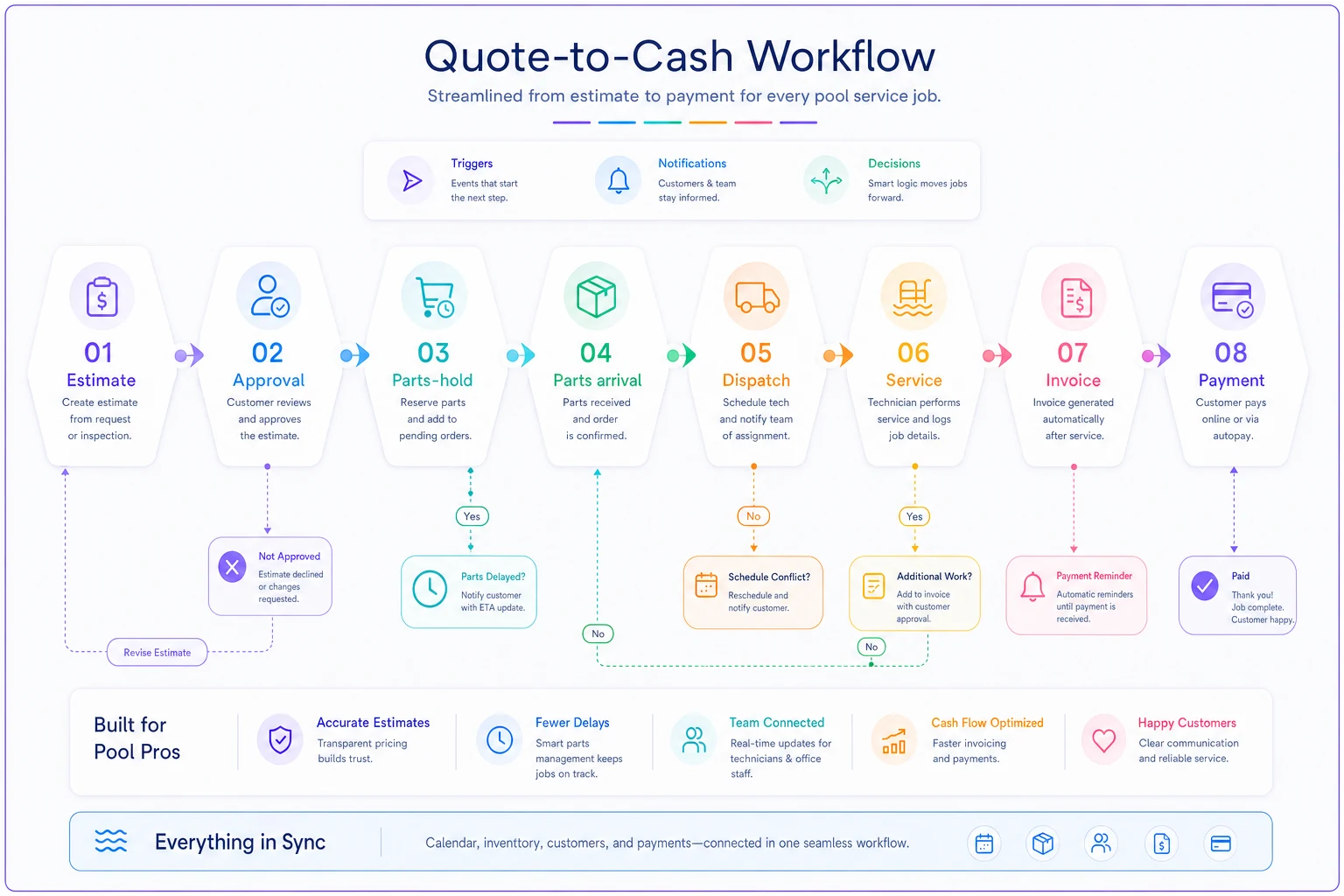
Fix the biggest gaps first. Usually that's the estimate follow-up process or the parts-hold communication. Get those working, then move to the other handoffs. Don't try to overhaul everything at once—that's how nothing actually changes.
The companies that scale successfully don't necessarily have fancy software. They have clear processes for every handoff, someone responsible for each step, and metrics that surface problems quickly.
Aligning your service plans with your operational capacity becomes possible when you know exactly where every job stands at any given moment. Your techs stop wasting time on incomplete information. Your office staff stops chasing approvals and payments all day.
Most importantly, you stop leaving money behind from approved work that never gets scheduled, completed work that never gets billed, and billed work that never gets collected.
The difference between a pool service company stuck at $1M and one scaling past $5M usually isn't marketing or sales. It's the operational discipline to move every quote through to cash—reliably, without the owner watching every step. That starts with mapping the handoffs, building the rules, and letting the system run so the tech knows what triggers dispatch, the office knows what pauses a job, the customer knows what happens next, and you know exactly where your money is at every stage of the process.
Ready to elevate your pool service business?
Join hundreds of pool service professionals using Splshly to save time, optimize routes, and enhance customer satisfaction.