

A dead truck at 6:45 AM doesn't just cost you one route. It cascades. The tech scrambles for another vehicle, the parts and chemicals are still loaded in the broken one, dispatch reshuffles the day, and by 9 AM you've got two techs behind schedule and a commercial client texting because their Monday open didn't happen. For a small pool fleet, one vehicle going down is rarely a small problem — it's usually a three-hour recovery scramble that eats into everyone's day.
Most pool service owners have a truck that's "the one that always acts up." They know it. And yet the plan for when it finally dies is basically: figure it out in the moment. That's the gap this article closes. Not a generic vehicle inspection lecture — a tight, pool-specific pre-shift routine plus the exact rules for what to do when a truck won't start.
Why the morning is the worst possible time to discover a problem
The failure pattern is almost always the same. The truck ran fine yesterday afternoon. Nobody looked at it after the last stop. The chemicals and the loaded repair kit sat inside overnight. At 6:40 AM the tech turns the key and gets a click, or a warning light, or a slow-leaking tire that's been losing pressure for three days.
The operational catch that makes it painful: everything the tech needs for the day is inside the dead vehicle. The stocked bins, the acid and chlorine, the special-order parts for the 10 AM heater job. So even if you have a spare sitting in the yard, activating it isn't just "grab the keys." It's a transfer job — and transferring chemicals in a rush is exactly how you get a spill or a mislabeled container, which is a whole separate problem covered in the mobile SOP for safe chemical storage and transport.
The morning is the worst time because you have zero slack. There's no buffer to diagnose, decide, and re-stock before routes need to roll. Any decision made at 6:45 is a bad one made under pressure. The whole point of a pre-shift check is to move the discovery from the morning of the failure to the evening before — or at minimum to the first five minutes of the day, when you still have options.
The 7-point check that actually catches pool-fleet failures
Generic vehicle checklists have 30 items and nobody does them. A pool tech isn't going to check tire tread depth with a gauge at 6:30 AM. The checklist that actually gets used is short, takes under three minutes, and targets the failures that specifically strand a pool route.
Eliminate missed appointments and dispatch delays.
Splshly ensures every pool service is scheduled, tracked, and completed efficiently.
- Unified scheduling dashboard
- Automated customer reminders
- Technician route optimization
No credit card required
The failures that actually kill a route morning aren't exotic. They're batteries, tires, coolant, and cargo problems. So the check targets exactly those.
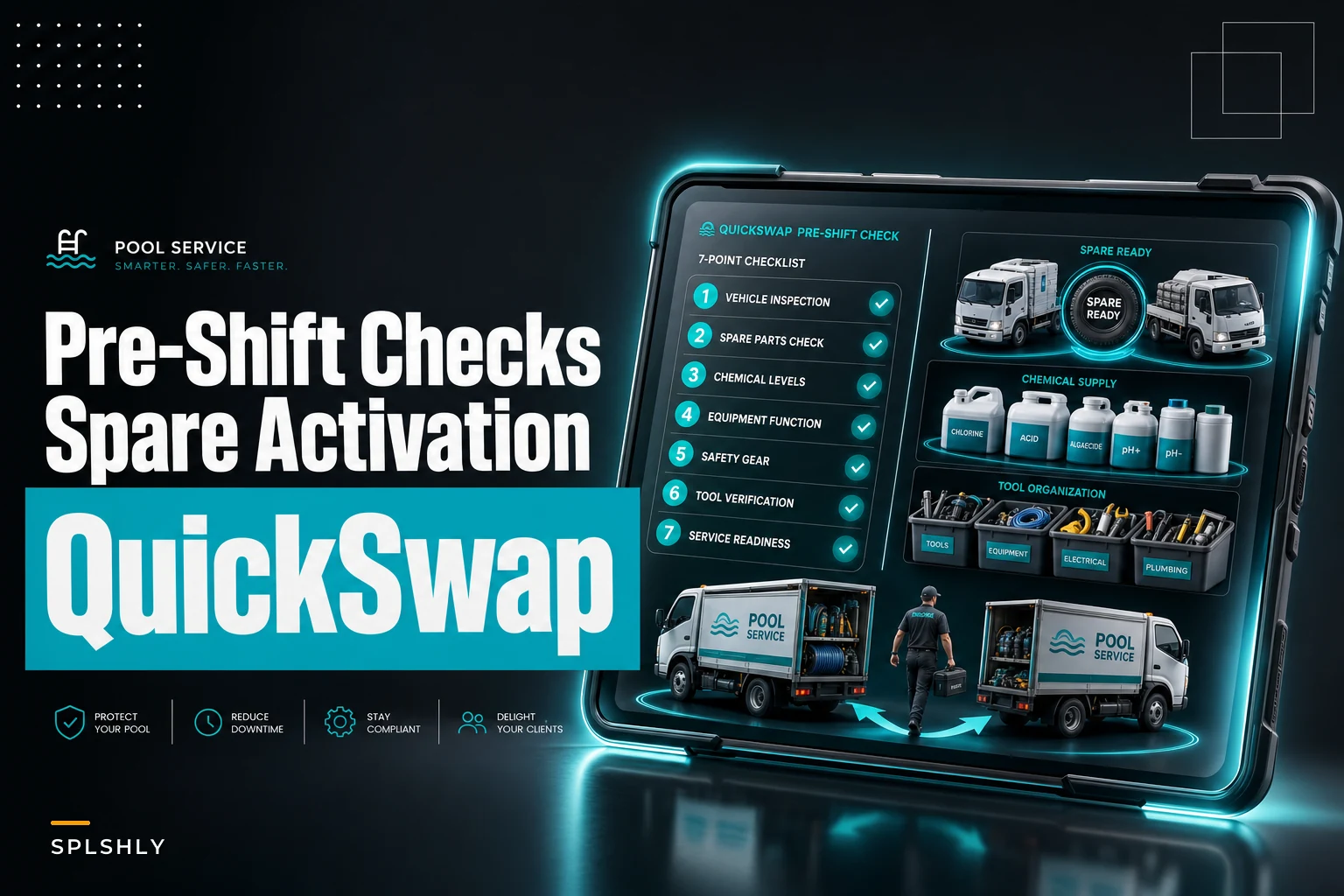
The daily 7-point pre-shift check:
-
Start & idle — Does it turn over cleanly on the first try? A slow or hesitant crank is your one-day warning before a dead battery. Note it, don't ignore it.
-
Dash warning lights — Any light that wasn't there yesterday. Check engine, ABS, battery, TPMS. A new light is a decision trigger, not a "watch it" item.
-
Tires (visual + one quick press) — Walk around, look for anything obviously low, press the front driver's tire with a boot. You're catching the slow leak that's been building for three days.
-
Coolant & oil level — Ten-second glance under the hood. Overheating on a summer route with a full chemical load is a genuine hazard, not just a delay.
-
Chemical containment — Are containers secured, upright, capped, and not leaking? This is the pool-specific item most fleets skip. A leak found in the yard is nothing. The same leak found at the third stop is a contamination and liability event.
-
Cargo & load security — Bins latched, nothing rolling loose, tailgate and doors closing properly. A shifting load isn't just a safety issue; it's how repair parts get lost between stops.
-
Fuel level for the route — Enough to run the planned route without an unplanned mid-day stop that wasn't in the route batching plan.
The thing most owners miss: this check should happen at end of shift, not start of shift. If the tech does the 7-point at the last stop of the day, any problem surfaces the afternoon before — when there's time to swap, rent, or repair. Doing it in the morning still helps, but you've thrown away your best buffer. The best-run small fleets do a full check in the evening and a 60-second "start and lights" glance in the morning.
The rental-vs-delay decision tree
This is where owners freeze. Truck's down. Do you rent something, wait for a repair, or shuffle routes across the remaining trucks? Deciding this from scratch every time is why the recovery takes three hours. The decision should already be made before the truck breaks — as a rule, not a debate.
The variable that actually drives the decision isn't the cost of the repair. It's how many revenue-critical stops are on that route today and how fast the fix realistically is.
| Situation | Route load today | Fix time estimate | Decision |
|---|---|---|---|
| Won't start, likely battery | Any | Under ~45 min | Jump/repair, hold route, push start times 30–45 min |
| Warning light, drivable | Light day, mostly residential recurring | Same-day shop slot | Run the route, shop it after |
| Won't start, unknown cause | Full day, includes commercial/contract stops | Unknown | Activate spare or rent immediately — don't diagnose first |
| Down + no spare available | Full day | 1+ business day | Rent same-day; redistribute only the overflow |
| Down, short route | 4–5 flexible residential stops | 1+ business day | Redistribute across other trucks, skip the rental |
The rule that saves the most days: when the route contains a commercial contract stop or a scheduled repair with a customer waiting, you don't diagnose — you activate. Diagnosis eats the buffer. A $90 same-day rental is cheaper than a missed commercial open that puts a contract at risk. Owners get this backwards constantly, spending 90 minutes trying to figure out why the truck won't start on a day where they had zero minutes to spare.
When it doesn't make sense to rent: a light residential day with flexible stops. If you've got four recurring pools that can slide a day or absorb into two other trucks without blowing their routes, redistribute and skip the rental cost. Renting a vehicle to cover four flexible stops is over-solving the problem.
Spare-vehicle activation SOP
A "spare truck in the yard" that isn't ready is not a spare. It's a lawn ornament. The fleets that recover in 20 minutes instead of two hours keep a spare that's activation-ready, with a written transfer sequence so the tech isn't improvising with acid jugs at dawn.
Spare activation sequence:
-
Confirm spare is drivable — This is why the spare gets the same 7-point check weekly, not just when you need it. A spare that also has a dead battery is the worst morning of the year.
-
Transfer chemicals first, carefully — Not last, not rushed. Secured and upright. This is the step where speed causes spills, so it goes first while attention is fresh.
-
Transfer the route-critical kit — The parts and tools for today's scheduled repairs, especially anything special-ordered. Refer to the day's job list, not a general grab.
-
Transfer standard truck stock — Bring what fits; note what didn't make it so dispatch knows the tech is running light on certain items.
-
Log the swap — Which truck, why, what got transferred, what got left behind. This log is what tells you which truck is your problem child over time.
-
Roll, then handle the dead truck — Get the route moving first. The broken vehicle gets dealt with during the day, not before the route leaves.
The steps people skip are the note-taking in step 4 and the log in step 5. When a tech swaps trucks in a hurry, half the truck stock gets left behind, and now they're short a fitting at the second stop and burning a return trip. Knowing exactly what didn't transfer means dispatch can route a parts drop or warn the customer before it becomes a same-day failure.
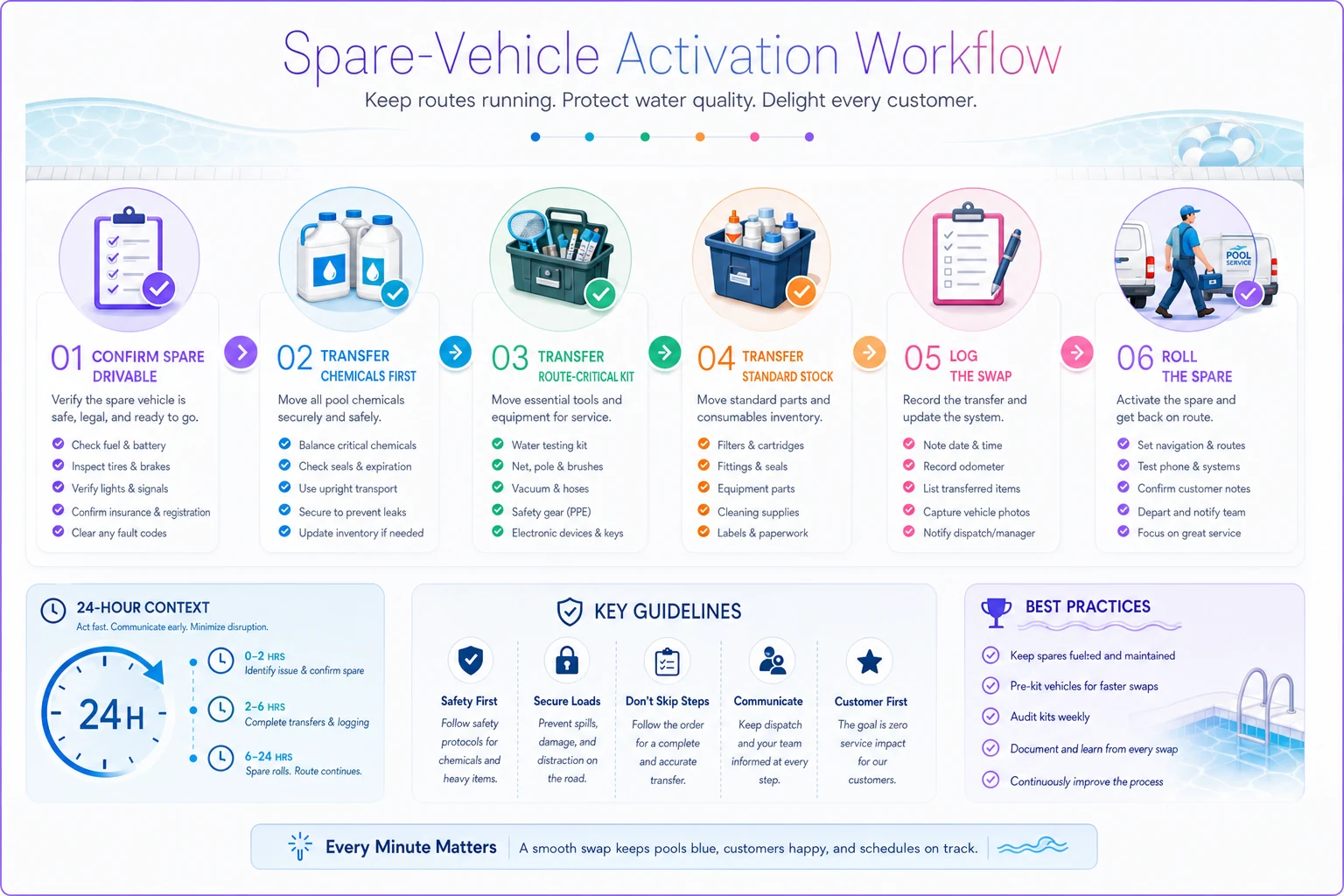
A simple visual checklist like this keeps technicians moving in the right order without thinking through the sequence at 6:50 AM.
Keeping the spare ready also ties directly into your maintenance rhythm. A spare vehicle should sit inside your normal preventive maintenance schedule, not get ignored until an emergency. A spare that only runs during crises tends to become a crisis.
Emergency swap rules for a small fleet
Rules matter more than judgment here, because these decisions happen at the worst possible moment. Write them down, put them somewhere visible, and make them non-negotiable so nobody has to think clearly under pressure.
-
Rule 1 — Commercial and contract stops get covered first. If capacity is tight, residential recurring visits slide before a commercial open gets missed. Contracts are what a missed day actually threatens.
-
Rule 2 — Never transfer chemicals in a rush without securing them. A spill in the yard cancels the time savings and creates a bigger problem. Slow is fast here.
-
Rule 3 — If two trucks are down, stop redistributing and rent. One truck down, you can shuffle. Two down and you're overloading the survivors and blowing three routes to save one rental fee.
-
Rule 4 — The tech doesn't decide alone. A quick call to dispatch or the owner with route load and fix estimate. The person seeing the whole day's map makes a better call than the person standing next to the dead truck.
-
Rule 5 — Every swap gets logged the same day. No log, no pattern. No pattern, and you'll keep nursing a truck that should've been replaced two months ago.
No log, no pattern. No pattern, and you'll keep nursing a truck that should've been replaced two months ago.
A real scenario
A five-truck operation running mixed residential and small-commercial routes had a recurring "figure it out" morning about once a month — usually a battery or a tire. Each incident burned roughly two to three hours of scrambling, and a few times each season it actually cost them a missed commercial stop, which meant an uncomfortable phone call and, once, a contract that didn't renew.
They made two changes. The 7-point check moved to end-of-shift, so problems surfaced the afternoon before. And they wrote the decision tree and the activation SOP and kept one spare truck on the weekly check rotation.
The next time a truck wouldn't start, it was caught the evening before during the end-of-day check — a battery on its way out. They swapped it that night. The route rolled on time the next morning like nothing happened. Over the following months, morning scrambles dropped to almost none, and the recovery time on the one genuine surprise failure went from a couple of hours to about 25 minutes because the spare was ready and the transfer sequence was already written down. The rental line item barely moved — they only rented once that season — because most incidents got caught early enough to fix cheaply.
Who this is overkill for — and who needs it most
If you run one or two trucks, a formal spare-vehicle SOP is probably more structure than you need. Your realistic plan is a same-day rental relationship and a solid roadside membership. The decision tree still helps, but keeping a dedicated spare on rotation is hard to justify at that size.
The fleets that need this most are the 4–15 truck operations with commercial contracts in the mix. That's the size where a down truck genuinely disrupts multiple routes, but there isn't enough slack to absorb it quietly. That's the exact spot where a written check routine, a decision tree, and an activation sequence turn a three-hour fire drill into a 20-minute swap.
None of this is really about the vehicles. It's about protecting the routes and the contracts that depend on them. A pre-shift check that surfaces problems the night before, a decision tree that removes the morning debate, and a spare that's actually ready — that combination is the difference between a fleet that absorbs a breakdown quietly and one that has a bad day every time a battery dies.
Ready to elevate your pool service business?
Join hundreds of pool service professionals using Splshly to save time, optimize routes, and enhance customer satisfaction.