
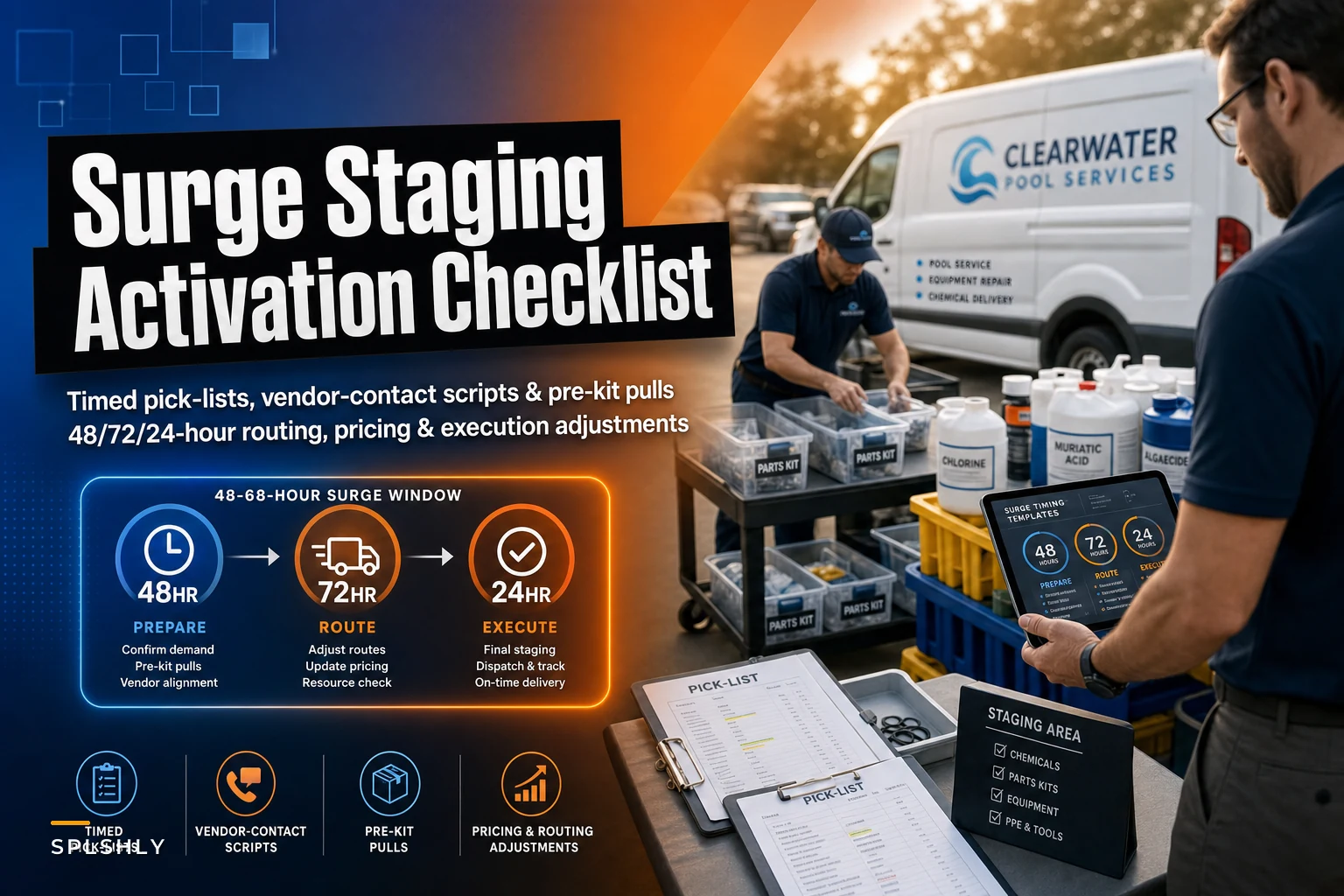

Most pool service operators know how to respond to a surge. Where they lose money and burn out crews is in the staging window—the 24 to 72 hours before trucks start rolling, when you're supposed to be pulling chemicals, pre-kitting parts, adjusting routes, and locking temporary pricing. That window gets improvised almost every time. Somebody grabs cases of shock off the shelf, somebody else guesses at how many cartridge filters to load, and by day two you're sending techs back to the warehouse mid-route because nobody staged for the actual demand curve.
This post is narrow on purpose. It's not a storm playbook and it's not a general prep guide. It's the execution layer: what to pull, when to pull it, how to price it temporarily, and how to reroute so the staging you did actually holds up once volume hits. If you want the upstream triggers and mutual-aid side of surge response, that's covered separately in the activation-ready storm surge playbook for pool services. This is what happens after you've decided to activate.
Why staging fails even when everyone works hard
The failure almost never comes from laziness. It comes from staging against yesterday's demand instead of the shape of the surge.
A normal week has a flat demand profile—recurring maintenance, a few repairs, predictable chemical usage. A surge has a curve. In a heat spike or post-event scramble, chemical demand front-loads hard: everyone needs shock, algaecide, and stabilizer in the first 48 hours, then it tapers. Parts demand does the opposite. It lags. Pump motors, cracked filter housings, and blown salt cells don't get diagnosed until techs are actually on-site, so parts pressure peaks around hours 48–72, not hour zero.
If you stage everything on day one—chemicals and parts—you overload trucks with parts you can't install yet and understock the chemicals you're burning through immediately. Then you're doing warehouse round-trips on both ends. The trucks look "fully stocked" on paper but the mix is wrong for the timing, and that mismatch is where the wasted hours hide.
The second reason staging fails: nobody assigns ownership of the pull. When it's "everybody's job" to load the vans, quantities get double-counted or missed entirely. Two techs each assume the other pulled the DE powder. Now you've got zero on three trucks.
The staging timeline that actually matches the demand curve
Instead of one big pre-load, split staging into three timed waves. Each wave has a specific pull list and a specific owner.
Eliminate missed appointments and dispatch delays.
Splshly ensures every pool service is scheduled, tracked, and completed efficiently.
- Unified scheduling dashboard
- Automated customer reminders
- Technician route optimization
No credit card required
T-72 hours: forecast lock and long-lead parts
-
Confirm surge tier and expected job volume for the window
-
Place vendor orders on anything with >24h lead time (motors, specific cartridge SKUs, salt cells)
-
Pull historical usage from the last comparable surge to set chemical targets
-
Assign wave owners for T-48 and T-24 pulls by name
T-48 hours: chemical bulk staging
-
Pull chemicals to route-level bins based on T-72 targets plus a surge buffer
-
Verify lot numbers and expiration on anything that's been sitting
-
Pre-mix nothing, but pre-group by job type (green-pool recovery kits vs. maintenance top-offs)
-
Flag any chemical you're short on now, while there's still time to source
T-24 hours: parts pre-kit and truck load
-
Kit repair parts by probable diagnosis tier (see pull list below)
-
Load chemical bins from T-48 staging
-
Apply temporary pricing to the day's dispatched jobs
-
Print or push the exact per-truck pull manifest so techs can verify against it before rolling
Here's a quick workflow view of the three-wave staging process.
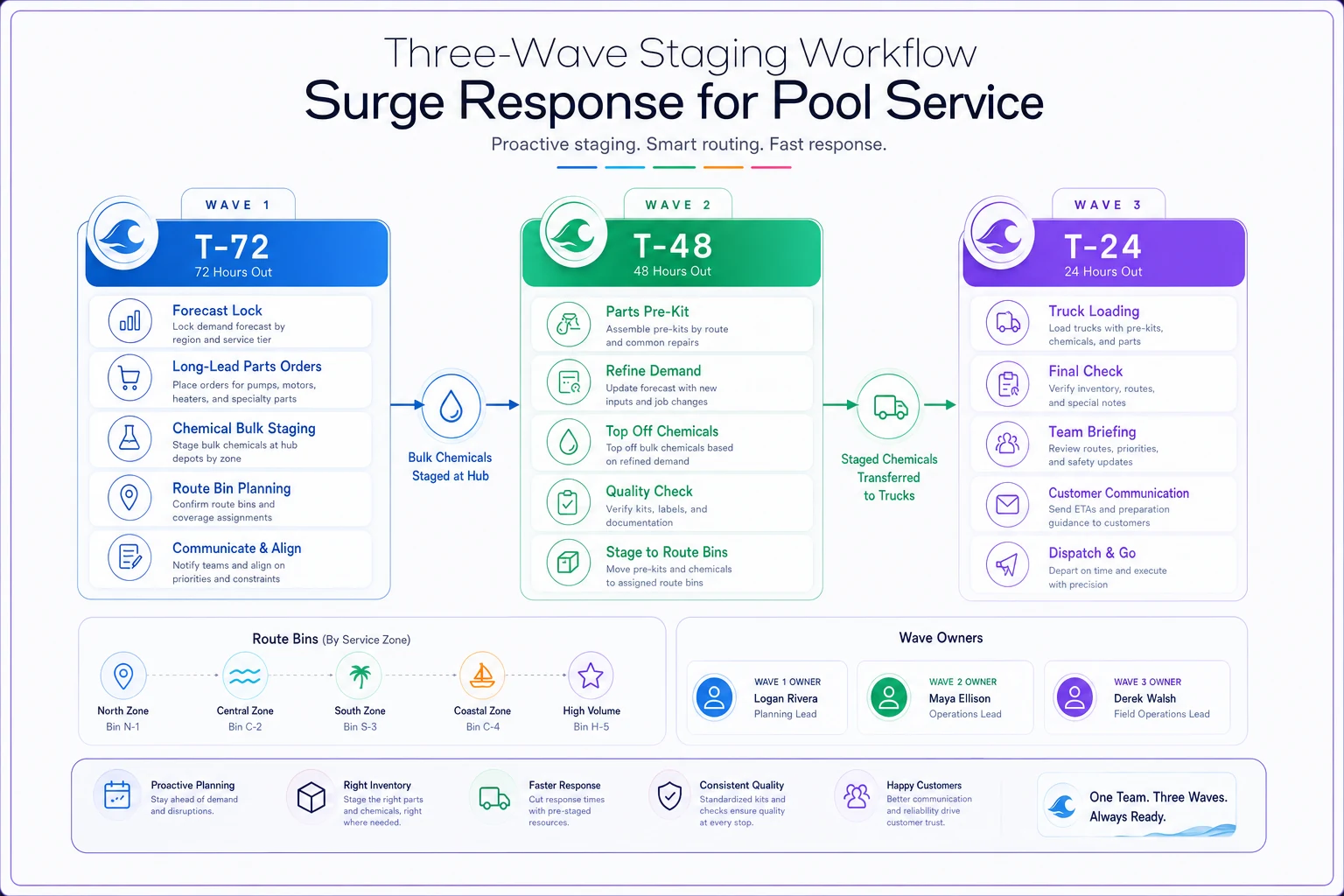
The diagram shows how staged bins transfer to trucks and how parts are kitted later to match the demand curve.
Exact chemical pull list by surge type
Not every surge burns the same chemicals. A heat-and-algae surge is a shock-and-algaecide event. A post-event debris surge is a filtration-and-clarifier event. Staging the same chemical mix for both is how you end up with 40 gallons of algaecide you didn't need and no filter cleaner.
| Chemical | Heat/Algae Surge (per 20 jobs) | Debris/Recovery Surge (per 20 jobs) | Notes |
|---|---|---|---|
| Cal-hypo / liquid shock | 30–40 lb or 25–30 gal | 15–20 lb or 12–15 gal | Front-load heavy on algae surges |
| Algaecide | 8–12 qt | 3–5 qt | Green-pool kits eat this fast |
| Stabilizer (CYA) | 15–20 lb | 5–8 lb | Heat surges drift low fast |
| Clarifier / flocculant | 4–6 qt | 12–18 qt | Debris recovery reverses the ratio |
| Filter cleaner | 2–3 gal | 6–8 gal | Cartridge/DE cleaning spikes post-debris |
| Muriatic acid | 8–12 gal | 6–10 gal | pH swings both directions |
| Test reagents/strips | 2× normal | 2× normal | Retest volume doubles during recovery |
These are staging starting points, not gospel—adjust to your average pool size and water chemistry. The two surge profiles pull almost mirror-image ratios on clarifier and shock. Stage one list for both and half your trucks are carrying dead weight.
Parts pre-kit by diagnosis tier
Since parts demand lags into the 48–72 hour window, you don't need every part on every truck. You need the probable parts kitted by how often each failure shows up during a surge. Kit in three tiers: Tier 1 on every truck, Tier 2 on repair-designated trucks, Tier 3 staged at the warehouse for same-day runs.
Tier 1 — load on every truck (high-frequency, low-cost):
-
O-rings and gasket assortments (pump lid, filter, valve)
-
Cartridge filter elements in your two most common sizes
-
Pump lid, drain plugs, unions
-
Pressure gauges
-
Basic electrical
fuses, wire nuts, GFCI test leads
Tier 2 — repair-truck only (medium-frequency, medium-cost):
-
Pump motors in your top two horsepower ratings
-
Salt cells for your dominant system brand
-
Multiport valve spider gaskets and diverters
-
Filter housing clamps and tension bands
Tier 3 — warehouse-staged for same-day pull (low-frequency, high-cost):
-
Full pump assemblies
-
Heater ignition/control modules
-
Automation control boards
-
Variable-speed drive units
If your tiering feels shaky, the underlying logic maps closely to a solid everyday stocking approach—the tiered truck stocking plan and seasonal PARs framework translates almost directly to surge kitting, just with tighter buffers.
Temporary pricing that doesn't blow up later
Surge staging without a pricing adjustment means you're absorbing the cost of expedited chemicals, overtime, and vendor rush fees while charging normal rates. But loose temporary pricing creates billing disputes weeks later when customers see a charge they don't recognize.
-
Define the pricing window with hard start/end timestamps. "Surge pricing in effect from Tuesday 6 AM to Friday 6 PM" is defensible. "During the heat wave" is not.
-
Separate the surge line item on invoices. Don't bake it into the base service rate. A visible, labeled surcharge is easier to defend and easier to remove when the window closes.
-
Cap the surcharge as a percentage, not a flat mystery number. A 15–25% surge line on affected jobs reads as reasonable. An unexplained $60 add-on reads as gouging.
The most common failure here is forgetting to turn the pricing off. Techs keep applying the surcharge for a week after the surge ends because nobody flipped the switch. Tie the pricing window to the same timestamps as your staging waves so it expires when the last surge route runs.
Routing adjustments that protect the staging you did
You staged trucks by tier and route. If dispatch then reroutes on the fly without checking what's loaded, the staging collapses—you send the maintenance truck to a motor-replacement job it can't complete.
The rule during a surge is stage-aware routing: jobs get assigned to trucks based on what that truck is actually carrying, not just proximity. Repair-tier jobs route to Tier 2 trucks. Chemical recovery jobs cluster to trucks carrying the heavy shock load. This sounds obvious, but under surge pressure dispatchers default to "who's closest," and the closest truck is often the wrong one.
Batch recovery jobs geographically so the heavy-chemical trucks aren't crisscrossing the territory burning fuel and time. When a truck runs dry on a fast-moving chemical mid-route, the reroute should send it to a staging bin, not the main warehouse—which is the whole reason you pre-grouped chemicals at T-48. For the intake and triage side of deciding which jobs even make the surge queue, the post-storm triage checklist for dispatchers covers the risk-tiering that should feed directly into this routing logic.
A real staging scenario
A mid-sized operation running seven trucks hit a five-day heat-and-algae surge. Their normal week runs around 260 stops. The surge pushed projected volume to roughly 380 over the window, with a spike of green-pool recovery calls.
Before they used timed waves, their previous surge had them making around 14 mid-route warehouse trips over three days—each one eating 45 minutes to an hour round trip. Chemicals ran short on day one. Parts sat unused on day one and then weren't kitted right when the repair calls hit on day two.
The next surge, they split staging into T-72 / T-48 / T-24 waves with named owners. Chemicals went into route bins. Parts got kitted by tier. Mid-route warehouse trips dropped to about four over the same window—mostly Tier 3 high-cost pulls that were always supposed to come from the warehouse anyway. The temporary surcharge, tracked as a separate line, held up cleanly. One billing question the whole week.
Nothing dramatic happened. They just stopped fighting their own staging. That's usually what improvement looks like—fewer wasted trips, less improvisation, crews not burning daylight on avoidable round-trips.
When timed staging waves make sense—and when they don't
This makes sense when:
-
You run three or more trucks and surges create warehouse round-trip pileups
-
Your surges have a clear demand curve (heat, algae, post-event debris)
-
You have enough warehouse space to pre-group chemicals by route
This is probably overkill when:
-
You're a one or two-truck operation where the tech is also the warehouse
-
Your "surges" are really just moderately busy weeks that normal PARs cover
-
You don't have a reliable forecast at T-72 and you'd just be guessing the pull quantities anyway
If you can't forecast the surge tier 72 hours out with any confidence, fix the forecasting first. Staging waves built on a bad forecast just organize the wrong quantities more efficiently.
Keeping the staging manifest honest
The weak point in all of this is verification. You can build perfect pull lists, but if no one checks that Truck 3 actually got its Tier 2 kit, you find out at the job site. A simple per-truck manifest that the tech confirms against before rolling closes that gap—two minutes before departure prevents the mid-route surprise.
Have techs snap a timestamped photo of each truck's manifest and staged bins before departure to keep verification simple and auditable.
This is one place where the operational software most pool businesses already run for scheduling and inventory earns its keep during a surge: generating per-wave pull lists from the forecast, pushing the per-truck manifest to each tech's phone, and auto-expiring the temporary pricing window so nobody has to remember to switch it off. The staging logic is yours; the software just enforces it consistently when everything's moving fast and it'd be easy to skip a step.
The core idea is simple. Surges don't fail because your team can't work hard—they fail because chemical demand and parts demand peak at different times, and staging everything at once fights that reality. Split the pull into waves that match the curve, assign each wave an owner, kit parts by probability instead of by hope, and tie your temporary pricing to the same clock as your staging. Do that, and the trucks roll loaded for the day they're actually going to have.
Ready to elevate your pool service business?
Join hundreds of pool service professionals using Splshly to save time, optimize routes, and enhance customer satisfaction.