


Your best tech just quit. Twenty-three years of experience walking out the door. He knew which Pentair pumps tend to crack at the volute after eighteen months. Which neighborhoods have aggressive calcium buildup that requires different chemical protocols. How to spot a failing salt cell before the customer notices the chlorine drop.
None of it written down anywhere.
This scenario plays out constantly at pool service companies. Veterans carry operational knowledge that never makes it into training materials. New techs spend months making the same mistakes, misdiagnosing the same problems, ordering wrong parts for equipment they've never seen before. Your experienced guys waste hours answering the same questions over text while trying to finish their routes.
Building a pool technician knowledge base isn't about creating another dusty manual nobody reads. It's capturing real field knowledge in a format techs actually use—searchable troubleshooting guides linked to specific equipment models, video snippets showing exact repair procedures, competency modules that train on actual failure patterns your team encounters.
Why traditional training breaks down in pool service operations
Pool service knowledge doesn't fit neatly into training manuals. A tech needs to know that Hayward VS pumps from 2018-2020 have a specific capacitor issue, but only when installed with certain automation systems. Or that algae treatment in a particular neighborhood requires different shock levels because of the municipal water source.
Most pool companies rely on ride-alongs and verbal knowledge transfer. New techs shadow veterans for a few weeks, picking up whatever sticks. But ride-along training has massive gaps. The new tech might never see a heat pump failure during training season. They won't encounter every pump model. They definitely won't learn the subtle diagnostic differences between similar symptoms.
Traditional documentation fails for different reasons. Nobody wants to read a 200-page technical manual on their phone while standing next to a malfunctioning pump. Generic manufacturer guides don't cover the real-world modifications and workarounds your team has developed. Static documents can't capture the decision trees experienced techs run through when diagnosing problems.
The knowledge exists—it's just trapped in your veterans' heads, scattered across text messages, buried in old invoices, and lost when techs leave. Every experienced tech has their mental catalog of equipment quirks, chemical adjustments for specific pools, and diagnostic shortcuts. Without a system to capture and organize this knowledge, every new hire starts from scratch.
Building knowledge taxonomies that match field reality
A useful pool technician knowledge base starts with organizing information the way techs actually think about problems. Not by manufacturer manual sections, but by the situations they encounter.
Eliminate missed appointments and dispatch delays.
Splshly ensures every pool service is scheduled, tracked, and completed efficiently.
- Unified scheduling dashboard
- Automated customer reminders
- Technician route optimization
No credit card required
Your taxonomy needs multiple entry points. A tech standing next to a pool with cloudy water needs immediate access to diagnostic flowcharts, not pump model numbers. But when ordering parts, they need equipment-specific information organized by manufacturer and model year. Same knowledge, different access patterns.
Start with failure modes as your primary organizing principle. Every piece of equipment has predictable failure patterns. Variable speed pumps lose prime differently than single-speed pumps. Salt cells fail in stages—reduced output, then intermittent operation, then complete failure. Each failure mode becomes a knowledge node with associated symptoms, diagnostic steps, repair procedures, and preventive indicators.
Layer equipment models within each failure category. A bearing failure looks different on a Pentair IntelliFlo versus a Hayward TriStar, even though the root cause is similar. Your knowledge base needs both the general bearing failure protocol and the model-specific variations.
Add geographical and seasonal modifiers. Freeze damage in North Texas pools follows different patterns than in South Florida. Chemical protocols that work in April might cause problems in August.
Connect related issues through cross-references. A pump cavitation problem might stem from a clogged impeller, but it could also indicate a suction-side leak or undersized plumbing. Your knowledge structure needs to guide techs through these diagnostic branches without forcing them down rigid paths.
Capturing knowledge through structured field documentation
Getting techs to document their knowledge sounds impossible. They're already rushed, dealing with difficult customers, trying to hit productivity targets. But the key isn't asking them to write lengthy reports—it's building documentation into their existing workflow.
Every service call generates knowledge. When a tech diagnoses a tricky problem, that diagnostic process has value. When they discover a new failure pattern, other techs need to know. The challenge is capturing this information without adding friction to their day.
Create simple capture templates tied to specific triggers. When a tech encounters an equipment failure, they fill out a quick form: equipment model, failure symptoms, root cause, fix applied, time to repair. Takes thirty seconds, captures the essential knowledge.
Use voice-to-text for complex explanations. Let techs record quick audio notes explaining unusual situations or complicated repairs. "This Jandy valve actuator was sticking because the homeowner's landscaper kept hitting it with the weed trimmer. Look for grass clippings in the gear assembly." Transcribe these later into searchable text.
Photo documentation becomes critical for visual learners. Before/after shots of repairs, close-ups of failure points, proper equipment positioning—these images teach faster than paragraphs of text. Build standard shot lists for common repairs so techs know exactly what to capture.
Incentivize knowledge contribution. Track who adds useful content to the knowledge base. Recognize techs who document novel solutions or create helpful guides. Make it clear that building institutional knowledge is valued work, not extra work.
The capture process has to be frictionless. If techs need to log into three systems or fill out complex forms, it won't happen. Build capture mechanisms into the tools they already use—service apps, messaging platforms, photo uploads.
Build standard shot lists for common repairs so techs know exactly what to capture.
Here's a quick visual of the capture workflow you'll want to standardize.
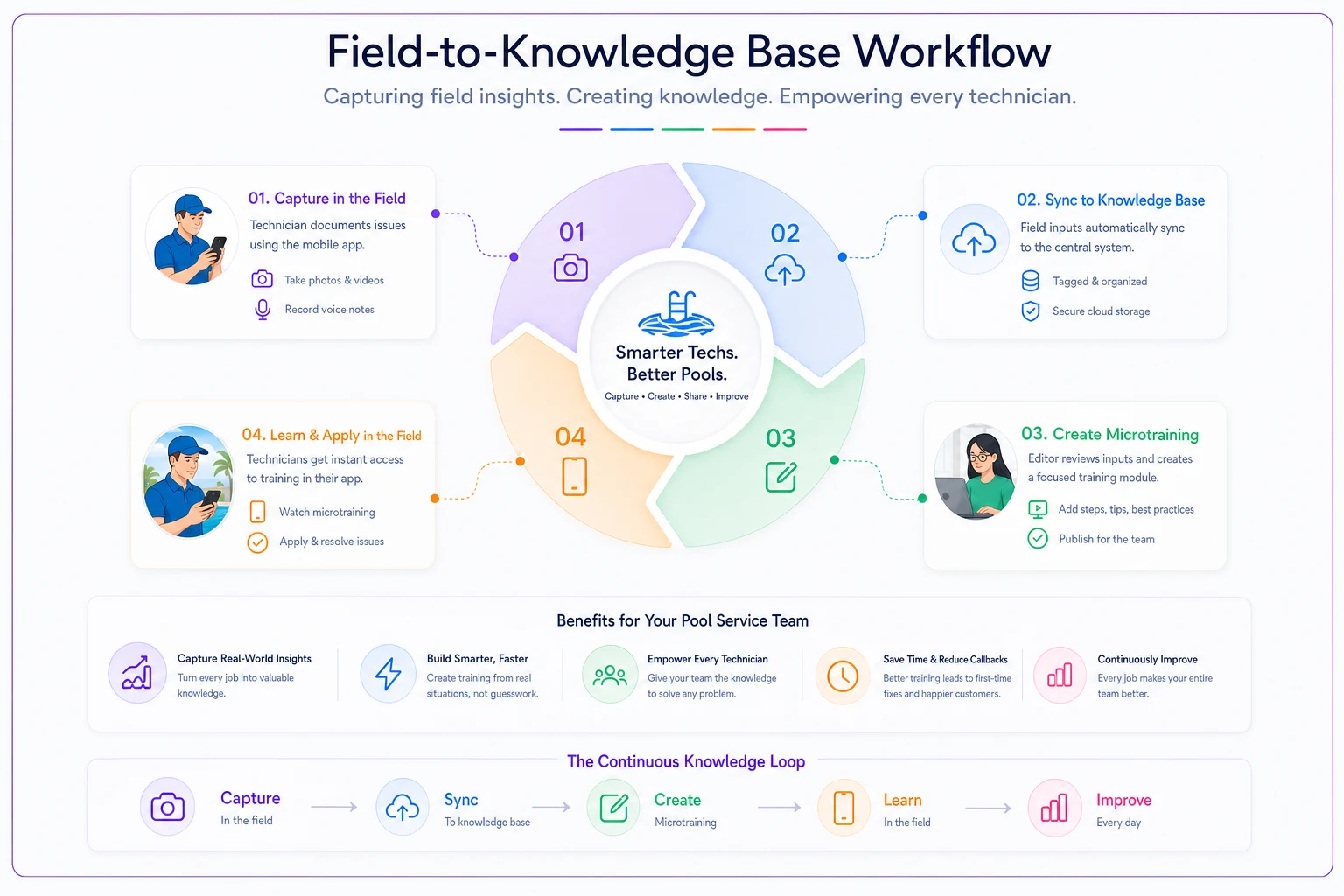
Make the capture workflow predictable and fast so the knowledge flows from field to base without extra steps.
Micro-lessons that stick: 3-minute modules for specific problems
Nobody learns pool chemistry from a textbook anymore. They learn from YouTube videos at 1.5x speed while eating lunch in their truck. Your internal training needs the same accessibility and specificity.
Break every skill into tiny, specific modules. Not "How to Service a Pool Heater" but "Diagnose Hayward H-Series Ignition Failure in 3 Steps." Not "Chemical Balancing" but "Fix Combined Chlorine Lockout in Salt Pools." Each module solves one specific problem a tech will actually encounter.
Keep modules under three minutes. A tech waiting for a customer can complete one. Someone troubleshooting in the field can quickly review the relevant procedure. Short modules get watched; long training videos get skipped.
Structure each module identically: problem identification (30 seconds), diagnostic steps (90 seconds), solution and verification (60 seconds). Consistent structure helps techs find information quickly even while multitasking.
| Structure each module identically |
|---|
| problem identification (30 seconds) |
| diagnostic steps (90 seconds) |
| solution and verification (60 seconds) |
Include decision points and branches. "If the pressure gauge reads over 25 PSI, go to Module 3B on backwash procedures. If under 10 PSI, continue with prime troubleshooting." This mirrors how experienced techs actually think through problems.
Use real equipment and real pools from your service area. Generic training videos showing pristine equipment in perfect conditions don't help when your tech is dealing with a ten-year-old pump covered in calcium scale. Film in the field, showing actual problems and working conditions.
Test competency through scenario-based questions, not multiple choice. Show a video of symptoms and ask techs to identify the most likely cause. Present a customer complaint and have them outline their diagnostic approach. Real competency means applying knowledge, not memorizing facts.
Review cycles that prevent knowledge decay
Knowledge bases die from two causes: outdated information and lack of use. Without active maintenance and verification, your carefully built system becomes another ignored resource.
Implement monthly knowledge audits by equipment category. Assign veteran techs to review specific sections, checking for accuracy and completeness. Has a manufacturer issued new guidance? Did someone discover a better diagnostic approach? Are the part numbers still current?
Track module usage and effectiveness. Which lessons do techs access most frequently? Which ones correlate with successful first-time fixes versus callbacks? Low usage might indicate the module is too generic or poorly indexed. High usage with poor outcomes suggests the content needs revision.
Create feedback loops from field results. When a tech uses a knowledge base solution and it doesn't work, that's valuable data. Maybe the module missed an edge case. Perhaps local conditions require modification. Build a simple "this didn't work because..." feedback mechanism.
Rotate knowledge ownership among senior techs. Don't let one person become the sole keeper of pump knowledge or chemical expertise. Rotating ownership forces knowledge transfer and brings fresh perspectives to established procedures.
Version control matters more than you'd think. When chemical recommendations change or equipment recalls happen, you need to know which techs learned the old method versus the new. Tag updates clearly, notify affected users, and track who's reviewed critical changes.
Set expiration dates on seasonal or regulatory content. Chemical protocols for pool openings might change year to year. Local health department requirements get updated. Build automatic reviews into time-sensitive content so nothing gets missed.
Competency mapping: connecting knowledge to failure prevention
Every callback, every misdiagnosis, every equipment failure tells you what your techs need to know. Smart companies track these patterns and build targeted training around actual operational gaps.
Map competencies to your most common service failures. If 30% of your callbacks involve salt cell cleaning issues, that's a competency gap. If new techs consistently misdiagnose suction-side air leaks as pump problems, you need better diagnostic training for that specific issue.
Build competency requirements by experience level. A six-month tech needs to identify and fix common chemical imbalances. A two-year tech should diagnose basic equipment failures. A five-year tech troubleshoots automation and complex multi-equipment problems. Clear progression paths help techs understand what to learn next.
Connect training modules directly to field tasks. Before a tech gets dispatched for their first heat pump service, they complete the relevant micro-modules. The system tracks completion and comprehension, ensuring they're prepared before arriving on-site.
Create pre-season competency sprints for seasonal issues. Before pool opening season, every tech reviews winterization damage patterns. Before summer heat, they refresh on algae identification and treatment. Timely knowledge refresh prevents seasonal callback spikes.
Use failure analysis to identify knowledge gaps. When something goes wrong—callback, warranty claim, customer complaint—trace it back to the knowledge component. Did the tech not know the proper procedure? Was the knowledge base incorrect? Or did they know but not apply the knowledge correctly? Each answer drives different improvements.
Track competency demonstration through actual work outcomes. Real competency shows up in metrics: first-call resolution rates, callback frequency, average repair time by problem type. Use these operational indicators to validate that knowledge transfers to field performance.
Implementation timeline and rollout phases
Building a pool technician knowledge base doesn't happen overnight. You're changing how your entire operation thinks about knowledge while maintaining daily service levels.
Start with your highest-impact knowledge gaps. Track every callback and miscommunication for two weeks. Which problems repeat most frequently? Those become your first knowledge modules. Better to have ten excellent modules techs actually use than fifty mediocre ones they ignore.
Phase one focuses on critical equipment failures—the stuff that causes emergency calls and ruins Saturdays. Document diagnostic procedures for the five most common pump failures, three most frequent heater issues, top filter problems. Get these right before expanding scope.
Phase two adds chemical troubleshooting and seasonal procedures. Build modules for algae identification, metal staining, calcium management. Create separate tracks for different pool types—salt, chlorine, UV systems. Include regional variations for water chemistry.
Phase three incorporates customer communication templates and quality check protocols. How do you explain a failed salt cell to a homeowner? What photos document a completed repair? Which inspection points prevent comebacks?
Roll out to small groups first. Pick three experienced techs and three newer hires. Have them use the system for a month, tracking what works and what frustrates them. Their feedback shapes the full rollout.
Measure adoption through natural metrics. Don't track login counts or module views—track whether callback rates drop, whether new tech ramp-up time decreases, whether parts ordering accuracy improves. Real adoption shows up in operational metrics, not usage reports.
Expect six months from inception to meaningful impact. First month: planning and taxonomy. Second month: initial content creation. Third month: pilot testing. Fourth month: refinement and expansion. Fifth month: full rollout. Sixth month: measurable operational improvement.
-
First month
planning and taxonomy.
-
Second month
initial content creation.
-
Third month
pilot testing.
-
Fourth month
refinement and expansion.
-
Fifth month
full rollout.
-
Sixth month
measurable operational improvement.
Expect six months from inception to meaningful impact. First month: planning and taxonomy. Second month: initial content creation. Third month: pilot testing. Fourth month: refinement and expansion. Fifth month: full rollout. Sixth month: measurable operational improvement.
Technology stack and platform decisions
Your knowledge base needs to work where techs work—in the field, on their phones, with spotty internet and wet hands. Desktop-only solutions or complex interfaces guarantee failure.
Mobile-first design isn't optional. Every interface element needs to work on a phone screen in bright sunlight. Large buttons, high contrast, minimal text entry. If a tech can't use it with pool water dripping off their hands, redesign it.
Search has to be intelligent and forgiving. Techs won't type "Pentair IntelliFlo Variable Speed Pump VSF Model 011028." They'll type "pentair pump weird noise" or voice-search "intelliflo won't prime." Your search needs to understand equipment variations, common misspellings, and symptom-based queries.
Offline capability keeps techs productive in dead zones. Basic diagnostic flowcharts and common procedures should work without internet. Queue updates and feedback for sync when connection returns. Nothing frustrates techs more than losing access to critical information at a customer's house.
Integration with existing systems multiplies value. When a tech scans an equipment serial number, relevant knowledge modules should appear automatically. When they mark a specific failure type, the system suggests related competency training. These connections turn isolated knowledge into operational intelligence.
Video storage and streaming requires planning. A three-minute repair video might be 100MB. Multiply by hundreds of modules and dozens of techs streaming simultaneously, and bandwidth becomes expensive. Consider compression, caching strategies, and whether to host internally or use content delivery networks.
AI-powered operational software can accelerate knowledge capture and distribution. Natural language processing helps convert voice notes into searchable text. Pattern recognition identifies knowledge gaps from service data. Automated scheduling ensures techs get relevant training before seasonal challenges. But the core value comes from capturing and organizing human expertise, not replacing it.
Measuring success: KPIs that matter
You'll know your pool technician knowledge base works when operational metrics improve, not when usage statistics look good. Track outcomes that directly impact profitability and customer satisfaction.
First-call resolution rate indicates whether techs have the knowledge they need. If techs can diagnose and fix problems without callbacks or senior tech assistance, your knowledge base is working. Track this by problem type—which issues still require multiple visits?
New technician ramp-up time directly reflects knowledge transfer effectiveness. How long before a new hire can handle basic service calls independently? Can you reduce the three-month training period to six weeks? Faster ramp-up means lower training costs and quicker productivity.
Parts accuracy shows diagnostic precision. When techs order the right part the first time, they're properly diagnosing problems. Track incorrect parts orders by technician and problem type to identify knowledge gaps.
Callback rate by issue type reveals knowledge application problems. If callbacks for chemical balance issues drop but equipment repairs still generate return visits, you know where to focus knowledge development next.
Senior tech interruption frequency matters more than you might expect. How often do experienced techs get pulled away from their routes to answer questions or help with problems? A good knowledge base should dramatically reduce these interruptions.
Customer satisfaction scores tied to technical competence provide external validation. When customers mention "fixed it right the first time" or "really knew what they were doing," your knowledge system is creating visible value.
Equipment failure prediction accuracy demonstrates advanced knowledge application. Can your techs identify equipment likely to fail before it does? This proactive capability comes from deep, organized knowledge about failure patterns and warning signs.
Common pitfalls and how to avoid them
Most pool companies abandon their knowledge base initiatives within six months. They make predictable mistakes that doom the system before it can provide value.
Information overload kills adoption faster than anything. Companies try to document everything immediately—every chemical protocol, every equipment model, every possible scenario. Techs get overwhelmed and ignore the entire system. Start narrow, prove value, then expand gradually.
Forcing techs to change their workflow causes rebellion. If you demand they fill out forms after every call or watch training videos during their lunch break, expect resistance. Build knowledge activities into natural workflow gaps—while driving between stops, during equipment warm-up cycles, while waiting for customers.
Ignoring veteran tech input creates irrelevant content. Your twenty-year veteran might not use computers well, but they know which Jandy valves leak and why. Capture their knowledge through conversation and observation, not forced documentation.
Making knowledge base maintenance someone's "additional duty" ensures decay. Assign clear ownership with dedicated time. If it's nobody's primary responsibility, it becomes nobody's responsibility at all.
Over-structuring reduces usability. Rigid taxonomies and complex categorization systems might satisfy organizational instincts, but they frustrate field users. A tech troubleshooting a heater failure doesn't care about your carefully crafted hierarchy—they just need the answer fast.
Underestimating the cultural shift sets unrealistic expectations. You're not just building a database; you're changing how your organization values and shares knowledge. This takes time, consistent reinforcement, and visible benefits before teams buy in.
Skipping the feedback loop prevents improvement. Without mechanisms to report errors, suggest improvements, or contribute new solutions, your knowledge base becomes a static resource that gradually loses relevance.
From tribal knowledge to operational asset
Your veteran techs won't be around forever. Every retirement, every resignation, every promotion takes irreplaceable knowledge out of the field. That expertise doesn't have to disappear.
Building a pool technician knowledge base transforms scattered individual knowledge into structured organizational capability. New techs ramp up faster. Experienced techs spend less time answering questions. Customers get consistent, competent service regardless of which tech shows up.
The process isn't complex, but it requires commitment. Start by identifying your most painful knowledge gaps—the problems that generate callbacks, confusion, and wasted time. Build capture mechanisms that work with your team's existing habits. Create micro-training modules that solve real problems quickly.
Ready to elevate your pool service business?
Join hundreds of pool service professionals using Splshly to save time, optimize routes, and enhance customer satisfaction.