

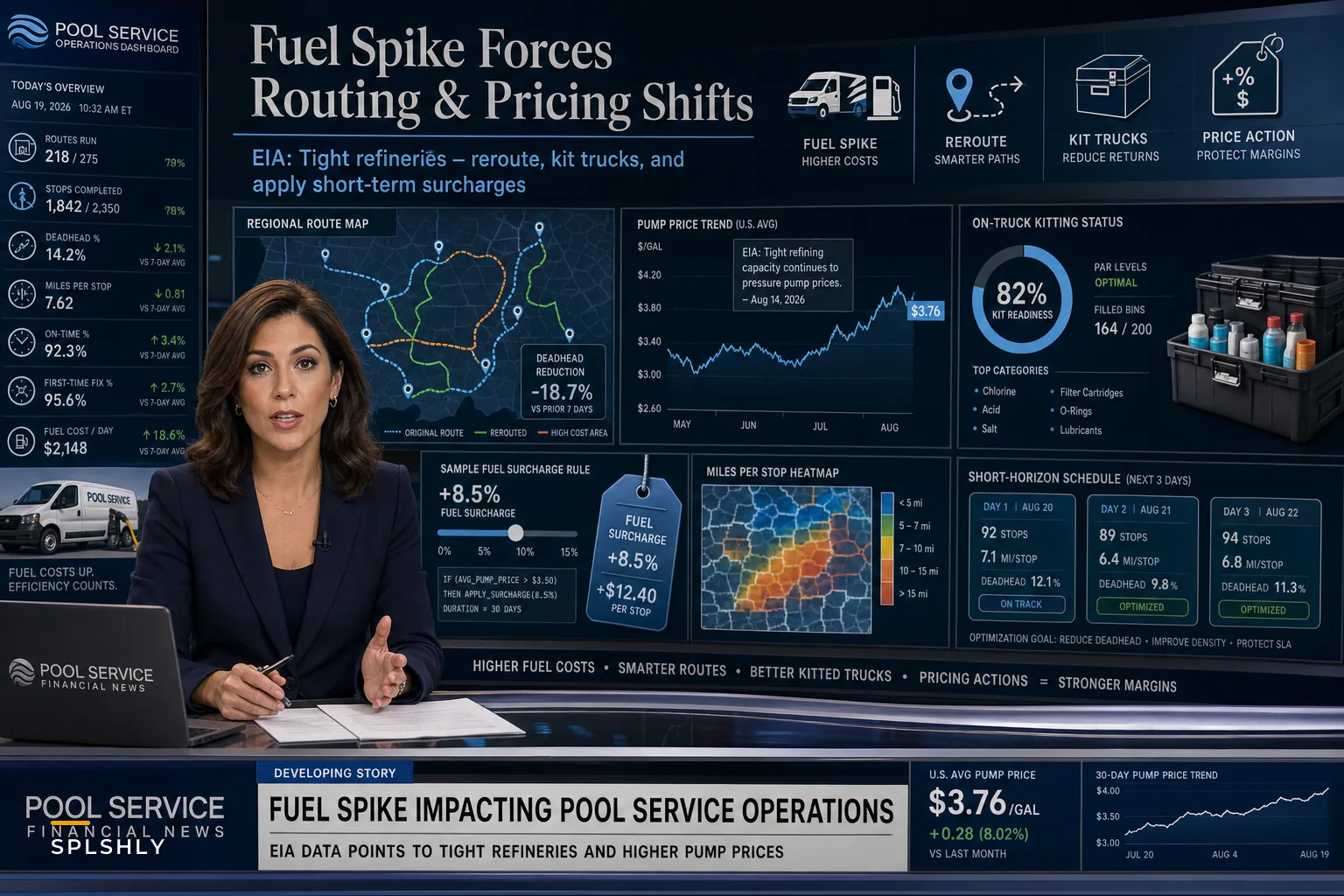

Fuel is one of those costs that doesn't show up loudly on the P&L until you actually add up a full month of route driving. And right now it's adding up faster than most owners planned for. Tight refining capacity, a couple of unplanned refinery outages, and elevated crack spreads have kept gasoline and diesel prices stubbornly high heading into the back half of pool season. The EIA's mid-August Short-Term Energy Outlook shows refiners running near capacity with limited slack, and a recent CNBC report pointed out that pump prices could stay elevated into fall even if crude itself settles down. The refining bottleneck — not just the barrel price — is doing the damage.
For a route-based fleet, that's not an abstract macro story. It's an immediate hit to your cost-per-stop. And the frustrating part is that fuel is the one big expense where you can't just renegotiate a vendor contract to fix it. What you can control is how many miles each truck burns to generate a dollar of revenue.
Why fuel hits pool routes harder than most people expect
Most owners underprice how sensitive their margins are to fuel because they think in terms of "gallons per week" instead of "gallons per completed job." Those are very different numbers.
A tech running a dense recurring route in a subdivision might do 14–18 stops in a day on maybe 40–55 miles of driving. A tech covering spread-out custom pools and repair calls across three towns can do 8–10 stops on 90+ miles. Same truck, same fuel price, but the second tech's fuel cost per job can be two to three times higher. When diesel jumps 60–80 cents a gallon, the dense route barely notices. The spread-out route bleeds.
That's the underlying problem fuel spikes expose: route density and job sequencing are usually the weakest link in a pool operation's cost structure, and nobody notices until fuel gets expensive. When gas was cheap, sloppy routing was forgivable. Now every backtrack, every "oh, I forgot the fitting, let me swing back," every emergency call jammed into the middle of a clean route — all of it costs real money.
The number that actually matters, and almost nobody tracks: fuel cost per completed stop. Not per mile, not per truck. Per stop. Once you have that, you can see which routes are quietly killing you.
The three levers you actually have
When fuel spikes, there are only three real moves. Everything else is noise.
Eliminate missed appointments and dispatch delays.
Splshly ensures every pool service is scheduled, tracked, and completed efficiently.
- Unified scheduling dashboard
- Automated customer reminders
- Technician route optimization
No credit card required
-
Burn fewer miles per stop (routing and territory discipline)
-
Eliminate the trips that shouldn't happen at all (truck stocking and first-time-fix)
-
Recover the cost you can't cut (pricing, surcharges, plan structure)
Most owners jump straight to #3 because it feels fastest. That's usually a mistake. If your routes are inefficient and your return-trip rate is high, a fuel surcharge just papers over waste — and your competitors who did fix their operations will underprice you. Do the operational cleanup first, then price for what's left.
Lever 1: Routing discipline that survives real chaos
The textbook advice is "optimize your routes." Fine, but pool routes don't stay optimized because emergencies, new sign-ups, and cancellations scramble them constantly. The goal isn't a perfect route once — it's a route that stays good enough under constant churn.
-
Cluster by geography before you cluster by day. Assign zip codes or neighborhood zones to specific days and defend those boundaries. A customer who wants Wednesday but lives in your Monday zone costs you more than the account is worth if you keep making exceptions.
-
Cap the "spread" on each route. Set a max drive-radius per tech per day. If a job falls outside it, it either waits for the right day or gets priced as a premium visit.
-
Batch emergencies into windows, not interruptions. Pulling a tech off a clean route to chase a green pool across town can wipe out the fuel savings of the whole morning. Hold non-critical calls until you can slot them into someone's existing path.
-
Sequence for right turns and traffic, not just distance. On dense routes, drive time matters more than raw mileage. Idling in traffic between two "close" stops burns fuel and daylight.
Operations that tighten territory rules tend to cut route mileage somewhere in the 10–18% range without adding a single truck. That's pure fuel savings plus more stops per day.
When aggressive route optimization is a bad idea
There's a limit. Compress routes so hard that techs are sprinting and skipping steps, and you'll trade fuel savings for callbacks and quality problems — which cost more than fuel. Density is good until quality starts wobbling. Push until that point, then back off.
Lever 2: Stop the return trips — the most expensive fuel you buy
The single most wasteful gallon in a pool operation is the one spent driving back to a job you already visited because the truck didn't have the right part. A forgotten pump seal, a wrong-size filter cartridge, a chlorinator part you were "pretty sure" you had — each one turns into a second round trip.
Do the math on a return trip during a fuel spike: 25 miles round, 45 minutes of a paid tech's time, lost stops you could've done instead. That single avoidable trip can run $40–$70 all-in. A few per week per truck and you've found more money than any surcharge will recover.
This is why truck stocking strategy becomes a fuel strategy the moment prices rise. Getting your on-truck inventory tiered correctly — high-frequency consumables always stocked, seasonal parts adjusted as demand shifts — is the highest-ROI fuel move most operators never think of as a fuel move. We broke down exactly how to build this in our guide on reducing wasted trips with a tiered truck stocking plan and seasonal PARs. If you only do one thing this week, dialing in your PARs will pay back faster than anything on the pricing side.
A quick checklist to audit whether your trucks are set up to prevent return trips:
-
Are your top 20 most-used parts stocked on every truck, every day?
-
Do techs restock at end-of-day or start-of-day, not "when they remember"?
-
Is there a fast way to flag a part that ran low before it hits zero?
-
Are seasonal items (heater parts in fall, pump parts in peak) adjusted by season, not left static year-round?
-
Do you know your first-time-fix rate right now? If not, that's the first number to start tracking.
Do you know your first-time-fix rate right now? If not, that's the first number to start tracking.
Lever 3: Pricing and surcharges — recovering what you can't cut
After the routing and stocking cleanup, whatever fuel cost remains is real and needs to be recovered. A lot of owners freeze up here, worried about losing customers. In practice, handled right, fuel surcharges rarely cause churn — customers see them everywhere now.
Here's a comparison of the common approaches and where each fits:
| Approach | How it works | Best for | Watch out for |
|---|---|---|---|
| Flat fuel surcharge | Fixed $ added per visit | Recurring maintenance accounts | Feels sticky if fuel drops and you don't remove it |
| Percentage surcharge | % of invoice total | Repair-heavy / variable-ticket work | Large repairs get an outsized add-on; may feel unfair |
| Index-tied surcharge | Adjusts with a published fuel index | Larger commercial contracts | Requires explaining the mechanism; more admin |
| Baked-in price increase | Raise base rates, no separate line | Owners who hate line-item friction | Harder to walk back; less transparent to customer |
| Zone-based pricing | Higher rate for distant accounts | Fleets with spread-out territory | Requires clean territory mapping |
The move most pool operators overlook is zone-based pricing. If certain accounts are simply far away and can't be routed efficiently, the fair fix isn't a blanket surcharge on everyone — it's charging distance-heavy accounts what they actually cost to serve. Your dense-route customers shouldn't be subsidizing the one pool 30 minutes past your normal territory.
Whatever approach you pick, communicate it plainly and tie it to something customers already understand. "Due to elevated fuel costs, a temporary $X fuel adjustment applies until prices stabilize" is enough. Don't over-explain it.
When a surcharge is the wrong call
If your routes are a mess and your return-trip rate is high, adding a surcharge is treating the symptom. You'll be charging customers for your own operational waste, and it won't hold up when a leaner competitor quotes the same neighborhood. Fix the internal bleed first.
A real scenario
A mid-size residential pool service running four trucks, roughly 330 recurring accounts, was watching margins slide as diesel climbed through the summer. Their fuel spend had crept up close to an extra $1,100–$1,400 a month across the fleet, and the owner's first instinct was a flat surcharge on everyone.
Before rolling that out, they spent about two weeks doing the boring work. They pulled route data and found two of the four routes had a spread problem — techs crossing town for a handful of scattered accounts. They re-zoned about 25 accounts, shifting a dozen customers to different service days to tighten the clusters. At the same time, they audited on-truck stock and found return trips were running higher than anyone realized, mostly over a short list of common pump and filter parts that weren't consistently stocked.
After the re-zoning and stocking fix, route mileage dropped noticeably — somewhere around 14% across the two problem routes — and return trips fell off sharply. Only then did they add a modest fuel adjustment, and only on their genuinely distant accounts via zone pricing. Net result: they recovered the fuel hit and actually improved margin slightly versus pre-spike, without a fleet-wide price increase that would've annoyed 300 customers.
The lesson wasn't the surcharge. It was that most of the "fuel problem" was actually a routing-and-stocking problem wearing a fuel costume.
The coordination problem underneath all of this
Here's what makes fuel spikes genuinely hard for pool operators: all three levers depend on information that's scattered across people's heads, spreadsheets, and text messages. The dispatcher knows the routes. The tech knows what's low on the truck. The owner knows the pricing. Nobody has the full picture in one place, in real time.
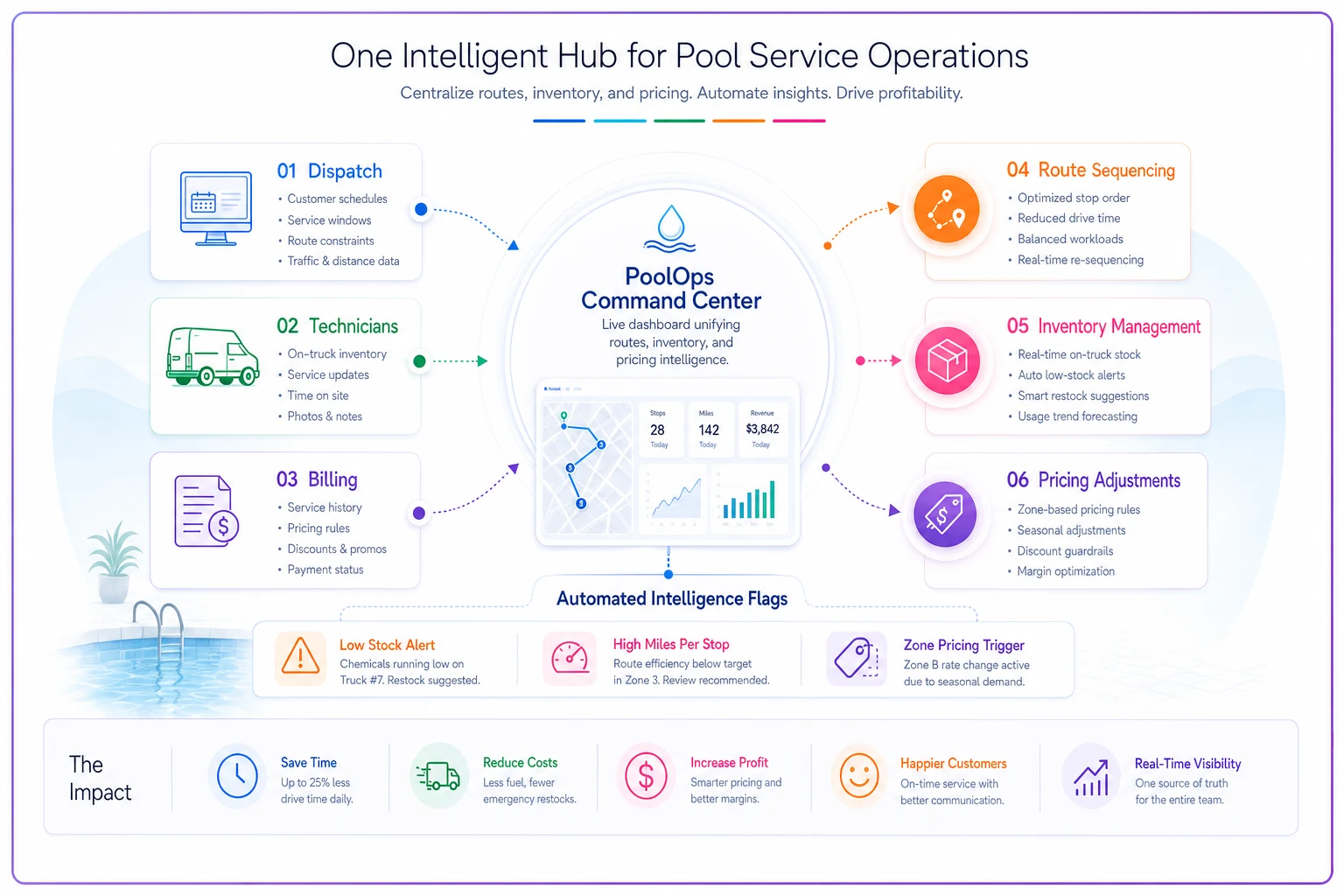
That's the deeper issue fuel exposes. When margins were comfortable, the disconnect between routing, inventory, and pricing was affordable. Now it isn't. Operations that centralize this — where route sequencing, on-truck stock levels, and job costing live in the same system — respond to fuel spikes in days instead of months. Operational software with smart automation genuinely earns its keep here: flagging low-stock parts before they cause a return trip, surfacing which routes are burning disproportionate miles per stop, letting you apply zone or surcharge rules without hand-editing invoices. Not magic, just removing the manual coordination that slows every reaction down.
A simple workflow can centralize route sequencing, inventory, and pricing.
The tooling is secondary, though. The thinking comes first. An owner who understands fuel cost per completed stop and attacks routing and stocking before pricing will outperform one who panics and slaps a surcharge on everything.
Where to start this week
Fuel prices aren't in your control. Your cost-per-stop is.
If diesel and gas stay elevated into fall like the current outlook suggests, the operators who come out ahead won't be the ones who raised prices fastest — they'll be the ones who quietly got their routes tight, their trucks stocked right, and their pricing aligned to what each account actually costs to serve. That's not complicated, but it does require doing things in the right order.
Start with the number nobody tracks: fuel cost per completed stop, broken out by route. It'll show you exactly which routes are worth fixing and which accounts are worth re-pricing. Everything else follows from there.
Fuel prices aren't in your control. Your cost-per-stop is.
Start with the number nobody tracks: fuel cost per completed stop, broken out by route. It'll show you exactly which routes are worth fixing and which accounts are worth re-pricing. Everything else follows from there.
Ready to elevate your pool service business?
Join hundreds of pool service professionals using Splshly to save time, optimize routes, and enhance customer satisfaction.