

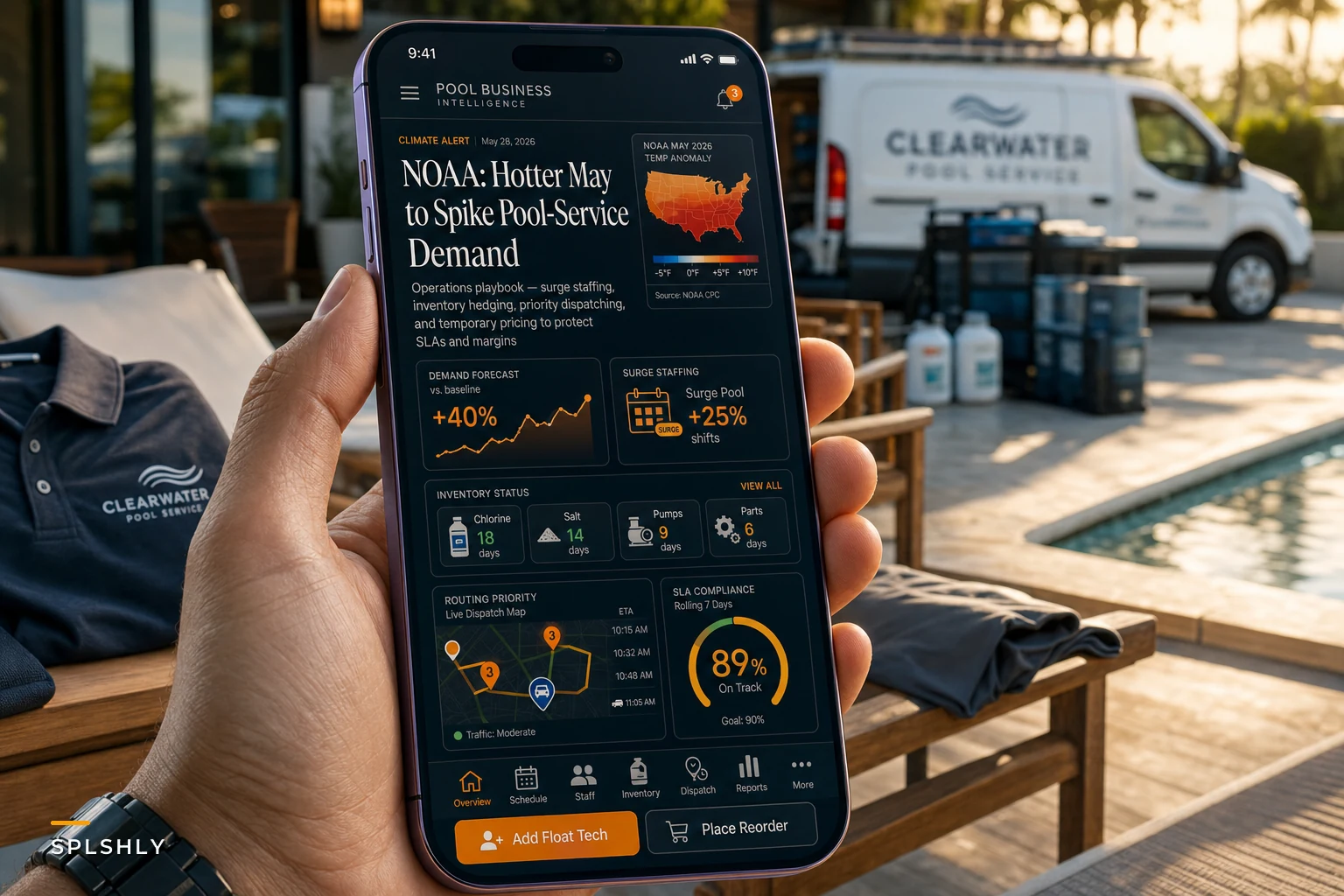

Last week, NOAA's Climate Prediction Center dropped their summer outlook, and it's basically a giant red blob across the entire country. Above-normal temperatures from June through August, with the Southwest and Southeast getting hit particularly hard.
For pool service businesses, this isn't just weather news. This is an operational code red.
I watched this exact scenario play out in 2011 across Texas when we had 90+ days above 100°F. Pool companies that weren't ready got absolutely crushed. The ones that survived had one thing in common: they treated heat waves like operational events that needed advance planning, not weather surprises that happened to them.
The difference between thriving and drowning during a hot summer comes down to three operational pressure points that most pool businesses completely miss until it's too late.
Why hot summers break pool service operations differently than busy seasons
A regular busy season ramps up predictably. Memorial Day weekend hits, demand increases 30-40%, you add some overtime hours, everyone pushes through until Labor Day.
But extreme heat creates a completely different operational pattern. Chemical consumption doesn't just increase—it becomes erratic. A pool that normally needs shocking every two weeks suddenly needs it twice a week. Algae blooms that usually take three days to develop can happen overnight. Salt cells that should last five years fail in three.
The math gets ugly fast. Say you service 180 pools on a standard weekly rotation. Normal summer maybe bumps 15% of them to twice-weekly visits. But during a heat wave? You're looking at 40-50% needing extra visits, plus emergency calls jumping from maybe 3-4 per week to 15-20.
That's not a 20% increase in workload. That's your entire operational model breaking.
Your usual 8-route week with 22-25 stops per tech per day suddenly needs to handle 280+ visits. Your chemical inventory that typically turns every two weeks gets depleted in five days. Your techs who normally finish routes by 4 PM are now working until dark and still falling behind.
The traditional response—just work harder and longer—creates a cascade of problems. Techs burn out and quit mid-season. Service quality drops because everyone's rushing. Customers get angry about delayed visits. Your best clients start shopping around because you can't maintain their pools properly.
The three operational bottlenecks that actually kill you
The businesses that fail always break at the same three points.
Eliminate missed appointments and dispatch delays.
Splshly ensures every pool service is scheduled, tracked, and completed efficiently.
- Unified scheduling dashboard
- Automated customer reminders
- Technician route optimization
No credit card required
Chemical inventory velocity Most pool businesses stock chemicals based on historical usage patterns. You know you go through X gallons of chlorine per week, so you order accordingly. But heat-driven demand doesn't scale linearly.
At 85°F, a pool might consume 3 pounds of chlorine per week. At 95°F, it jumps to 5 pounds. At 105°F with heavy usage? You're looking at 8-10 pounds. Now multiply that across your entire client base, and your two-week chemical buffer evaporates in four days.
The real killer isn't just running out—it's the ripple effects. You send techs out without proper chemicals, so they make partial repairs. That generates callbacks. Callbacks disrupt tomorrow's schedule. Disrupted schedules create more incomplete visits. The cycle compounds until your entire operation is basically just putting out fires.
Tech capacity elasticity Your staffing model probably assumes each tech can handle 20-25 stops per day, maybe 30 if they hustle. During extreme heat, two things happen simultaneously: each stop takes longer (more testing, more adjustments, more chemical applications) and you need more total stops.
A normal 15-minute maintenance visit becomes 25 minutes. Your tech who usually completes 24 stops now maxes out at 18. Meanwhile, you need 35% more visits total. The math simply doesn't work.
Overtime isn't the solution—it's a Band-Aid that makes things worse. A tech working 60-hour weeks in 100°F heat isn't just inefficient; they're dangerous. Heat exhaustion, mistakes with chemicals, vehicle accidents from fatigue. I've seen techs accidentally dump entire chlorine loads because they were dizzy from heat and misread the pool volume.
Customer communication bandwidth This is the silent killer nobody talks about. During normal operations, maybe 10% of your customers contact you each week. During a heat crisis, that jumps to 40-50%.
"Why is my pool green?" "Can someone come today?" "The chlorine smell is really strong." "My pump sounds weird."
Your office manager who usually handles 20 calls a day is suddenly fielding 80. Your scheduling system that works fine for routine adjustments completely breaks when half your routes need daily reshuffling. Response times slip from hours to days.
Then the death spiral begins: customers can't reach you, so they call competitors. They post negative reviews. They cancel service. Your reputation tanks right when you need referrals most.
Building heat-resistant operational capacity without massive overhead
The standard advice is to "hire seasonal help" and "stock extra inventory." That's like telling someone in a flood to "get a bucket." Technically correct but practically useless.
Smart pool businesses build what I call surge capacity infrastructure—operational systems that can expand and contract without breaking your business model or margins.
Start with dynamic routing intelligence. Instead of fixed daily routes, you need zones that can be serviced by multiple techs based on priority and proximity. When heat spikes, you compress routine maintenance to every 10-12 days and use the freed capacity for critical chemical adjustments.
For example, break your service area into 12 zones. During normal operations, each tech owns 2-3 zones. During surge periods, you shift to priority-based dispatch: all techs can service any zone, but they focus on pools showing specific indicators (chlorine below 1.0 ppm, visible algae, customer complaints). This approach can increase effective capacity by 25-30% without adding bodies.
Chemical inventory requires a different approach. Instead of ordering more of everything, identify your heat-critical chemicals (shock, algaecide, clarifier, stabilizer) and create a separate surge inventory with different reorder triggers. Normal operations might trigger reorders at 30% remaining. Surge inventory triggers at 60%.
But here's the crucial part: pre-position surge inventory at strategic points. If you have techs who store chemicals at home, increase their truck stock allowances. Partner with local suppliers for guaranteed 24-hour delivery windows. Create emergency supply agreements with competitors—yes, really. During the 2011 Texas heat dome, three competing pool companies in Austin created a chemical sharing agreement that saved all their businesses.
A simple workflow for activating surge capacity:
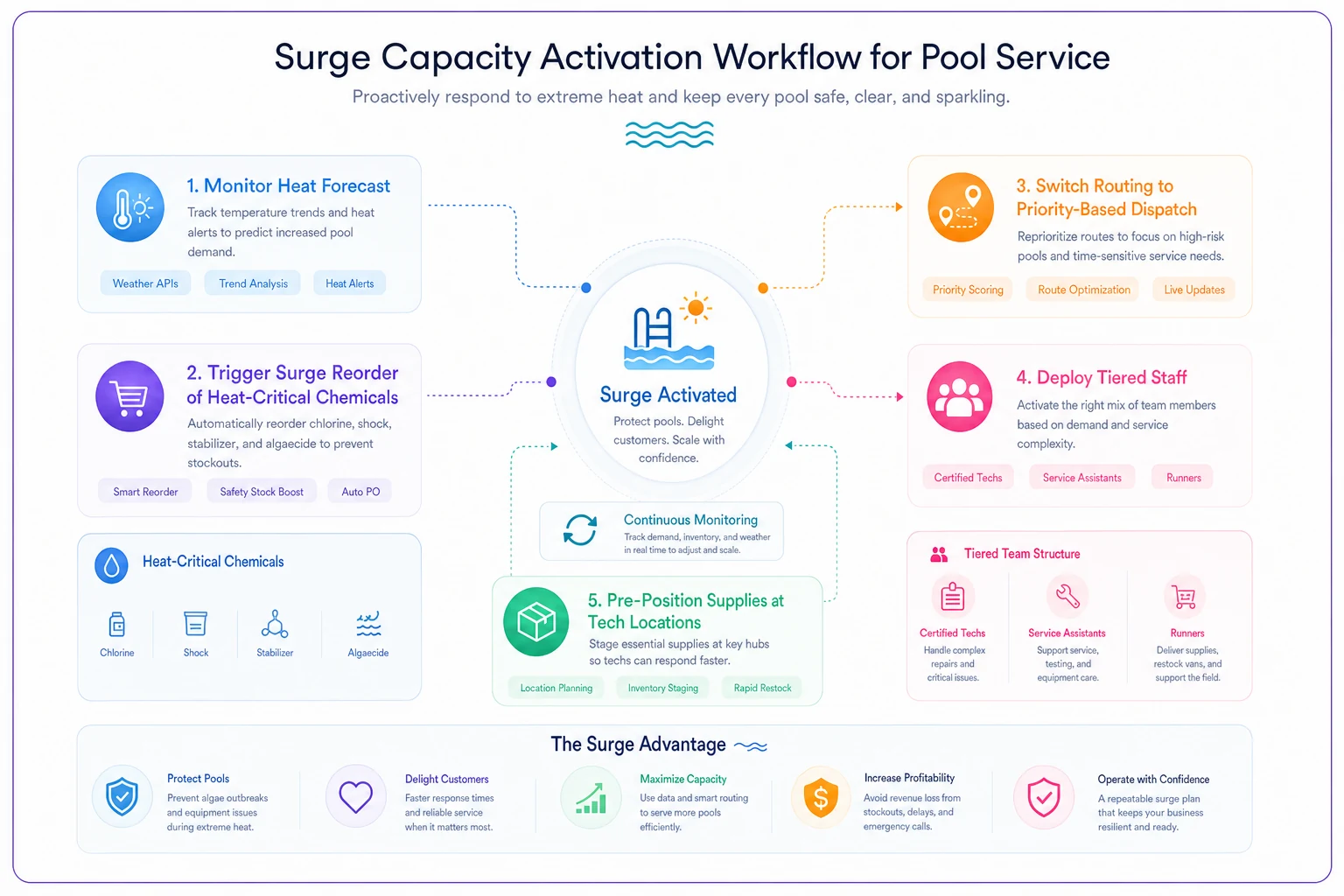
Pre-positioning, supplier agreements, and flexible routing together form the backbone of surge capacity—none of this requires hiring a bunch of long-term staff, but it does require planning and partnerships.
The staffing equation that actually works
Hiring temporary techs for summer sounds logical until you realize it takes 3-4 weeks to train someone to not destroy pools with chemical mistakes. By the time they're useful, summer's half over.
The sustainable approach uses skill stratification. Not every summer task requires a fully trained technician.
Create three operational tiers:
| Tier | Role & Description |
|---|---|
| Tier 1: Certified techs | Certified techs handle chemical adjustments, equipment repairs, and problem pools. These are your core team members who know the science. |
| Tier 2: Service assistants | Service assistants handle routine cleaning, basic chemical additions (following strict protocols), and customer check-ins. These can be seasonal hires with 2-3 days of training. |
| Tier 3: Runners | Runners deliver chemicals, pick up parts, and transport equipment. Zero pool knowledge required, just reliability and a driver's license. |
During normal operations, you might run 8 certified techs. During heat surges, you keep the same 8 techs but add 4 service assistants and 2 runners. The techs focus exclusively on technical work while assistants handle the volume.
This model increases capacity by roughly 40% while only increasing costs by about 20%. The catch? Having the organizational structure ready before you need it. Job descriptions written, training materials prepared, even preliminary interviews conducted with potential seasonal help.
Supply chain arbitrage most businesses miss
Everyone panic-orders chemicals when heat waves hit. Prices spike, availability crashes, and you're stuck paying premium prices for whatever you can find.
The businesses that thrive do something completely different: they lock in surge pricing before the season starts.
Contact your suppliers in March, not May. Negotiate a surge provision: you guarantee to buy X amount at regular prices year-round, and they guarantee Y additional amount available at a 15% premium during peak season. That 15% premium looks expensive in March but feels like a gift from heaven when spot prices jump 40% in July.
Geographic arbitrage works too. If you're in Phoenix and everything's depleted, your suppliers in Albuquerque might have inventory. The four-hour drive costs less than losing clients.
Some companies even create "chemical co-ops" where 3-4 non-competing pool services (different cities or service areas) collectively negotiate with distributors. Combined buying power gets better surge provisions than anyone could negotiate alone.
Pricing dynamically without losing customers
Most pool companies eat the increased costs of hot summers. Extra chemical usage, overtime pay, emergency supply runs—it all comes out of margins. That's backwards.
Smart operators build heat adjustments into their service agreements upfront. Not surprise charges, but pre-agreed frameworks that customers understand.
Include a "severe weather provision" in your contracts: if average temperatures exceed 95°F for more than 14 days in a month, chemical surcharges apply automatically. Set the threshold high enough that it rarely triggers, but when it does, customers already agreed to it.
Or offer "heat insurance" as an add-on service. For an extra $30/month from May-September, customers get unlimited chemical adjustments and priority emergency service during heat waves. About 30% of customers take it, and it funds your entire surge operation.
Transparency and advance communication matter more than perfect pricing. Send emails in April explaining how extreme heat affects pool chemistry. Share NOAA forecasts like the current summer 2026 outlook. When the heat hits and costs increase, customers already understand why.
Protecting your core team from burnout while maintaining quality
Your experienced techs are irreplaceable during heat waves. They diagnose problems faster, fix issues right the first time, and keep difficult customers happy. Burning them out in June means you're crippled by August.
Physical protection comes first. Mandate break schedules—not suggestions, requirements. Every 90 minutes in extreme heat, minimum 15-minute cooling break. Provide cooling vests, endless water, and electrolyte supplements. One company I know installed portable air conditioners in all their service trucks. Cost them $8,000 total, saved them three experienced techs who would've quit otherwise.
Rotate senior techs through "command center" duty so they spend one day per week dispatching and answering technical questions off-site.
But physical protection isn't enough. You need operational protection too.
Create a "technical triage" system where your best techs only handle genuinely technical problems. Green pool that needs shocking? That's a Tier 2 task. Pump making weird noises? That's Tier 1. This isn't about ego or hierarchy—it's about using expertise efficiently.
Rotate your senior techs through "command center" duty where they spend one day per week dispatching, answering technical questions by phone, and planning routes. Gets them out of the heat while leveraging their knowledge to multiply the effectiveness of junior staff.
Technology integration without the tech nightmare
Every software vendor claims their system handles surge scheduling. Most are lying.
What you actually need during heat waves isn't fancy—it's functional. The ability to mass-reschedule routes based on priority. Quick chemical inventory snapshots by truck. Customer communication that doesn't require individual texts.
If you're not already using operational software, don't try to implement it two weeks before summer. That's a disaster. Instead, build simple frameworks using what you have. Even a shared Google Sheet with color-coded priorities beats trying to keep everything in your head when visit volume doubles.
For companies already using scheduling platforms designed for pool services, the key is actually using the surge features before you need them. Run drill weeks in May where you simulate 50% increased demand. Find out what breaks when it doesn't matter.
The most useful tech during heat waves is often the simplest. Group texting to notify customers of delays. Digital forms for chemical readings so techs don't waste time with paperwork. GPS tracking so you know exactly where your teams are when emergency calls come in.
Converting crisis into competitive advantage
Extreme summers aren't just challenges—they're opportunities to dominate your market.
When heat waves hit, poorly prepared companies publicly fail. Their Yelp reviews tank. Their Google ratings plummet. Customers actively search for alternatives. If you're the company that maintains service quality during the crisis, you capture market share that sticks for years.
Document everything during heat waves. Take photos of pools you save after competitors fail. Track response times when everyone else is overwhelmed. These become powerful marketing materials for next season. "During the 2026 heat wave, we maintained 98% on-time service while others had two-week delays."
Create a "heat wave hero" program where customers can refer friends struggling with other services. Offer expedited onboarding for switches during crisis periods. Yes, it's aggressive. It also works.
The businesses that grow fastest aren't the ones with the most aggressive marketing—they're the ones that deliver when conditions get tough. A customer who switches to you because you saved their pool during a heat wave becomes an evangelist for your business.
The post-summer leverage most companies waste
When September hits and temperatures drop, most pool companies collapse in exhaustion and return to normal operations. That's leaving money and opportunity on the table.
Your surge capacity infrastructure—the extra staff relationships, supplier agreements, operational systems—has value beyond crisis response. Those service assistants you trained? Some want full-time work and can be developed into certified techs. Those emergency supplier relationships? They give you leverage for better terms on routine orders.
Document everything that worked and didn't work during the heat wave. Which chemical predictions were accurate? Which routing adjustments actually increased capacity? Which customer communication methods prevented complaints? This operational data is gold for planning next season.
But the real leverage comes from reputation. Every customer who saw you maintain quality during the crisis becomes a reference. Every competitor who failed becomes a sales opportunity. Every lesson learned becomes operational advantage.
Use September to lock in annual contracts with surge-period customers. They just experienced the value of reliable service—they're primed to commit long-term. Offer slight discounts for annual prepayment and use that capital to fund next year's surge preparations.
Moving from reactive scrambling to operational readiness
The difference between companies that thrive and those that merely survive hot summers isn't resources—it's preparation systems.
Build your surge playbook now, while you have time to think clearly. Document trigger points: at what temperature forecast do you activate surge protocols? At what chemical consumption rate do you switch suppliers? At what callback volume do you bring in temporary help?
Create staged responses, not all-or-nothing plans.
-
Level 1 might be increased chemical orders and modified routing.
-
Level 2 adds temporary staff and emergency supplies.
-
Level 3 implements full crisis operations with all contingencies activated.
Most importantly, stop treating extreme weather as an unpredictable anomaly. With climate patterns shifting, hot summers are becoming the norm, not the exception. The operational systems you build for 2026's heat wave become your competitive advantage for the next decade.
Your summer pool service staffing isn't just about having enough bodies to throw at problems. It's about building elastic operational capacity that can expand and contract without breaking your business model, burning out your team, or destroying your reputation.
The pool companies that will dominate the next decade aren't the ones with the most trucks or the biggest marketing budgets. They're the ones that turned weather crises into operational systems, building businesses that get stronger under pressure instead of breaking.
The NOAA forecast isn't a warning—it's your opportunity to separate from competitors who are still hoping this summer won't be "that bad." While they're scrambling in June, you'll be executing a playbook you've been refining since now.
Ready to elevate your pool service business?
Join hundreds of pool service professionals using Splshly to save time, optimize routes, and enhance customer satisfaction.