


Scope & Limits (read this first). This is an operational communication workflow — a way to organize when and how your company talks to customers about water safety across the service year. It is not a safety-inspection protocol, a code-compliance guide, a legal opinion, or a substitute for qualified repair, aquatic-safety training, or professional barrier/alarm/drain assessment. Nothing here tells your technicians they can certify compliance or diagnose hazards outside their service scope. Pool-safety legal requirements vary by state, county, municipality, property type, installation era, and equipment, so every requirement-sounding statement below defers to your local authority having jurisdiction (AHJ) and the relevant manufacturer instructions. When in doubt, refer out.
Version 1.0 — Published for review. See the Methodology & Disclosure section at the end for author identity, reviewer status, source-access dates, and the update process.
Why this workflow exists
Trade guidance increasingly encourages service companies to fold water-safety messaging into billing and routine customer communication. The idea being that service pros can promote water safety year-round and include reminders about covers, alarms, gates, and swim lessons inside the communications they already send.
Good advice. The problem is operational. "Include safety messaging in your billing" sounds simple until you're the dispatcher deciding whether a tech's note about a loose gate latch goes into a friendly invoice line, a formal observed-condition notice, or an urgent phone call to the office. The gap most companies fall into isn't should we communicate — it's who sends what, when, and where does a routine reminder stop and an escalation begin.
That boundary question is really the whole thing. Say too little and you've ignored a condition a tech actually saw. Say too much — "your gate doesn't meet code" — and a technician who isn't a code official has just made a determination the company can't stand behind. This brief sits precisely in that middle lane: structured, repeatable, non-alarmist communication with hard stops where real expertise has to take over.
A quick, honest disclaimer on evidence: the matrix, decision tree, and documentation fields below are Splshly's author-created operational framework. They organize communication. They are not claimed to prevent drownings, reduce incidents, lower liability, or cut insurance costs. Every factual safety statement — what a barrier is for, what the CPSC says about drains — is cited to an external primary source and kept separate from our workflow opinions. We'll flag that line throughout.
The factual safety ground this stands on (externally sourced)
Before any workflow, here's the sourced public-health and standards material the messaging can responsibly reference. These are the only things your communications should state as fact. Everything else is "we observed X, please consult a qualified professional."
Eliminate missed appointments and dispatch delays.
Splshly ensures every pool service is scheduled, tracked, and completed efficiently.
- Unified scheduling dashboard
- Automated customer reminders
- Technician route optimization
No credit card required
-
Layers of protection / supervision. U.S. public-health guidance consistently frames drowning prevention as multiple overlapping layers — close and constant adult supervision, barriers, and swimming skills — rather than any single measure.
-
Barriers and fencing. The U.S. Consumer Product Safety Commission's Safety Barrier Guidelines for Residential Pools describes isolation fencing, gate, and latch concepts. Note it is guidance, not a national mandate — local code governs.
-
Drain / suction-entrapment hazards. The Virginia Graeme Baker Pool & Spa Safety Act and CPSC entrapment guidance address drain covers and suction fittings. This is the single area where "don't touch, defer, escalate" matters most.
-
Swim lessons / water competency. Public-health and aquatic organizations support formal swimming instruction as one protective layer.
-
Covers and alarms. Manufacturer instructions and recognized standards (e.g., ASTM safety-cover standards referenced by manufacturers) govern cover specifications and use. Alarms likewise follow product documentation and local code. These vary by product and jurisdiction, so your messaging should point customers to manufacturer instructions and local requirements, not to a universal rule.
The hard rule for messaging: your company can educate ("public-health guidance recommends layers of protection") and report what a tech observed ("we noticed the gate did not self-latch on today's visit"). Your company should not state that any specific pool "meets" or "fails" code, is "safe," or is "certified." That's an inspection and a legal determination — outside service scope.
The four-touchpoint seasonal message matrix
This is the backbone. Four seasonal touchpoints, each with a defined audience, trigger, channel, permitted message purpose, the documentation field it generates, the escalation threshold, and what it's based on. This matrix is Splshly's operational framework; the safety facts it allows you to reference are the externally sourced ones above.
Two things worth calling out before the table. First, Touchpoint 3 is deliberately a dead-end for technician observation — it's a broadcast education message, not a vehicle for condition claims, because nobody's on-site. Second, notice that every row's "permitted purpose" column is written to allow education and factual observation while blocking compliance or "safe/unsafe" determinations. That column is where most companies accidentally overreach.
| Touchpoint | Audience & Trigger | Channel | Permitted message purpose (what you MAY say) | Documentation field generated | Escalation threshold | Basis |
|---|---|---|---|---|---|---|
| 1. Pool Opening / Season Start | Residential customers scheduled for opening; trigger = opening work order created | Appointment reminder + opening service report | General water-safety education for the season; reminder to review barriers, gate operation, covers, and swim readiness per local requirements and manufacturer instructions; offer no determination of compliance | "Seasonal education sent: Y/N," message category, send date/method | Tech observes a gate that won't latch, missing/damaged drain cover, exposed wiring, damaged safety cover, or inoperative alarm → observed-condition notice + office escalation | Author framework; education content cites CDC/CPSC |
| 2. Post-Service-Visit | Any customer after any routine visit; trigger = visit marked complete | Service report / invoice line | Neutral note of work performed; if something was observed, a factual observed-condition line; general reminder that service is not a safety inspection | Observation text, photo (where permitted), notification method, acknowledgement status | Any observed condition touching barriers, gates, alarms, covers, drains/suction, or electrical → structured observed-condition notice; "stop" conditions → urgent escalation | Author framework; facts cite CPSC/VGB |
| 3. Higher-Use / Holiday-Gathering Periods | All active residential accounts; trigger = calendar (e.g., early summer, major holidays) | Seasonal email / SMS | General, non-alarmist reminder about supervision and layers of protection during heavy-use periods; link to public-health resources | "Seasonal outreach batch ID," send date, audience segment | None by default (education only). If a customer replies reporting a hazard → route to dispatch as a new observed-condition intake | Author framework; cites CDC/Red Cross |
| 4. Closing / Off-Season | Customers scheduled for closing or on off-season plans; trigger = closing work order or season end | Closing service report + off-season reminder | Reminder about cover use/condition per manufacturer instructions, continued barrier integrity during off-season, and that an unused pool still requires attention per local rules | Closing observation notes, cover condition note, notification method | Damaged cover, compromised barrier, or standing-water/entrapment concern noted at closing → observed-condition notice + escalation | Author framework; facts cite CPSC/manufacturer docs |
This matrix is Splshly's operational framework; the safety facts it allows you to reference are the externally sourced ones above.
The message-selection decision tree
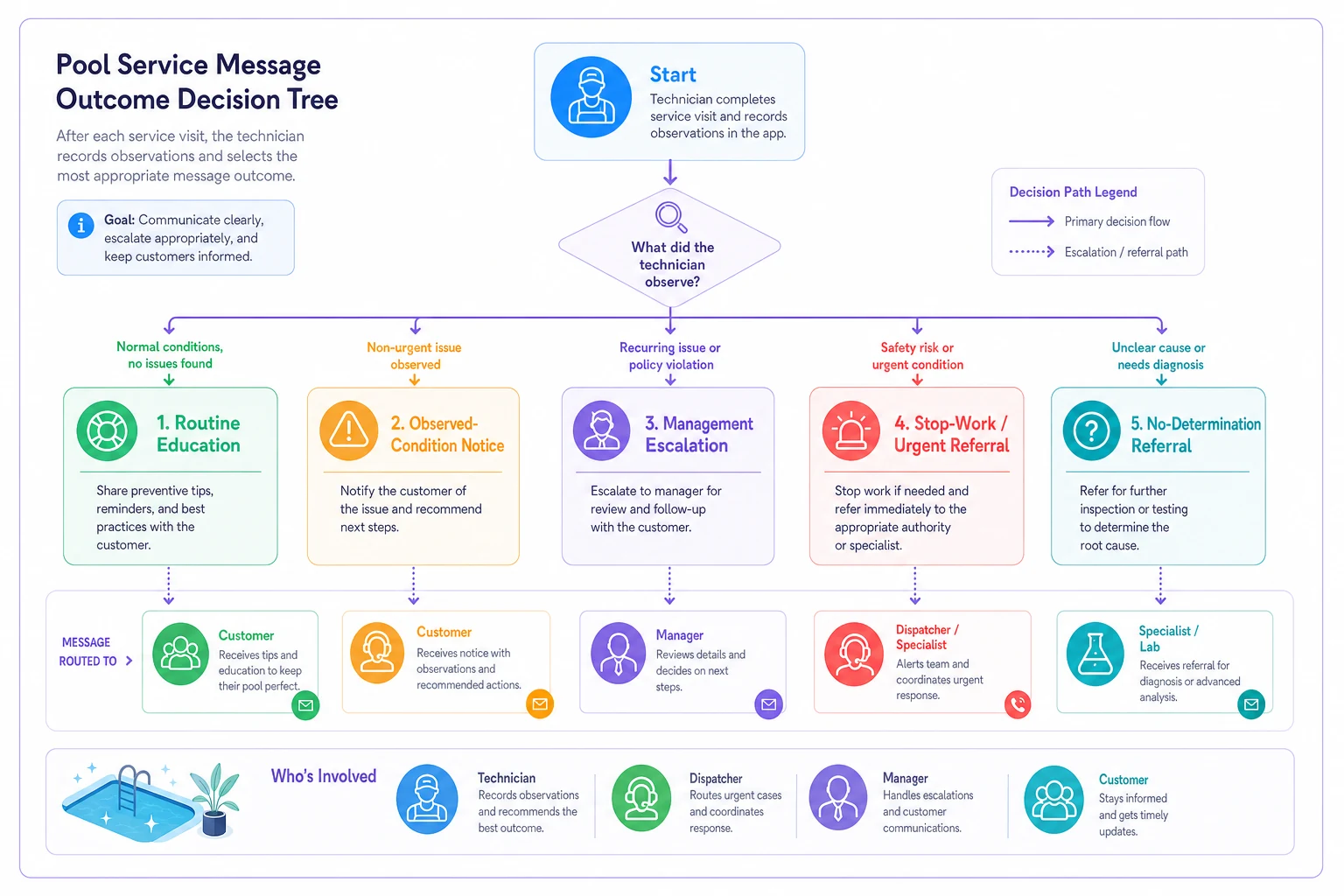
When a technician finishes a visit — or a dispatcher reads a tech's note — this is how you decide what kind of communication it becomes. Five distinct outcomes, no overlap.
Start: A technician observed or a customer raised something related to water safety.
-
1. Is it general, non-specific education? (e.g., it's opening season, you want to remind the customer about supervision and layers of protection.) → Outcome A — Routine Education. Use approved seasonal language. No property-specific claim. No determination. Document: message category + send method.
-
2. Did the tech observe a specific condition at the property (loose gate latch, cover tear, missing drain cover, standing water, corroded fitting) that is within normal reporting but NOT an immediate danger? → Outcome B — Observed-Condition Notice. State only what was seen, factually, with a photo where permitted. Recommend the customer consult the applicable qualified professional / local authority. Do not label it a code violation or declare the pool unsafe. Document: observation, date/time, photo ref, notification method, acknowledgement.
-
3. Does the observed condition look serious but you're unsure of severity, or it's ambiguous (possible electrical issue near water, suspected entrapment risk, barrier that may not isolate the pool)? → Outcome C — Management Escalation. Route to a supervisor/manager before deciding on customer wording. Management decides whether it becomes an observed-condition notice, an urgent referral, or a stop-work. Document: escalation record + owner.
-
4. Is there an apparent immediate hazard — exposed energized wiring near water, a missing/broken main-drain cover on an operating suction outlet, a child-access path with no functioning barrier where the tech is actively working? → Outcome D — Stop-Work / Urgent Referral. Technician stops the relevant work, does not attempt a repair outside scope, notifies the office immediately, and the customer is urgently referred to the appropriate qualified professional or authority. Entrapment/drain and electrical concerns default here. Document: urgent escalation record, time, action taken.
-
5. Is the question something the technician simply cannot answer within their qualifications — "Does my fence meet code?" "Is my pool legal for a daycare?" "Will this pass inspection?" → Outcome E — No Determination Beyond Scope. The tech states plainly that they can't make that determination and refers the customer to the local AHJ, a licensed/qualified professional, or a code official. Document: referral record.
Treat Outcome E as a first-class documented response — record the referral contact or AHJ direction when possible.
The discipline here is that Outcome E is a legitimate, documented outcome, not a failure. "I'm not qualified to make that call, here's who is" is the single most protective sentence a technician can say, and the workflow treats it as a first-class response rather than an awkward dodge.
The diagram below illustrates the decision tree workflow.
The discipline here is that Outcome E is a legitimate, documented outcome, not a failure. "I'm not qualified to make that call, here's who is" is the single most protective sentence a technician can say, and the workflow treats it as a first-class response rather than an awkward dodge.
Technician documentation minimums
Every safety-related communication should leave a record. Not a paragraph — fields. At minimum:
-
- [ ] Date and time of the observation and of the customer notification (separately — they're often not the same)
-
- [ ] Property / equipment observation, written factually ("gate did not self-latch on release" — not "gate is unsafe")
-
- [ ] Photo(s) where permitted, with a neutral caption (respect customer privacy and any property-access limits)
-
- [ ] Exact customer notification method (in-person, phone, invoice line, service report, SMS, email) — be specific
-
- [ ] Message category (Routine Education / Observed-Condition / Management Escalation / Urgent Referral / No-Determination)
-
- [ ] Acknowledgement status if obtained (customer confirmed receipt? verbal? reply?)
-
- [ ] Work performed on the visit (and explicitly, work not performed because it was out of scope)
-
- [ ] Escalation / referral record (who it went to, when, and the recommended professional or authority)
-
- [ ] Follow-up owner (the named person responsible for the next step)
When permitted, attach a photo with a neutral caption and the exact observation wording to reduce later disputes.
One pattern worth flagging: companies tend to document what the tech did and forget to document what they told the customer and whether the customer heard it. The notification-method and acknowledgement fields exist precisely because "we think we mentioned it" is not a record.
Neutral customer-message examples
These are written to educate and report — not to certify, inspect, or alarm. Each is labeled by use case and carries the same core caveat. Edit for your jurisdiction and voice; these are examples, not legal language, and have not been reviewed as legal text.
1. Invoice line (general seasonal education) > "As the swimming season begins, we encourage all pool owners to review water-safety basics. Public-health guidance recommends layering protections — close supervision, secure barriers, and swimming skills. This note is general education and is not a safety inspection or compliance certification of your pool."
2. Service report (post-visit, nothing observed) > "Routine service completed on [date]. Our visit addressed water chemistry and equipment service as scheduled. Please note a service visit is not a comprehensive safety inspection or a certification that your pool meets any code or safety requirement."
3. Appointment reminder (opening or high-use period) > "Your [service] is scheduled for [date]. A friendly seasonal reminder: supervision and secure barriers remain important whenever a pool is in use. This message is general information only and is not a safety inspection, diagnosis, or compliance determination."
4. Observed-condition notice (something was seen) > "During today's visit on [date], our technician observed the following: [factual description — e.g., 'the pool gate did not self-latch when released']. We are not able to determine whether this affects code compliance or safety requirements. We recommend you consult a qualified professional and your local authority to review this condition. This notice reports an observation only and is not an inspection, repair recommendation, or compliance certification."
5. Referral (out-of-scope question) > "Thank you for your question about [barrier / alarm / drain / electrical / code]. This falls outside what our service visit covers and outside what our technicians are qualified to determine. We recommend contacting [a licensed professional in the relevant trade / your local building or health authority] for an assessment. We're glad to coordinate access for scheduled service as needed."
Notice what none of these say: safe, compliant, up to code, certified, passed, failed. That vocabulary is reserved for people whose job is to make those determinations.
Escalation boundaries by condition type
Where routine education must stop. For each category: educate generally, report factually, and defer the determination to local requirements and qualified professionals.
-
Barriers & gates. You may report what you saw (e.g., a gate not latching). You may not declare whether the barrier meets isolation requirements — fencing rules vary widely by jurisdiction and property. Defer to local code and the CPSC barrier guidelines as reference only.
-
Alarms. Report whether an alarm appeared to function during your visit if you observed it; defer operation, suitability, and requirement questions to manufacturer instructions and local code.
-
Covers. Report visible cover damage or improper fit; defer specification and rated-use questions to the manufacturer's documentation and applicable standards.
-
Suction / drain hazards. This is a default-to-escalation category. A missing, broken, or non-compliant drain cover on an operating suction outlet is treated as urgent. Do not attempt out-of-scope repair; refer to a qualified professional and relevant CPSC/VGB guidance.
-
Electrical concerns. Any suspected energized hazard near water is stop-work and urgent referral to a qualified electrician/authority. Technicians do not diagnose electrical compliance.
-
Equipment defects. Report the observed condition; defer repair determinations and safety ratings to qualified repair and manufacturer guidance. Companies that already run an unsafe-equipment documentation and escalation process should fold these conditions into that same intake rather than creating a parallel one.
Where routine education must stop. For each category: educate generally, report factually, and defer the determination to local requirements and qualified professionals.
Implementation checklist: who owns what
Communication breaks down at the handoffs, so assign owners explicitly.
-
1. Management — Approves the master message-template pack; owns version control; decides the seasonal send calendar; reviews escalations that reach Outcome C and D.
-
2. Office / customer-service — Sends routine education (Touchpoints 1 and 3); logs acknowledgements; maintains the approved-template library so no one is writing safety wording from scratch.
-
3. Dispatch — Routes technician observations to the correct outcome; triggers observed-condition notices; escalates ambiguous or urgent items to management immediately.
-
4. Technicians — Observe and document factually; use approved language; apply the decision tree in the field; never improvise code or safety determinations; execute stop-work when warranted.
-
5. Everyone — Uses only the current approved template version.
Version control checklist for templates:
-
- [ ] Each template carries a version number and last-reviewed date
-
- [ ] Old versions are archived, not left in circulation
-
- [ ] Any safety fact in a template links to its source
-
- [ ] Templates are re-reviewed when a cited source updates or local requirements change
-
- [ ] One named owner approves changes before release
Centralizing the approved templates — in whatever operational platform you already run — matters more than the tool itself. The failure mode is ten technicians with ten slightly different versions of a "safety" line, three of which accidentally imply certification. A single source of truth for approved wording, plus structured documentation fields, is the operational point. Any capable field-service system can do this; the workflow is tool-agnostic.
A realistic scenario (illustrative only)
A mid-size residential route company — roughly 300–350 recurring accounts, four techs — had no standard for safety wording. Technicians mentioned things verbally; some notes made it into service reports, most didn't. During opening season a tech verbally told a homeowner "your gate's a little loose" with nothing logged. Weeks later the customer disputed that they were ever told.
After adopting a structured version of this workflow — approved templates, the five-outcome decision tree, and the documentation fields — the same kind of observation now produces an observed-condition notice with a photo, a recorded notification method, and a named follow-up owner. Nothing about this prevents anything on its own, and we're not claiming it does. What changed is narrower and more honest: the company now has a consistent, defensible record of what it observed, what it said, and where it referred the customer — instead of relying on "we're pretty sure the tech mentioned it." (This scenario is illustrative of how the workflow functions. It is not evidence of a safety, liability, or business outcome.)
This scenario is illustrative of how the workflow functions. It is not evidence of a safety, liability, or business outcome.
When this workflow makes sense — and when it doesn't
It makes sense when: you run recurring residential service, your techs already see barrier/cover/equipment conditions routinely, and your communications are currently ad hoc. Structure helps most where there's volume and inconsistency.
-
you run recurring residential service, your techs already see barrier/cover/equipment conditions routinely, and your communications are currently ad hoc. Structure helps most where there's volume and inconsistency.
It's a poor fit — or needs adaptation — when: you operate heavily commercial or regulated aquatic facilities (those carry inspection and compliance obligations this brief deliberately does not address), or when local rules impose specific notification duties on service providers. In those cases, get qualified legal and code review first; this workflow is not a substitute for it.
-
you operate heavily commercial or regulated aquatic facilities (those carry inspection and compliance obligations this brief deliberately does not address)
-
when local rules impose specific notification duties on service providers
Who should not use the message examples as-is: anyone who hasn't had the wording reviewed against their own jurisdiction's requirements. Treat the examples as starting drafts.
Methodology & Disclosure
What this is. A publicly available operational-communication framework for pool-service businesses. The matrix, decision tree, documentation fields, and checklists are Splshly's author-created operational framework. They organize communication; they are not evidence of safety or business outcomes.
What the external sources support. Every factual water-safety statement in this brief is attributed to a named public-health, standards, regulatory, or manufacturer-level source (CDC, CPSC, the VGB Act / Pool Safely, American Red Cross, and manufacturer/standards documentation), with access noted as 2024. Those sources support the facts the messaging may reference — not any claim that this workflow changes outcomes.
Source categories (kept distinct):
-
Public-health guidance
CDC Drowning Prevention; American Red Cross water safety.
-
Regulation / federal law
Virginia Graeme Baker Pool & Spa Safety Act (via CPSC / Pool Safely).
-
Standards & guidelines
CPSC Safety Barrier Guidelines for Residential Pools (Pub. 362); ASTM safety-cover standards as referenced in manufacturer documentation.
-
Manufacturer instructions
product-specific cover and alarm documentation (consult your specific products).
-
Expert commentary / trade
Pool & Spa News How-To coverage.
-
Splshly's own framework
the matrix, decision tree, documentation minimums, and checklists.
Jurisdictional limitation. Pool-safety legal requirements are not uniform nationally. They vary by state, county, municipality, property type, installation date, and equipment. Nothing here should be read as establishing a duty to inspect, notify, repair, certify, or determine compliance. Consult your local authority having jurisdiction and qualified counsel.
Expert / legal review status — stated honestly. This brief has not yet undergone formal independent review by a qualified aquatic-safety professional, a code official, or legal counsel. The content contract for this resource calls for exactly that review before any factual safety messaging or escalation boundary is treated as validated. Until a named external reviewer with relevant aquatic-safety, pool-safety, code, technical, or legal credentials has reviewed it — and that reviewer's name, credentials, and review scope are published in this section — readers should treat the safety facts as pointers to the cited primary sources and the workflow as an organizational draft. We will not imply a review occurred that has not. When review is completed, the reviewer and scope will be added here and the version number incremented.
Original data. No survey or proprietary dataset underlies this brief. We have not published prevalence, effectiveness, incident-reduction, liability, or ROI figures because we do not have methodology-backed data to support them. If a transparently disclosed operator survey is conducted later, its full methodology (eligibility, sample size, recruitment, field dates, geography, exact question wording, treatment of incomplete responses, limitations, and sponsorship) will be published as an appendix before any findings are cited.
Conflict disclosure. Splshly provides pool-service operational software. This workflow is tool-agnostic — it can be run on paper, spreadsheets, or any field-service platform. We have an obvious commercial interest in service operations, and we've tried to keep this brief useful independent of any product. No claim is made that Splshly software produces water-safety, compliance, risk, or liability outcomes.
Author. Prepared by the Splshly operations team, drawing on pool-service field-operations and dispatch workflow experience. The author is affiliated with Splshly.
Version 1.0 — Access dates for cited sources: 2024. Next review: upon completion of external expert/legal review, or when a cited source or local-requirement landscape changes materially.
Downloadable artifacts (included in full below)
Because these are meant to be reused, here they are in full rather than behind a download. Copy, adapt to your jurisdiction, and version them.
One-page seasonal communication & escalation checklist
Scope note: operational communication only — not an inspection, certification, legal, or code-compliance tool. Defer all determinations to local requirements and qualified professionals. Version 1.0.
-
- [ ] Opening send approved seasonal education (Touchpoint 1); log send method
-
- [ ] Each visit complete documentation minimums; apply decision tree if anything observed
-
- [ ] Observed condition issue observed-condition notice (Outcome B); photo where permitted; name follow-up owner
-
- [ ] Ambiguous/serious escalate to management (Outcome C) before customer wording is finalized
-
- [ ] Immediate hazard (electrical / drain-suction / barrier-access) stop-work + urgent referral (Outcome D)
-
- [ ] Out-of-scope question record referral to AHJ/qualified pro (Outcome E)
-
- [ ] High-use/holiday send general education broadcast (Touchpoint 3); no property claims
-
- [ ] Closing/off-season note cover/barrier condition; escalate damage
-
- [ ] Always use current approved template version; record notification method + acknowledgement
Editable message-template pack
Use the five labeled examples in the "Neutral customer-message examples" section above as your base templates — invoice line, post-visit service report, appointment reminder, observed-condition notice, and referral. Each already carries the "not an inspection or compliance certification" caveat. Before use: have the wording reviewed against your jurisdiction, add your company voice, and stamp each with a version number and review date. Template pack version 1.0 — jurisdictional adaptation required; referral language included.
This brief is operational guidance, not legal advice, not a code-compliance guide, and not a comprehensive pool-safety inspection protocol. Requirements vary by location, property, and equipment. Consult your local authority having jurisdiction and qualified professionals.
This brief is operational guidance, not legal advice, not a code-compliance guide, and not a comprehensive pool-safety inspection protocol. Requirements vary by location, property, and equipment. Consult your local authority having jurisdiction and qualified professionals.
Ready to elevate your pool service business?
Join hundreds of pool service professionals using Splshly to save time, optimize routes, and enhance customer satisfaction.