



Every July, the same conversation plays out in pool-service offices across the country. The second-visit count climbs, the schedule starts spilling into Saturdays, and somewhere in a Monday meeting someone says, "Our techs aren't fixing things right the first time."
Sometimes that's true. Usually it isn't — or at least, not in the way it sounds.
Most operators don't have a shared definition of what a "return visit" even is. When a tech goes back to a property, that second trip gets lumped into one undifferentiated pile: planned replasters that were always two visits, warranty callbacks, parts that weren't on the truck, a customer who added a heater after the first stop, and genuine misdiagnoses all look identical in a spreadsheet. You can't fix what you can't classify.
This toolkit gives you a consistent way to classify work-order follow-ups during the season when volume is highest and the temptation to point fingers is strongest. It's a framework, not a benchmark — more on that distinction below.
Before you blame technician performance, review these five things
Repeat work is a system output, not a technician scorecard. A second visit can be caused by routing decisions made in dispatch, by a part nobody stocked, by a customer who wasn't home, by a warranty process that requires manufacturer authorization, or by documentation so thin that nobody can tell what happened on visit one.
-
Capacity — were techs so overbooked that corners got cut, or that a job got deferred and re-scheduled as a "return"?
-
Routing — did the route force a short visit window that didn't allow the full job?
-
Parts availability — was the fix known but the part unavailable on the truck or from the vendor?
-
Documentation quality — can you actually reconstruct what happened on visit one, or are you guessing?
-
Scope changes — did the customer add or change work between visits?
Skip this review and you'll "fix" a people problem that was actually a stocking problem. That misdiagnosis is expensive — it damages morale and leaves the real bottleneck untouched.
Definitions sidebar (Splshly-developed framework)
> Note on scope: The definitions, metrics, and classification categories below are a Splshly-developed operational framework, version dated May 2025. They are a structured way to think about your own work orders. They are not an industry benchmark, census, or validated study, and none of the thresholds or illustrative numbers in this article should be read as "typical" or "optimal" for the industry.
Eliminate missed appointments and dispatch delays.
Splshly ensures every pool service is scheduled, tracked, and completed efficiently.
- Unified scheduling dashboard
- Automated customer reminders
- Technician route optimization
No credit card required
-
Work-order unit — the single countable thing you're measuring. Usually one scheduled job at one property for one customer request. If you count a two-visit replaster as one work order, be consistent; if you count each visit separately, be consistent the other way. Pick one and document it.
-
First-visit resolution — the customer's original request was fully completed on the first scheduled visit, with no further visit required for that same request.
-
Planned staged work — work that was always intended to take more than one visit (acid wash then refill, equipment ordered in advance, multi-day projects). The second visit is expected and scheduled from the start.
-
Unplanned return visit — a second visit that was not planned, triggered because the original request wasn't completed. This is the category people usually mean when they say "callback."
-
Unrelated new work — a second visit for a different request (new leak, new equipment, added service). Same property, different job. Not a return at all.
-
Documented stockout — the fix was identified but couldn't be completed because a required part wasn't available, and that unavailability is recorded on the work order.
-
Schedule spillover — scheduled work that couldn't be completed within the planned period and rolled into overtime, weekends, or the following week.
-
Documentation completeness — whether the work order contains enough information (cause, action taken, parts used, photos, next step) to classify it without calling the technician.
Documentation completeness — whether the work order contains enough information (cause, action taken, parts used, photos, next step) to classify it without calling the technician.
The classification decision tree
When a second visit shows up for a property, walk it through these branches. The outcomes are deliberately observable — you should be able to land on one using the work order itself, not a memory.
Start: A second visit occurred at this property.
-
Was the second visit for the same original request? - No → Separate new job. Different request, different work order. Stop. - **Yes → continue.
-
Was the second visit planned from the start (multi-visit job)? - Yes → Planned follow-up. Expected. Stop. - **No → continue.
-
Was the original fix identified but blocked by an unavailable part, and is that recorded? - Yes → Stockout-related follow-up. This is a supply-chain outcome, not a diagnostic one. Stop. - **No → continue.
-
Does visit-one documentation explain what happened and why a return was needed? - No → Insufficient documentation to classify. You cannot fairly call this an avoidable return. Flag it for documentation follow-up, not a performance conversation. - Yes → Unplanned return visit. Now — and only now — you have a defensible candidate for a first-visit-resolution miss worth reviewing.
The single most common mistake is skipping branch 4. Teams collapse "insufficient documentation" into "unplanned return," which inflates the callback number and quietly converts a paperwork gap into a technician-blame problem.
The peak-season review workflow
You don't need to audit every work order — during peak season you won't have time, and honestly you don't have to. A weekly sample is enough to spot patterns. The workflow runs in five passes:
Here's a simple visual of the workflow.
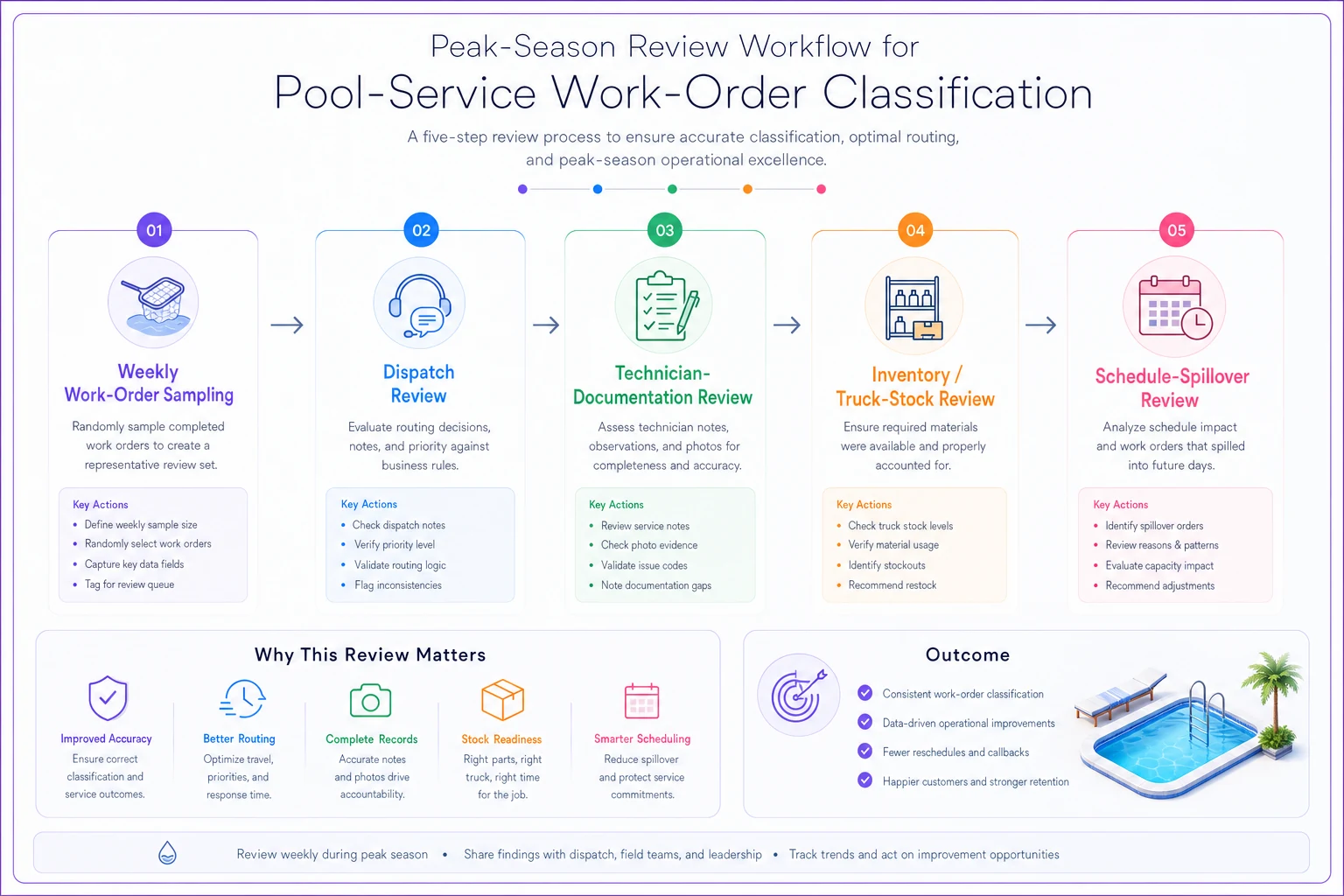
The order matters. Reviewing documentation before you count returns keeps you from counting paperwork gaps as failures.
-
Weekly work-order sampling. Pull a consistent sample each week (every second-visit work order plus a random slice of first visits, for example). Keep the sampling rule identical week to week so trends are actually comparable.
-
Dispatch review. For each sampled second visit, check whether routing or booking windows contributed. Short-windowed jobs that turned into returns are a dispatch signal, not a tech signal.
-
Technician-documentation review. Run each through branch 4 of the tree. Count how many land in "insufficient documentation." That count is its own metric — it tells you how trustworthy the rest of your numbers are.
-
Inventory / truck-stock review. Tally stockout-related follow-ups and the specific parts involved. Three callbacks for the same unavailable part is a stocking decision, full stop.
-
Schedule-spillover review. Compare planned capacity to what actually got completed. Spillover that tracks with capacity rather than callbacks means you're overbooked, not under-performing.
Review documentation before you count returns.
The order matters. Reviewing documentation before you count returns keeps you from counting paperwork gaps as failures.
Hypothetical worked example
> This example is hypothetical. "Blue Harbor Pools" is fictional. The numbers are illustrative inputs chosen to show the math — they are not observed results, customer data, or an industry average.
Hypothetical setup: Blue Harbor Pools sampled 40 work orders in one peak week. They count each original customer request as one work-order unit.
| Classification | Count | Notes (hypothetical) |
|---|---|---|
| Completed first visit | 28 | Original request fully closed |
| Planned staged work | 4 | Two replasters, one heater install, one acid wash |
| Unplanned return | 3 | Same request, return needed, documented |
| Unrelated new work | 2 | New leaks reported at return |
| Stockout-related follow-up | 2 | Salt cell + a pump seal unavailable on truck |
| Insufficient documentation | 1 | Can't tell why a return happened |
| Total | 40 |
Illustrative metric math (framework formulas, hypothetical inputs):
-
- First-visit resolution = first-visit completions ÷ eligible requests. Eligible = total minus planned staged work (those were never going to be one visit) = 40 − 4 = 36. So 28 ÷ 36 ≈ 78% (illustrative only).
-
- Unplanned return-trip rate = unplanned returns ÷ eligible requests = 3 ÷ 36 ≈ 8% (illustrative only).
-
- Documented stockout rate = stockout follow-ups ÷ total sampled = 2 ÷ 40 = 5% (illustrative only).
-
- Documentation completeness = classifiable ÷ total = 39 ÷ 40 ≈ 98% (illustrative only).
The takeaway isn't the percentages — it's the shape. In this hypothetical, two of the "returns" were stockouts and two were new jobs. Only three were genuine unplanned returns, and one couldn't even be judged. A naïve count would have reported eight "callbacks" and kicked off a performance conversation that the evidence doesn't support.
Management questions that actually move the needle
Once the week is classified, the decisions sort themselves by category. This is where the framework actually earns its keep — not in the counting, but in where you point the fix.
-
Capacity Is spillover tracking with volume rather than quality? If so, the fix is scheduling headroom, not coaching.
-
Routing Are returns clustered in specific territories or time windows? That's a dispatch-rule conversation.
-
Parts availability Which exact SKUs keep generating stockout follow-ups? Those belong on the truck or in a faster reorder trigger.
-
Documentation quality Is the "insufficient documentation" count rising? Fix that before trusting any other metric — it's the measurement's foundation.
-
Scope changes Are "returns" actually new work the customer added? If yes, that's revenue, and it should be quoted and billed, not logged as a failure.
These questions sound obvious written out. The problem is most teams never get to ask them cleanly because the classification step didn't happen in the first place.
When this framework fits — and its limitations
This approach works best for operators carrying a mix of recurring maintenance and repair work during a defined busy season. If you're nearly all flat-rate weekly cleaning with little repair volume, the classification tree still helps but the metrics will be thin.
Limitations you have to respect:
-
Definitions must be adapted to your own service mix. A company doing heavy renovation work will have far more legitimate planned staged visits than a cleaning-only route.
-
Warranty practices change the picture. Manufacturer-authorized warranty returns aren't technician misses; decide upfront how you'll tag them (this framework does not provide warranty-process guidance — follow your manufacturer's documented requirements).
-
Geographic seasonality shifts what "peak" and "normal spillover" mean.
-
Staffing model matters — subcontracted crews may document differently than W-2 techs.
-
The toolkit does not establish industry-average return rates, correct stocking levels, capacity targets, or savings outcomes. It gives you internal consistency, nothing more.
Any number you generate is only comparable to your own prior numbers under your own definitions.
Printable work-order classification checklist
Copy this into a sheet and fill one row per reviewed work order.
For each work order, capture:
-
- [ ] Work-order ID
-
- [ ] Initial-visit date
-
- [ ] Follow-up date (if any)
-
- [ ] Classification first-visit complete / planned staged / unplanned return / unrelated new work / stockout follow-up / insufficient documentation
-
- [ ] Documented reason (what the work order actually says)
-
- [ ] Stockout status (part name + availability, or "n/a")
-
- [ ] Documentation status (classifiable without calling the tech? yes/no)
-
- [ ] Reviewer (who classified it)
-
- [ ] Corrective-action owner (who owns the next step)
Corrective-action owner (who owns the next step)
Metric-definition sheet
Most teams track callbacks without agreeing on what a callback actually is. This sheet forces that agreement. Fill it in once at the start of the season and post it somewhere everyone on the operations side can see it.
| Metric | Numerator | Denominator | Exclusions | Interpretation caution |
|---|---|---|---|---|
| First-visit resolution | Requests fully completed on first visit | Eligible requests (exclude planned staged work) | Planned multi-visit jobs; unrelated new work | Low rate may reflect parts/scope, not skill |
| Unplanned return-trip rate | Documented unplanned returns | Eligible requests | Planned follow-ups; stockouts; new jobs | Rises artificially if stockouts miscoded |
| Documented stockout rate | Stockout-related follow-ups | Total sampled work orders | Returns with parts available | Undercounts if techs don't record stockouts |
| Schedule spillover | Scheduled work not completed in period | Total scheduled work in period | Jobs rescheduled at customer request | High spillover often = capacity, not quality |
| Documentation completeness | Work orders classifiable from record alone | Total sampled | — | If low, treat all other metrics as unreliable |
Track these weekly through peak season. After a month you'll have enough data to see which category is actually driving your second-visit count — and it's rarely the one everyone assumed.
Author and framework disclosure
This framework was developed by Splshly, a provider of pool-service operations software. The author works on operational-data and field-service workflow design for pool-service companies and built this classification approach from common dispatch, repair, and follow-up patterns in the trade.
This is a Splshly-developed operational framework, not an independent industry benchmark, survey, or statistically representative study. The worked example is explicitly hypothetical, and no percentage in this article should be treated as an industry norm.
Practitioner review status: This framework is intended to be reviewed by a currently active pool-service owner, operations manager, or dispatcher for terminology and workflow realism before publication. Where that review has occurred, the reviewer's role, review date, and scope should be recorded alongside the hosted version. If you are reading a version without a recorded reviewer, treat the terminology as a starting draft to adapt to your own operation rather than a field-validated standard.
The honest value here is small but real: a shared vocabulary, a repeatable classification step, and a weekly habit of reviewing documentation before performance. Do that consistently through one peak season and the second-visit argument stops being about blame and starts being about which part of the system to fix next.
The honest value here is small but real: a shared vocabulary, a repeatable classification step, and a weekly habit of reviewing documentation before performance. Do that consistently through one peak season and the second-visit argument stops being about blame and starts being about which part of the system to fix next.
Ready to elevate your pool service business?
Join hundreds of pool service professionals using Splshly to save time, optimize routes, and enhance customer satisfaction.