



Most pool companies don't lose money because their pricing is wrong. They lose it in the gaps between the truck leaving the driveway and the payment actually clearing the bank. A tech skips a green pool because the gate was locked, nobody flags it, and the customer still gets billed the full monthly rate. A repair gets done on a handshake, the deposit never gets collected, and now you're chasing $1,400 for a pump swap the homeowner "doesn't remember approving." A card expires in July—your busiest month—and the failed charge sits unnoticed for three weeks.
None of these are pricing failures. They're billing operations failures. And they compound quietly, because each one feels small in isolation.
This guide treats billing as a connected system, not a set of isolated tasks. The goal is to give you the controls, workflows, and templates to make sure what gets done in the field matches what gets billed, what gets billed matches what gets collected, and what gets collected matches what lands in your accounting. At the end you'll find template outlines you can copy into your own documents, plus a maturity scorecard to figure out where your process actually stands.
One note before we start: everything here is operational guidance, not legal, tax, or payments-compliance advice. Rules around recurring-payment authorizations, collections communications, and consumer contracts vary by state—California in particular has specific requirements around autopay disclosures and cancellation. Before you finalize any billing policy, run it past a qualified attorney or accountant familiar with your state. I'll flag the spots where this matters most.
What "modern billing operations" actually means for recurring pool-service businesses
Forget the buzzword version. For a pool company, modern billing operations comes down to one principle: every dollar you bill should be traceable back to a verified event, and every event should have a clear billing consequence.
That's it. Service completed → invoice generated. Service skipped → credit or exception logged. Repair approved → deposit collected before parts are ordered. Card declined → a defined sequence kicks in, not a shrug.
The reason this matters more for pool service than for, say, a plumbing contractor is the recurring piece. You're not billing one transaction. You're billing the same 300–600 customers month after month, and the volume hides the leaks. A single mis-billed repair gets noticed. A $12 chemical surcharge applied inconsistently across 400 accounts does not—until you tally it at year-end and realize you left somewhere around $8k–$15k on the table, or worse, over-billed a chunk of customers and created a wave of disputes.
What separates a mature billing operation from a leaky one isn't software. It's whether the field, the office, the payment processor, and the books agree on what happened. When those four don't reconcile, you get revenue leakage in both directions: money you never collected, and money you collected wrongly that turns into chargebacks and churn.
Worth internalizing early: billing problems almost never show up where they're created. The tech creates the problem in the field. The office discovers it in accounting. That distance—sometimes 30 to 45 days—is why so many owners never trace the leak back to its source.
Recurring-service invoicing controls
The four control points that matter
Eliminate missed appointments and dispatch delays.
Splshly ensures every pool service is scheduled, tracked, and completed efficiently.
- Unified scheduling dashboard
- Automated customer reminders
- Technician route optimization
No credit card required
1. Service completion verification. The invoice should not fire on the calendar. It should fire on confirmed completion. If your billing runs on the 1st regardless of whether all August visits actually happened, you're going to bill for skipped service. Tie the invoice trigger to visit confirmation—even something as simple as the tech marking the stop complete with a timestamp and a chemical reading.
2. Exception handling. Every route has exceptions: locked gate, aggressive dog, homeowner asked to skip while on vacation, storm closure. The question isn't whether they happen—it's whether they're captured before billing runs. An exception logged the day it happens is a one-minute credit adjustment. The same exception discovered after billing is a customer complaint, a manual refund, and a dent in trust.
3. Credit and adjustment authority. Decide who can issue a credit and up to what amount without approval. A common structure: techs can flag an exception, office staff can credit up to one visit's value, anything larger needs a manager. Without this, you either bottleneck every small credit or let anyone comp anything.
4. Invoice timing consistency. Pick a billing model and hold it. The two common ones:
| Model | How it works | Best for | Watch out for |
|---|---|---|---|
| Bill in advance | Charge for the month at the start | Steady residential routes, predictable service | Skipped visits create credits you owe back |
| Bill in arrears | Charge after service is completed | Variable service, commercial accounts | Cash comes in later; needs tight completion tracking |
Most residential recurring plans bill in advance because it smooths cash flow. But if you bill in advance, your exception process has to be airtight, because every skip becomes a credit you're now managing.
The mistake to avoid: treating recurring invoices as "set and forget." The recurring bill needs the same completion check as a one-off job. Automation is fine—the missing piece is confirmation feeding the automation.
Repair billing workflow: estimates, approvals, deposits, change orders, final invoices
Repairs are the opposite problem. Recurring billing leaks through inattention; repair billing leaks through informality. The work is bigger, the margins are better, and the process is usually looser.
Here's the workflow that closes the gaps, in order:
-
Estimate created with scope in writing. Not a verbal number. A written estimate listing the problem, the parts, the labor, and the total—even a photo-annotated one sent by text counts.
-
Customer approval captured and stored. This is the single most-skipped step and the source of most repair disputes. You need a recorded yes: a signed estimate, a text reply, an e-signature, a checked box. "They told me on the phone" is not an approval you can defend during a chargeback.
-
Deposit collected before parts are ordered. For anything over a threshold you set (many shops land somewhere in the $300–$500 range), collect a deposit—commonly 30–50% of the total. This filters out tire-kickers and means you're never fronting the full cost of a special-order variable-speed pump on a promise.
-
Change orders documented separately. The tech opens the equipment pad and finds a cracked union nobody could see from the surface. That's a change order—new scope, new approval, before the extra work happens. Rolling it silently into the final invoice is how a $900 job becomes a $1,300 surprise and a dispute.
-
Final invoice reconciled against the estimate plus change orders. Deposit applied, balance clearly shown, nothing on the invoice that wasn't approved somewhere.
A realistic example: a shop doing around 25–30 repairs a month at an average ticket near $600 was running maybe $16k–$18k in monthly repair revenue. No deposit policy, no formal approval capture. Over a season they wrote off a handful of unpaid completed repairs and ate a couple of chargebacks where the customer "never approved" the work—call it $3k–$5k lost across the summer, plus the labor and parts already sunk. After putting a written-approval-plus-deposit rule in place (deposit required on anything over $400), the write-offs mostly disappeared. Nothing about the work changed. The billing controls did.
The deposit isn't really about cash flow. It's about proof of consent. A customer who paid a deposit rarely disputes the work. The deposit is your approval capture, monetized.
Autopay and payment-method policy checklist
Autopay is the highest-leverage thing you can do for pool-service cash flow, and also the easiest to implement carelessly in a way that creates compliance and chargeback problems later.
Before turning on autopay for anyone, your policy should cover the following. Treat this as a checklist and have your attorney review the disclosure language, especially for California accounts:
-
Clear enrollment consent. The customer must affirmatively agree to recurring charges—not buried in fine print. Store what they agreed to, when, and how (e.g., signed form dated, or e-sign record).
-
Disclosure of amount and timing. State the recurring amount (or how variable amounts like chemical surcharges are calculated), the billing frequency, and the charge date.
-
Authorization record retention. Keep the signed authorization on file for as long as autopay is active plus a retention period. This is your first defense in a chargeback.
-
Card/bank data handling. Do not store raw card numbers in a spreadsheet or a notes field. Use a PCI-compliant processor that tokenizes the payment method. Storing card data yourself pulls you into PCI obligations most small shops aren't equipped to meet.
-
Expiration and update handling. Have a process for expiring cards. Many processors offer account-updater services that refresh expired card data automatically—worth enabling.
-
Change and cancellation terms. Define how a customer changes their payment method or cancels autopay, and how much notice is required. Several states regulate cancellation ease for recurring billing—confirm yours.
-
Receipt and notification cadence. Decide whether customers get a charge notification each cycle. For variable amounts (surcharges, extra visits), advance notice of the amount is a good practice and in some cases a requirement.
Autopay makes the most sense for recurring residential and commercial maintenance accounts where the amount is stable or predictable. That's the sweet spot.
Where it's a bad idea: large one-off repairs. Don't auto-charge a $2,000 repair to a card on file without a fresh, specific approval for that amount—that's chargeback bait, and depending on your original authorization scope, potentially not authorized at all. Repairs get their own approval every time.
Any shop still keeping payment info in an unsecured spreadsheet should fix that first, then scale autopay. Doing it in the wrong order multiplies your exposure.
Customer billing communications
Most billing disputes aren't really about money. They're about surprise. A customer who knows what's coming and why rarely fights the charge. The communication sequence is your cheapest dispute-prevention tool.
Break it into four moments.
Onboarding. This is where you set expectations that prevent most of the friction that shows up later. Spell out: what the monthly service includes, when they're billed, how autopay works, what triggers a surcharge (chemicals, extra visits), and how repairs are quoted and approved separately. A customer who understood the surcharge policy on day one doesn't call it a "surprise fee" in August.
Failed payments. A declined card is not a moral failing—usually it's just an expired card. Your messaging should assume good faith first and escalate only if ignored. A workable sequence:
-
Day 0 (decline)
Friendly heads-up. "Your card on file was declined—here's a secure link to update it." No late fee, no threat.
-
Day 3
Reminder, slightly firmer, still helpful.
-
Day 7
Notice that service may be affected and a late fee may apply per your terms.
-
Day 14
Clear statement of account status and next steps.
Past-due notices. These should be factual, calm, and specific: the amount, the age, what happens next, and how to resolve it. Emotion loses money here. A neutral, consistent notice collects better than an angry one.
Dispute handling. When a customer disputes a charge, you want the paper trail ready: the service completion record, the approval, the authorization. The tone should be "let's look at what happened together," not defensive. Most disputes evaporate when you can calmly show the timestamp and the signed approval.
The customers who dispute the most are usually the ones who were never properly onboarded. Fix the front door and the back-door disputes shrink.
Collections escalation workflow and account-status definitions
Collections goes sideways when "past due" means something different to every person in your office. One staffer keeps servicing a 60-day-late account out of politeness; another cuts someone off at day 15. You need shared definitions.
Define your account statuses explicitly:
| Status | Definition | Typical action |
|---|---|---|
| Current | Paid, or within grace period | Normal service |
| Past Due | Balance older than terms (e.g., 15+ days) | Reminder sequence active |
| Delinquent | 30+ days, unresolved after notices | Late fee applied; service pause under review |
| Hold | Service suspended pending payment | No visits scheduled; customer notified in writing |
| In Collections | Sent to recovery / final demand | Per your legal/collections process |
| Write-Off | Deemed uncollectible | Removed from AR; documented reason |
The escalation between these should be rules-based, not mood-based. A simple version:
-
Balance ages past terms → status flips to Past Due, reminder sequence starts automatically.
-
No resolution by day 30 → Delinquent, late fee applied per terms, manager notified.
-
No resolution by day 45–60 → Hold decision. Service pauses, customer gets written notice.
-
Beyond that → In Collections per whatever process your attorney has approved.
Important compliance note: collections communications are regulated. There are rules about frequency, timing, and content of contact—and some states (California among them) add their own requirements. Do not build an aggressive automated collections sequence without legal review. The goal here is consistency and documentation, not pressure.
Shops that never define a Hold status end up servicing accounts that are 90+ days late "because we're already out there anyway." That's not customer service. That's funding a customer's pool with your own cash. Define the line and enforce it the same way for everyone.
Daily and monthly reconciliation handoffs
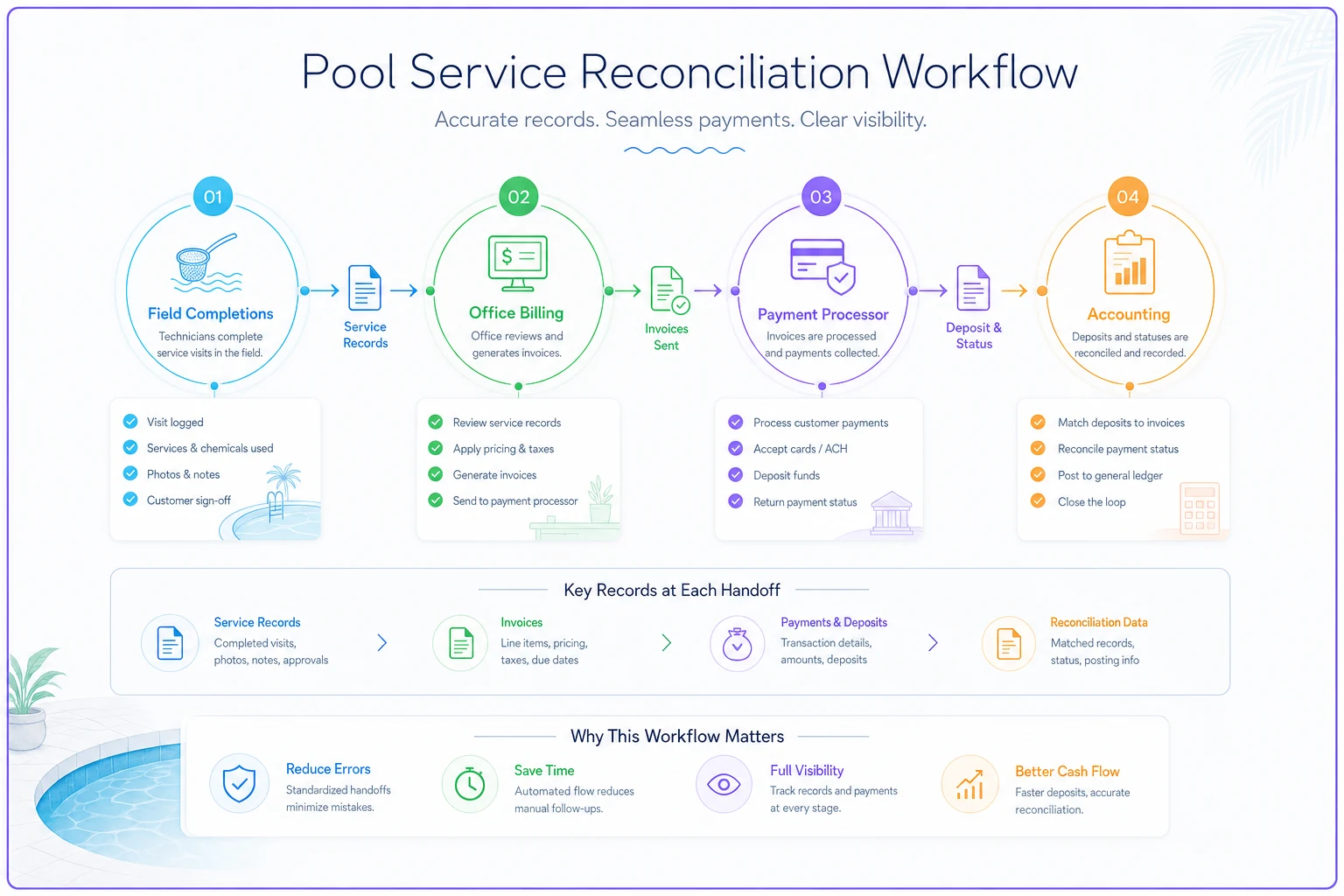
This is the part nobody wants to do and the part that keeps the whole system honest. Reconciliation is where you catch the mismatches between four separate worlds: what the field did, what the office billed, what the payment processor collected, and what accounting recorded.
When these four drift apart, you get the classic year-end mess: revenue that doesn't tie out, deposits sitting in limbo, chargebacks nobody logged, credits that were promised but never issued.
A clean reconciliation cycle flows in one direction—field completions feed office billing, billing feeds the payment processor, and the processor feeds accounting. Every handoff should produce a record. When that chain breaks at any point, the month-end becomes detective work instead of a quick check.
Field Completions → Office Billing → Payment Processor → Accounting ↓ ↓ ↓ ↓ Status logged Invoice issued Charge processed Revenue recorded (complete/skip/ (confirmed, (success/decline (net of fees, exception) not calendar) → follow-up) chargebacks)
Daily handoff (field → office)
At the end of each service day, the field's completions, skips, and exceptions should hand off to the office before the next billing cycle touches those accounts. The daily question is simple: does every stop have a status? Completed, skipped-with-reason, or rescheduled. No stop should sit in limbo.
Daily handoff (office → payments)
New charges, deposits, and payment-method updates get processed. Declines get flagged and enter the failed-payment sequence. The daily question: did every charge we submitted either succeed or enter a follow-up path?
Monthly handoff (payments → accounting)
This is the big reconciliation. You're matching three things:
-
Invoices issued vs. payments received vs. deposits in the processor
-
Fees deducted by the processor (so your recorded revenue is net-accurate)
-
Chargebacks and refunds logged against the right accounts
The month-end question: can every dollar in your bank deposit from the processor be traced to specific invoices, and does total billed minus total collected equal your actual outstanding AR?
If those don't tie out, you have a leak, and month-end is when it's cheapest to find. Shops that reconcile monthly catch a $200 mis-posting in week one. Shops that reconcile "when we have time" find a $6k discrepancy in February and can't remember which August job caused it.
This is also where operational software earns its keep—not by replacing the reconciliation, but by making the four handoffs feed one shared record instead of four disconnected ones. When completions, invoices, payments, and adjustments all live in the same system, month-end stops being detective work. But the discipline has to exist first; software just enforces a process you've already defined.
Run a quick AR tie-out before you close the month—catching small mismatches weekly saves hours at month-end.
Keep a one-line record at each handoff so you can trace any deposit back to the originating invoice without digging through three systems.
Billing controls for the messy exceptions
The clean cases bill themselves. Your billing integrity is decided by how you handle the messy ones. These are the recurring pool-specific exceptions that quietly distort revenue.
Route changes. When you move a customer to a different day or tech, make sure the billing frequency and rate travel with them. A surprising number of accounts end up mis-billed after a route reshuffle because the schedule changed but the billing record didn't.
Skipped service. Every skip needs a reason code and a billing decision. Was it your fault (tech no-show, truck breakdown)? That's a credit. Was it the customer's request or an access issue on their end? Your policy decides whether that's billable. The key is that the decision is made and recorded, not left to whoever runs billing that month.
Chemical surcharges. These are the single most disputed line item in pool billing because they're variable and often poorly disclosed. If you pass through chemical costs or apply seasonal surcharges, the rule is: disclosed at onboarding, calculated consistently, and visible on the invoice. A surcharge that appears without explanation reads as a hidden fee, even when it's completely fair.
Weather-related exceptions. Storm closures, freeze events, pool closed for the season. Decide in advance: does a weather skip get credited, or is it part of the plan? Many maintenance plans are priced as an annual amount divided into equal payments, meaning a rained-out visit doesn't earn a credit. Whatever you choose, put it in the service agreement so it's not a monthly argument.
The unifying principle across all four: an exception without a recorded decision becomes a dispute. The decision itself matters less than whether it's captured, consistent, and defensible.
Downloadable templates (outlines you can copy and adapt)
These are starting frameworks. Adapt the specifics to your shop and have the legal/compliance-sensitive ones reviewed for your state before you use them.
1. Billing-Policy Outline
-
Service plans offered and what each includes
-
Billing model (advance vs. arrears) and billing date
-
Accepted payment methods
-
Autopay enrollment and terms
-
Surcharge and pass-through policy (chemicals, extra visits)
-
Skipped-service and weather policy
-
Late fees and grace period
-
Credit and adjustment authority levels
-
Dispute resolution process
2. Repair-Deposit Policy
-
Deposit threshold (e.g., required on jobs over $____)
-
Deposit percentage (e.g., ___% of estimate)
-
What the deposit covers (parts order, scheduling)
-
Refundability terms
-
Approval-capture requirement before deposit
-
Change-order re-approval rule
-
Final invoice reconciliation (deposit applied, balance shown)
3. Failed-Payment Message Sequence
-
Day 0
Decline notice + update link (friendly, no fee)
-
Day 3
Reminder (helpful, slightly firmer)
-
Day 7
Service-impact + late-fee notice
-
Day 14
Account-status notice + resolution steps
-
Escalation trigger into collections workflow
4. Past-Due Escalation Tracker
-
Account name / ID
-
Balance and age (days past due)
-
Current status (Current / Past Due / Delinquent / Hold / Collections)
-
Last contact date and method
-
Next action and due date
-
Notes / approval records on file
-
Owner (who's responsible for next step)
5. Month-End Reconciliation Checklist
-
- [ ] All service days closed (every stop has a status)
-
- [ ] All exceptions/credits for the period applied
-
- [ ] Invoices issued total captured
-
- [ ] Payments received total captured
-
- [ ] Processor deposits matched to invoices
-
- [ ] Processor fees recorded (net revenue accurate)
-
- [ ] Chargebacks and refunds logged to correct accounts
-
- [ ] Outstanding deposits tracked
-
- [ ] AR = total billed − total collected (ties out)
-
- [ ] Discrepancies over $___ investigated and documented
These templates are outlines—you'll want to copy them into your own documents and adapt the specifics.
Implementation scorecard: how mature is your billing process?
Score each item 0 (not in place), 1 (partial/inconsistent), or 2 (documented and consistently followed). This works regardless of what software—if any—you use.
Invoicing controls
-
Recurring invoices trigger on confirmed completion, not the calendar
-
Exceptions are captured before billing runs
-
Credit authority levels are defined
Repair billing
-
Every repair has a recorded written approval
-
Deposits collected on jobs over a set threshold
-
Change orders re-approved before extra work
Autopay & payment security
-
Autopay authorizations stored with date and method
-
No raw card data stored outside a PCI-compliant processor
-
Expiration/update process exists
Communications
-
Onboarding covers billing, surcharges, and repair approval
-
Defined failed-payment message sequence
-
Neutral, consistent past-due notices
Collections
-
Account statuses defined and shared
-
Rules-based (not mood-based) escalation
-
Collections language reviewed for compliance
Reconciliation
-
Daily field-to-office handoff on every stop
-
Monthly payments-to-accounting reconciliation
-
AR ties out to billed-minus-collected
Scoring:
0–12: High-leak zone. You're likely losing revenue you can't even see. Start with completion-triggered invoicing and month-end reconciliation.
13–24: Functional but fragile. Your controls exist but aren't consistent. Focus on written approvals and defined account statuses.
25–36: Mature. Tighten reconciliation frequency and compliance review. You're probably ready to automate confidently.
The scorecard is software-agnostic by design. You can't automate a process you haven't defined. Most shops that buy billing software and stay leaky do so because they automated their existing chaos. Tools like an integrated field-and-office platform genuinely help—especially with the reconciliation handoffs, where one shared record beats four disconnected ones—but only after you know what "correct" looks like. Build the process, then let the software enforce it.
Where this leaves you
Billing in a pool-service business isn't a finance function bolted onto the operation. It's the operation's nervous system—the thing that tells you whether what happened in the field actually turned into money in the bank. Every disconnect between the truck, the office, the processor, and the books is a place where cash quietly slips out.
The shops that get this right aren't running fancier systems than everyone else. They've just decided, ahead of time, what happens in each situation: when a visit is skipped, when a card declines, when a repair grows mid-job, when an account goes 45 days late. The decisions are made once, written down, and applied the same way every time. That consistency is worth more than any single tool.
Start with the scorecard. Find your lowest-scoring area, grab the matching template, and fix that one thing this month. Then reconcile at month-end and see what surfaces. The leaks have been there the whole time—you just haven't been standing in the right spot to see them.
This guide covers general operational practices only. Payment-processing, consumer-protection, collections, tax, and contract requirements vary by state and change over time. Consult a qualified attorney and accountant—particularly for California-specific autopay, disclosure, and collections rules—before finalizing any billing policy.
Ready to elevate your pool service business?
Join hundreds of pool service professionals using Splshly to save time, optimize routes, and enhance customer satisfaction.