

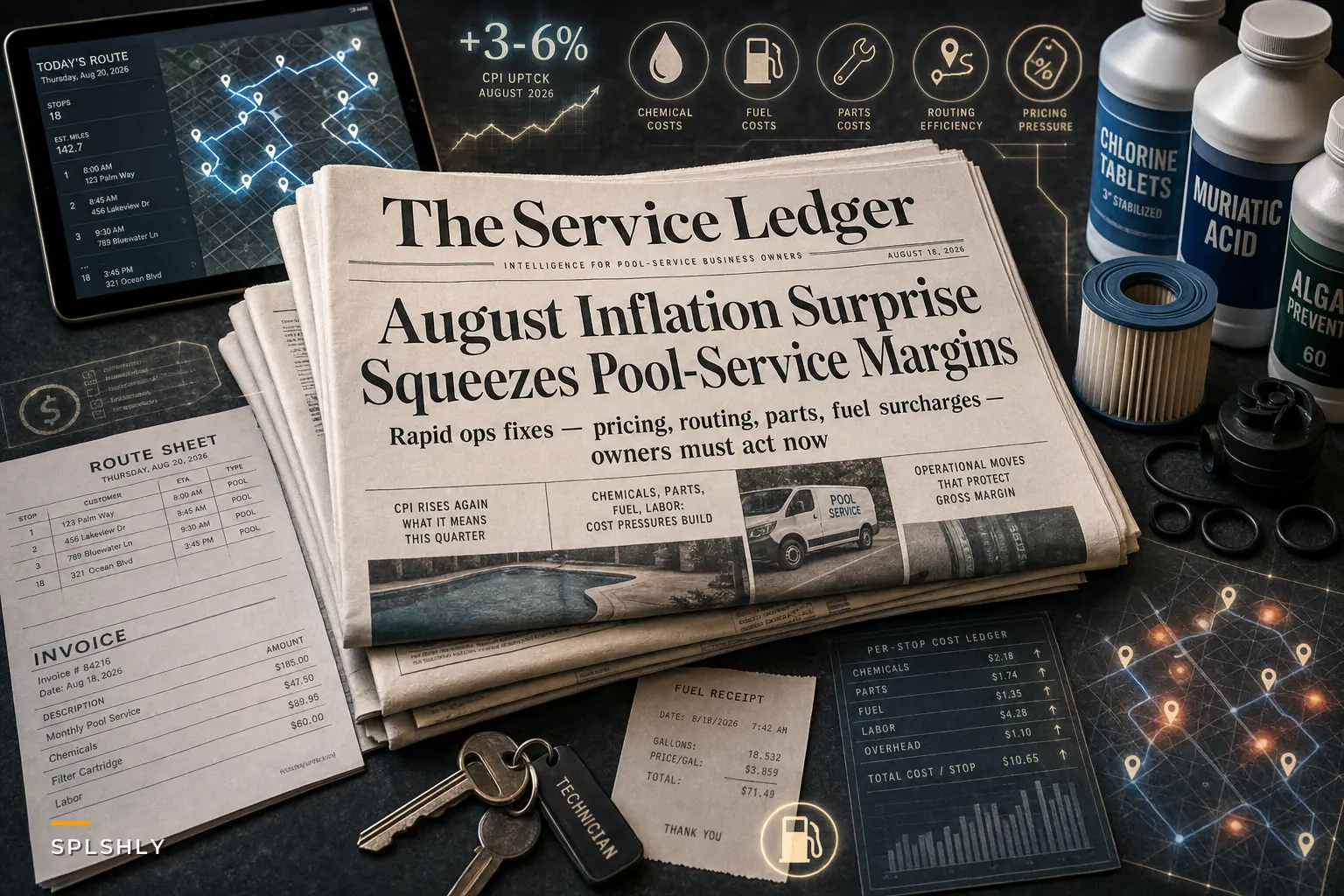

The August CPI report landed on September 11 and it wasn't the number most operators were hoping for. Consumer prices picked up more than expected, and as Reuters reported, the uptick pushed the Fed closer to holding its higher-for-longer stance. For most people that's an abstract macro story. For a pool-service owner staring at a chemical invoice that crept up again, it's just Tuesday.
The inflation impact on pool service businesses rarely shows up as one dramatic cost spike you can point to. It shows up as slow leakage — a few extra dollars per chlorine tab case, a bump on a replacement cartridge filter, fuel ticking up, a supplier quietly shortening net terms from 45 days to 30. None of it feels urgent on its own. Stacked across a 300-stop route over a season, it quietly eats your margin alive.
This isn't a piece about watching the economy. It's about the specific, boring, high-leverage moves you can make in the next two or three weeks before the cost creep compounds through fall.
Where the money actually leaks (and why owners miss it)
The mistake most operators make isn't overspending. It's mispricing recurring accounts against rising variable costs and never noticing because the monthly invoice looks fine on the surface.
Recurring maintenance plans are the trap. You signed a residential customer at $155/month in spring. Your cost to serve that pool — chemicals, drive time, labor allocation — was maybe $95 at the time. Nine months later chemicals are up, fuel's up, and that same stop costs you $108. Your margin dropped from roughly 39% to around 30% and nobody sent you a memo. The customer's still happy, you're still technically profitable, and you're slowly bleeding.
A few patterns worth naming:
-
Chemical cost drift is invisible without a per-stop cost model. Most owners track chemical spend as one big monthly bucket, not per account. When the bucket grows, they blame usage or a hot summer, not price creep.
-
Fuel gets watched, chemicals don't. Fuel is emotional because you feel it at the pump. Chemicals arrive on a pallet with an invoice you skim. But chemical inflation has been the quieter, stickier problem for route-based service.
-
Emergency trips absorb inflation worst. A same-day equipment call already runs thin on margin. Add a 6% parts bump and a fuel surcharge you're not passing through, and some of those visits go from marginal to actually losing money.
The customer's still happy, you're still technically profitable, and you're slowly bleeding.
The per-stop cost model you should rebuild this week
Before you touch pricing, you need to know your real cost to serve today, not in April. This one exercise changes everything, and most operators skip it because it feels tedious.
Eliminate missed appointments and dispatch delays.
Splshly ensures every pool service is scheduled, tracked, and completed efficiently.
- Unified scheduling dashboard
- Automated customer reminders
- Technician route optimization
No credit card required
Rebuild it at the account tier level, not per individual pool. Group your book into a handful of buckets and calculate current cost to serve for each:
| Account type | Old cost to serve (spring) | Current cost to serve | Current price | Real margin now |
|---|---|---|---|---|
| Standard residential (weekly) | ~$92 | ~$106 | $155 | ~32% |
| Large residential / spa combo | ~$130 | ~$149 | $195 | ~24% |
| Small commercial (2x weekly) | ~$310 | ~$358 | $460 | ~22% |
| One-off equipment repair | varies | +6–9% parts | quoted | often thin |
Those numbers are illustrative — yours will differ — but the shape is what matters. The large residential and commercial tiers get squeezed hardest because they consume more chemical volume and more drive time, so cost inflation hits them on a bigger base. A flat 5% price increase across the board would still leave your commercial accounts underwater relative to where they were in spring.
inflation doesn't hit your account tiers evenly, so a uniform price increase doesn't fix it evenly either.
The process for rebuilding this model is straightforward enough that you can knock out a first pass in an afternoon:
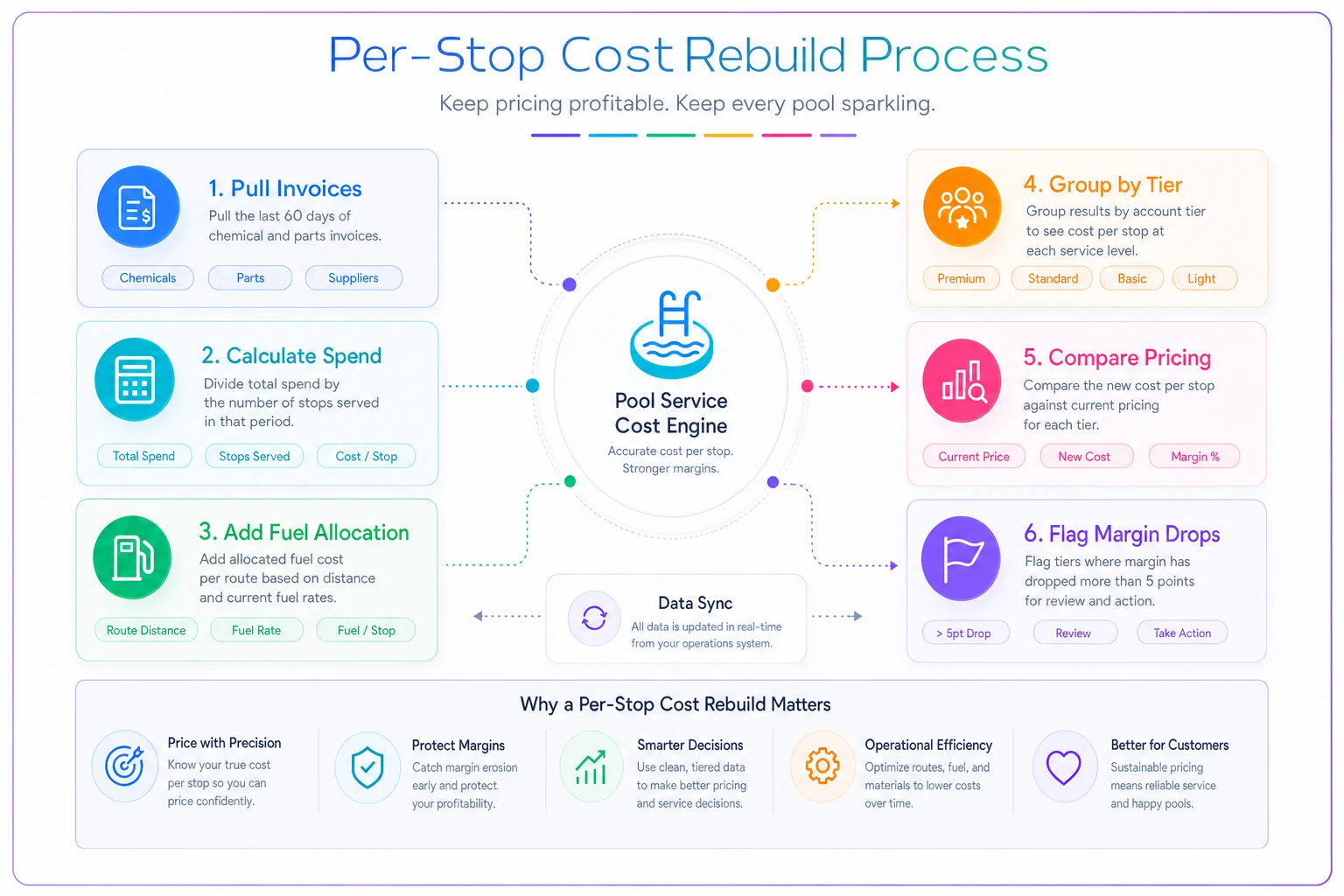
Visual workflow for rebuilding per-stop costs.
Group accounts into a handful of buckets rather than modeling each pool — it's faster and reveals the same leverage.
The process for rebuilding this model is straightforward enough that you can knock out a first pass in an afternoon:
Fix pricing surgically, not with a blanket increase
Once you can see cost-to-serve by tier, you can move precisely. A few rules that hold up in practice:
-
Re-price the worst-margin tier first. Don't lead with your loyal, easy weekly residentials. Lead with commercial and large-residential accounts where the margin compression is most severe.
-
Introduce a chemical/fuel adjustment line, not a hidden bake-in. Customers accept a transparent "seasonal cost adjustment" line item far better than a mysterious jump in their base rate. It also lets you scale it back later without looking like you're gouging.
-
Stagger increases across the book. Re-price a third of your accounts each month rather than all at once. This protects cashflow, spreads out any churn, and keeps your phones from lighting up in the same week.
-
Protect first-time-fix on repairs. Every return trip now costs more in fuel and labor than it did six months ago. Underquoting a repair and eating a second visit is a double loss in this environment.
On the fuel-surcharge side — if you already built surcharge logic when gas spiked earlier — reuse it. That same pass-through playbook translates directly to a broader cost-inflation situation, not just a pure fuel event.
When a blanket increase actually makes sense
To be fair: if your book is small and homogeneous — say 80 nearly-identical suburban weekly residentials — the per-tier surgery is overkill. A clean, well-communicated flat increase of 5–7% is fine and far less work. The surgical approach earns its keep once you've got mixed residential/commercial territory and real variation in cost to serve.
When it's a bad idea
Don't re-price aggressively into a book you haven't audited for delivery quality. If a chunk of your accounts have inconsistent service or open complaints, a price increase becomes the trigger that makes them shop around. Fix service quality issues first, price second. Raising rates on shaky accounts is how you turn a margin problem into a churn problem.
The working-capital side nobody talks about
Margin isn't the only thing inflation squeezes. Working capital gets tighter too, and route businesses feel it in a specific way.
When chemical and parts costs rise, the dollar value of your truck stock and warehouse inventory rises with it — you're now carrying more cash frozen in the same physical inventory. Meanwhile, if suppliers tighten terms (which a CNBC analysis of the report suggested is likely as the higher-cost environment persists), you're paying faster while collecting at the same pace. That gap is where seasonal cash crunches get born.
A short checklist for tightening this up:
-
Audit truck stock dollar value, not just unit counts. You may be carrying 15% more cash on wheels than last spring without adding a single item.
-
Trim slow-moving SKUs from truck PARs. Anything that hasn't been pulled in 60 days is frozen cash — and now it's more expensive frozen cash.
-
Tighten AR aggressively. In a rising-cost period, a 40-day average collection window is far more painful than when your costs were flat. Even shaving it to 30 days meaningfully eases the squeeze.
-
Renegotiate volume pricing before eating the increase. Suppliers expect the conversation right now. Consolidating spend with fewer vendors is your leverage.
Taking these steps isn't about being aggressive with customers — it's about closing the gap between when money goes out and when it comes back in. That gap quietly kills otherwise healthy route businesses every slow season.
A real scenario
Consider a mid-size operator running roughly 340 accounts, mostly residential with a handful of small commercial pools. Coming out of spring their blended margin sat around 34%. By late summer, without any pricing changes, cost-to-serve creep had quietly pulled that down to about 27% — the kind of drop that shows up as "somehow we made less this quarter" with no obvious culprit.
They did three things over about a month: rebuilt cost-to-serve by tier, re-priced the eight commercial accounts and the top-consuming residentials with a transparent seasonal adjustment line, and pulled roughly $2,800 of stale inventory off the trucks. Nothing dramatic. Blended margin recovered to around 32–33% within two billing cycles, and because the increases were staggered and clearly explained, they lost only two accounts.
The bigger win was quieter: they could finally see where the leak was, so the next round of cost increases won't blindside them the same way.
The deeper problem this exposes
An inflation surprise really reveals one thing: most pool-service businesses don't have a fast feedback loop between rising costs and pricing. Costs move weekly. Pricing moves once a year, if that. In a stable environment you get away with it. In a higher-for-longer environment, that lag is the problem.
The operators who handle this well aren't smarter about macroeconomics. They just have their cost data, account tiers, inventory value, and pricing living in one place so they can react in weeks instead of quarters. When per-stop costs, route data, and billing all sit in the same operational system — whether that's AI-powered software or a well-structured spreadsheet you actually maintain — spotting a margin drop and adjusting the right accounts becomes a Tuesday task, not a year-end scramble.
That's less about any particular tool and more about not flying blind. According to the BLS CPI release, the cost pressures behind this uptick aren't expected to resolve quickly, which means the operators who build tighter feedback loops now are the ones who won't be caught flat-footed again.
Do this in the next two weeks
To keep it concrete, here's the short list worth acting on before the fall cost creep compounds:
-
Rebuild cost-to-serve by account tier using current chemical, fuel, and parts prices.
-
Identify your worst-margin tier and re-price it first, with a transparent adjustment line.
-
Stagger the rest of your increases across two to three billing cycles.
-
Audit the dollar value of truck stock and cut anything untouched in 60 days.
-
Push average collections toward 30 days.
-
Open the volume-pricing conversation with your top one or two suppliers now.
None of this is glamorous. Protecting margin in a rising-cost stretch is won in exactly these unglamorous moves — knowing your real costs, pricing with precision instead of a blunt across-the-board hike, and refusing to let frozen inventory and slow collections quietly drain the cash you'll need heading into the slower season. The owners who tighten these loops now will barely feel the next uptick. The ones who wait will be having the same "where did our margin go" conversation in December.
The owners who tighten these loops now will barely feel the next uptick. The ones who wait will be having the same "where did our margin go" conversation in December.
Ready to elevate your pool service business?
Join hundreds of pool service professionals using Splshly to save time, optimize routes, and enhance customer satisfaction.